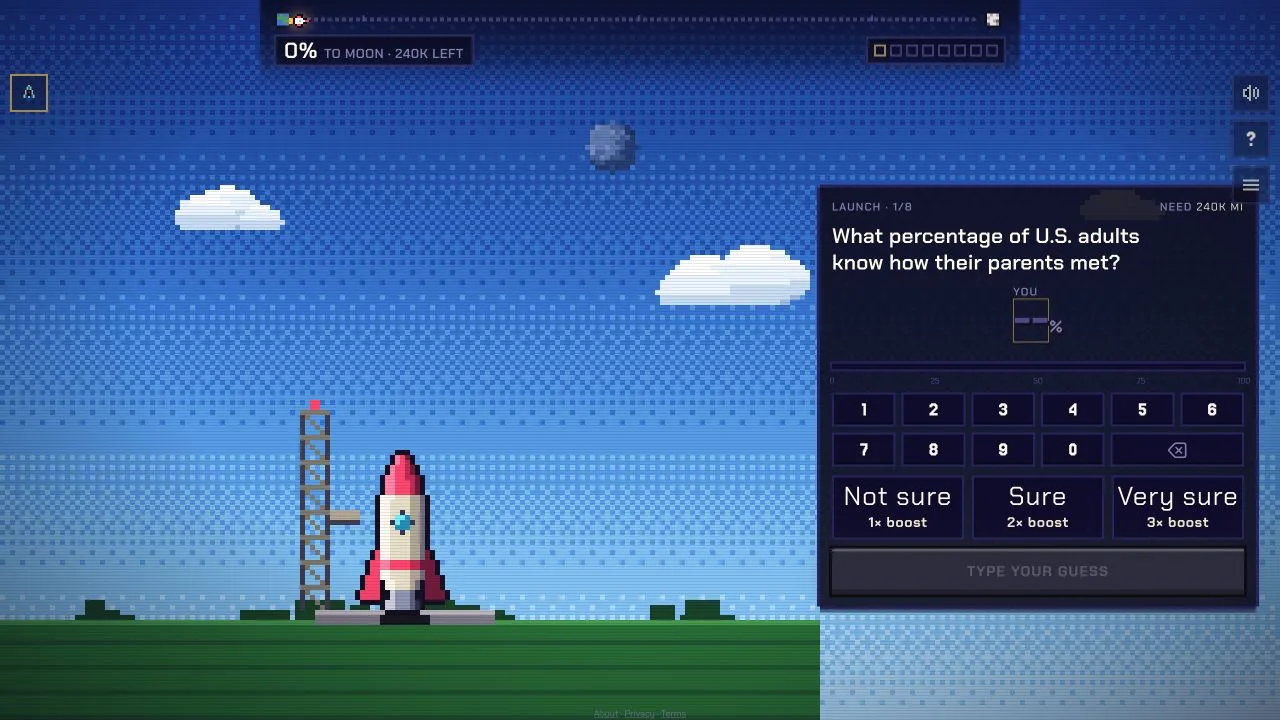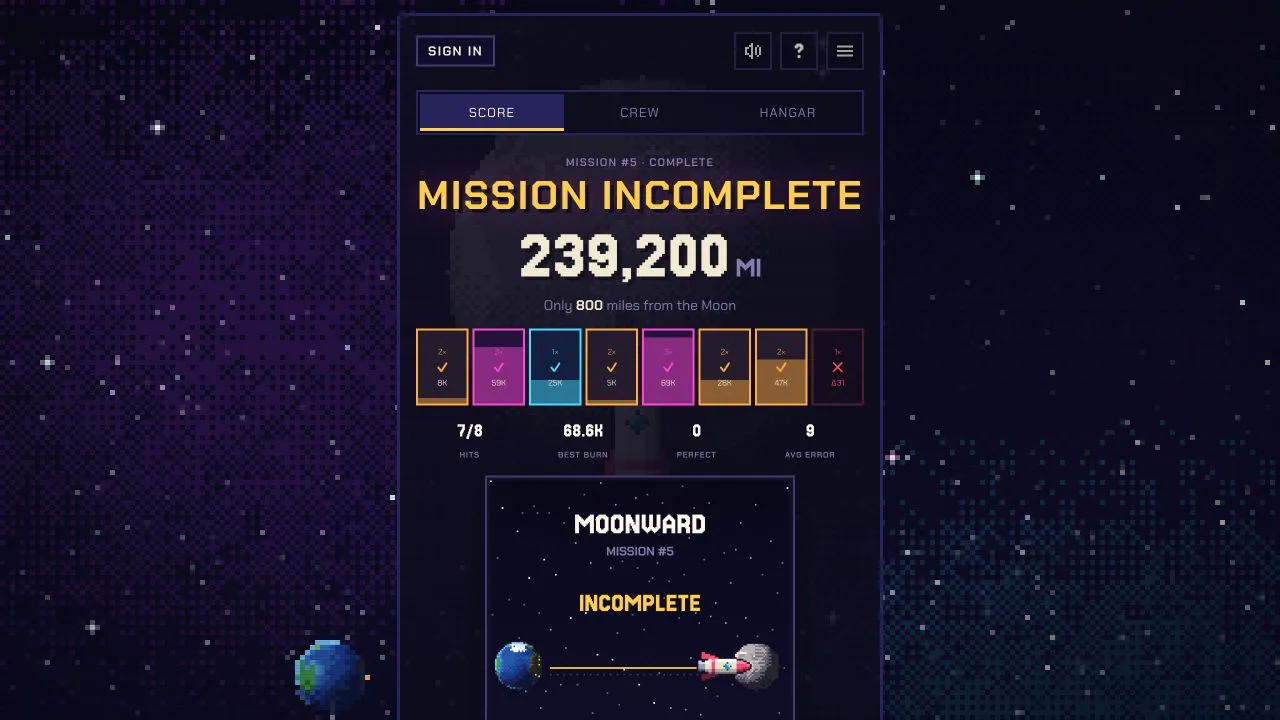

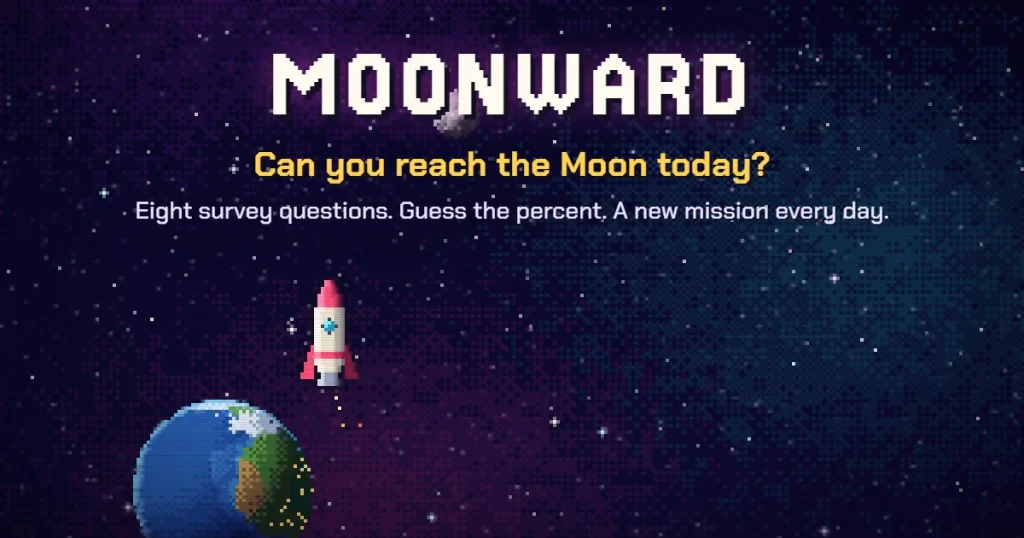
Moonward is a daily survey guessing game: estimate eight percentages, choose how confident you are, and turn your accuracy into rocket fuel. Everyone gets the same daily mission, with the Moon roughly 240,000 miles away. My completed flight stopped at 239,200 miles, just 800 short, after a final guess earned nothing. That narrow miss made the confidence choices feel consequential.
Eight estimates, each with a confidence decision
Each question asks what percentage of a stated group gave a particular survey response. My mission covered American habits and attitudes, including household routines, sleep and social etiquette. The challenge is estimating the surveyed population rather than answering according to your own preference.
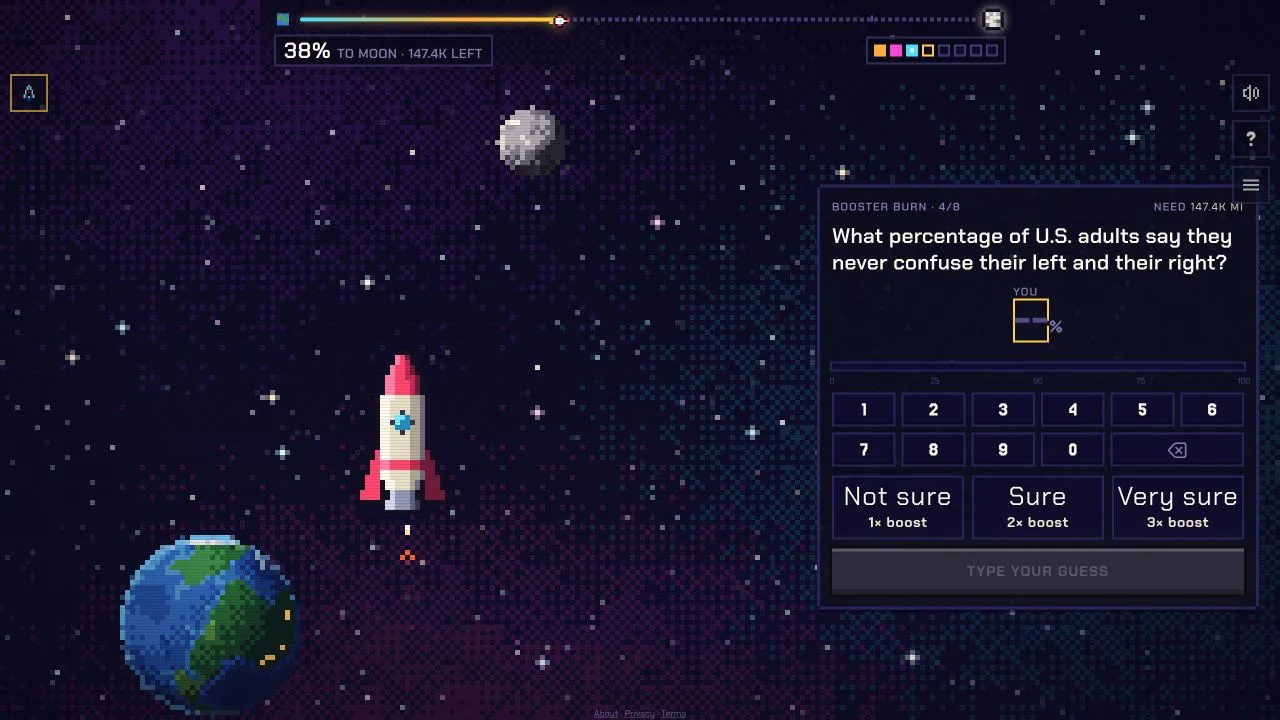
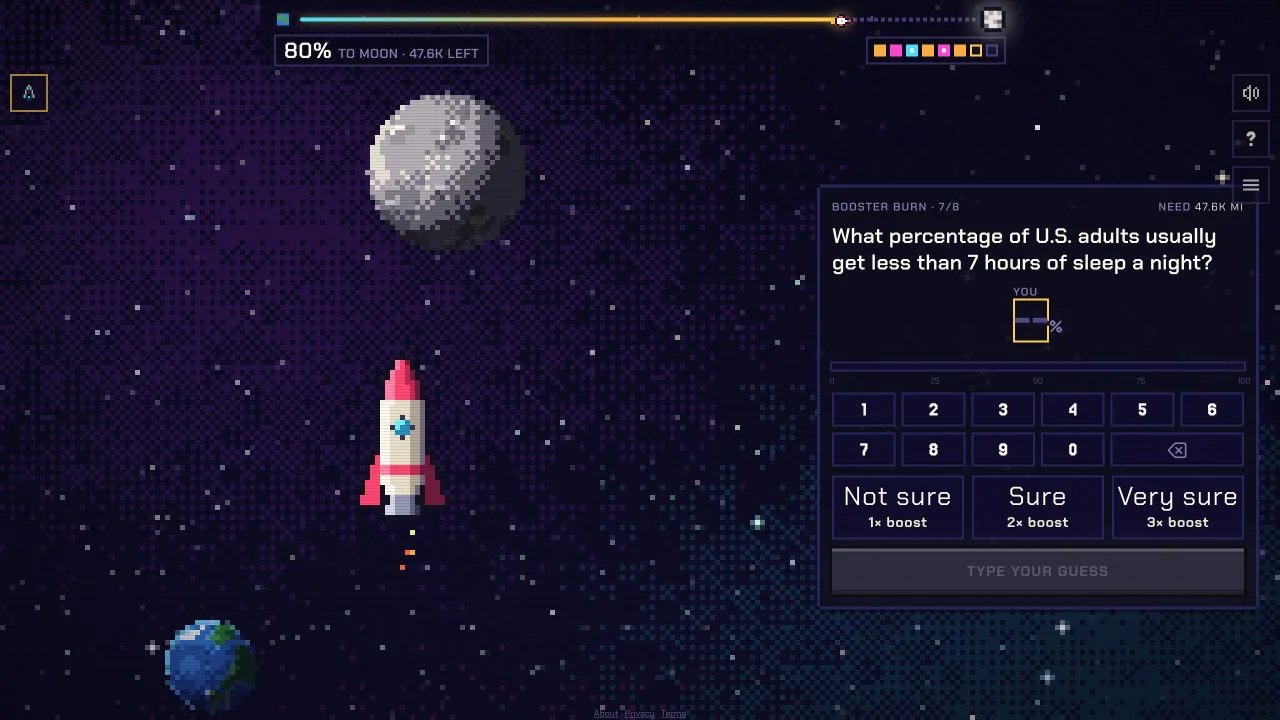
I entered numbers through the on-screen keypad, selected a confidence level, then pressed the launch button. A percentage slider is also visible. The three choices are Not sure at 1×, Sure at 2× and Very sure at 3×. Higher confidence offers a stronger boost when your estimate is close enough, but the game's instructions warn that it demands greater accuracy.
After an ignition animation, the console reveals your guess, the survey result and the miles earned. I saw amber GRAZED feedback for weaker burns, IN RANGE for closer estimates, and red MISSED feedback when my final answer produced zero miles. The numerical comparison explains the outcome more clearly than color alone. Pressing Next Burn advances to a fresh question rather than another attempt at the same one.
Why the biggest boost needs restraint
One early estimate missed by 13 percentage points at 2× confidence and earned only 7,800 miles. My next estimate was within two points at 3× and sent the rocket another 59,280 miles. A later cautious 1× answer was only one point away, yet earned 25,480 miles. Those results show why closeness and confidence both matter, without establishing an exact scoring formula.
The useful habit is to separate your estimate from your certainty. First decide what proportion seems plausible. Then ask whether you have a reason to trust that number beyond your own circle of friends. Familiar wording can create false confidence, especially when a question concerns a behavior you personally consider obvious.
My last turn was a particularly sharp lesson. The rocket needed only 800 more miles, so I chose the cautious multiplier. My estimate still missed by 31 percentage points and earned nothing. Low confidence cannot rescue a sufficiently inaccurate answer. Earlier, a strong fifth burn had made the finish look comfortable; reaching 99 percent did not guarantee arrival.
The rocket journey and the survey report
Moonward gives numerical progress a physical setting. My rocket left a grassy launchpad, passed into a dark starfield and approached an increasingly large Moon. A progress bar and remaining-distance display kept the goal readable throughout. The pixel art made a modest burn feel different from a long leap, though waiting through ignition and reveal animations slowed the rhythm when I already wanted the next question.
After all eight turns, the mission report showed total distance, individual burns, hits and average error. Its expandable questions-and-sources section listed the survey organizations, dates and links, with sample sizes where supplied. My report included YouGov and CDC references. These are useful starting points for understanding a surprising result; I did not independently audit the studies.
Compared with Wordle, the tension comes from calibration rather than eliminating possible words. Each question is a new estimate, and earlier results contribute distance rather than clues to a single hidden answer. If approximate numerical answers appeal to you, Estimatle is another daily game to explore.
Moonward FAQ
Is Moonward free?
Yes. I completed the daily mission without payment or an account. A sign-in prompt appeared after play, and choosing Not Now let me continue to the report.
Where do Moonward's questions come from?
The official About page describes questions drawn from published surveys. After my flight, the report linked each question to a named source and supplied survey details.
Is Moonward like Family Feud?
Both use survey responses, but Moonward asks for a numerical percentage. You are estimating how common a response was, then choosing your confidence to determine the potential rocket boost.