
Estimatle is a free daily estimation quiz with five numerical questions. Instead of typing an exact answer, you move a slider to your best estimate and earn points for how close you get. Our short hands-on session covered music, TV, population, history and biology; after each guess, a histogram showed how other players had answered.
How do you play Estimatle?
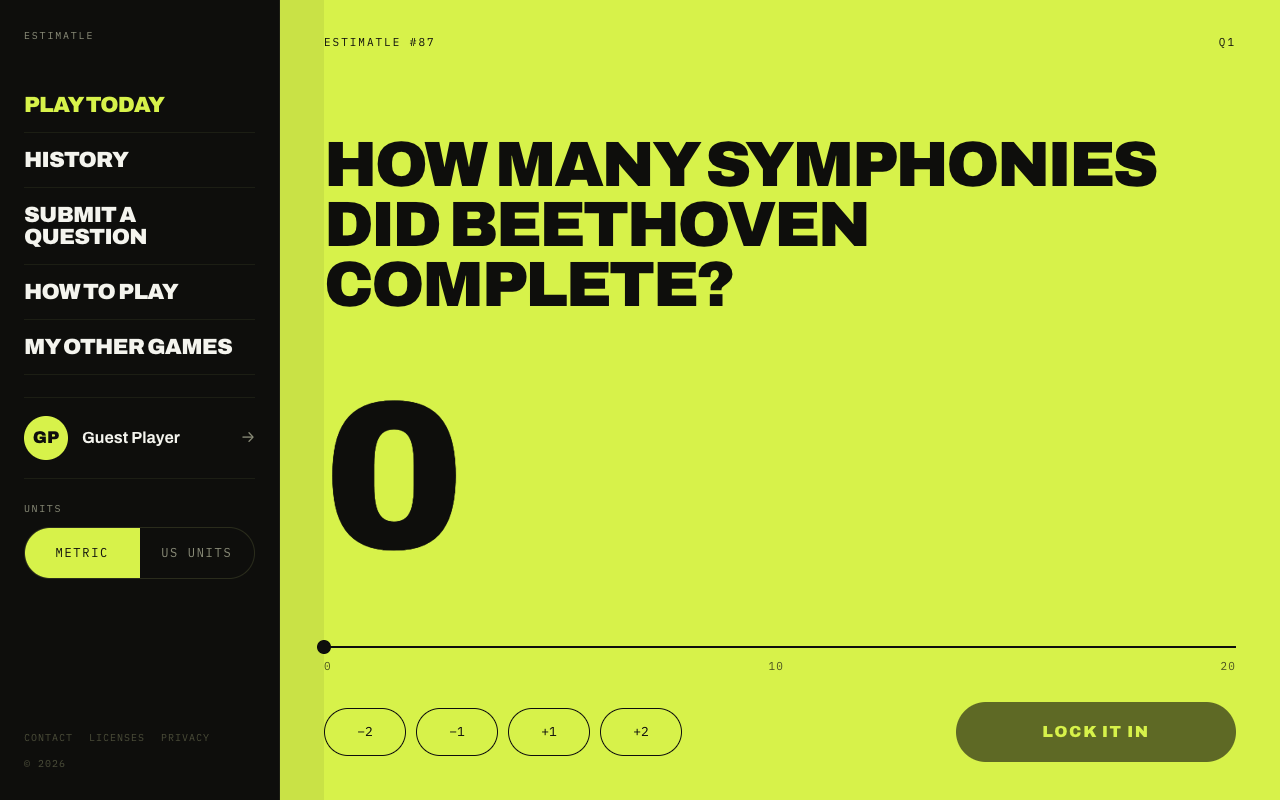
Each question has a ruler-style slider and adjustment buttons. The step size changes with the question, so check both the units and the amount each step represents before choosing a number.
- Read the question and check the slider's step size.
- Drag to set a rough estimate, then use the adjustment buttons or arrow keys to fine-tune it.
- Press Lock it in to submit your guess.
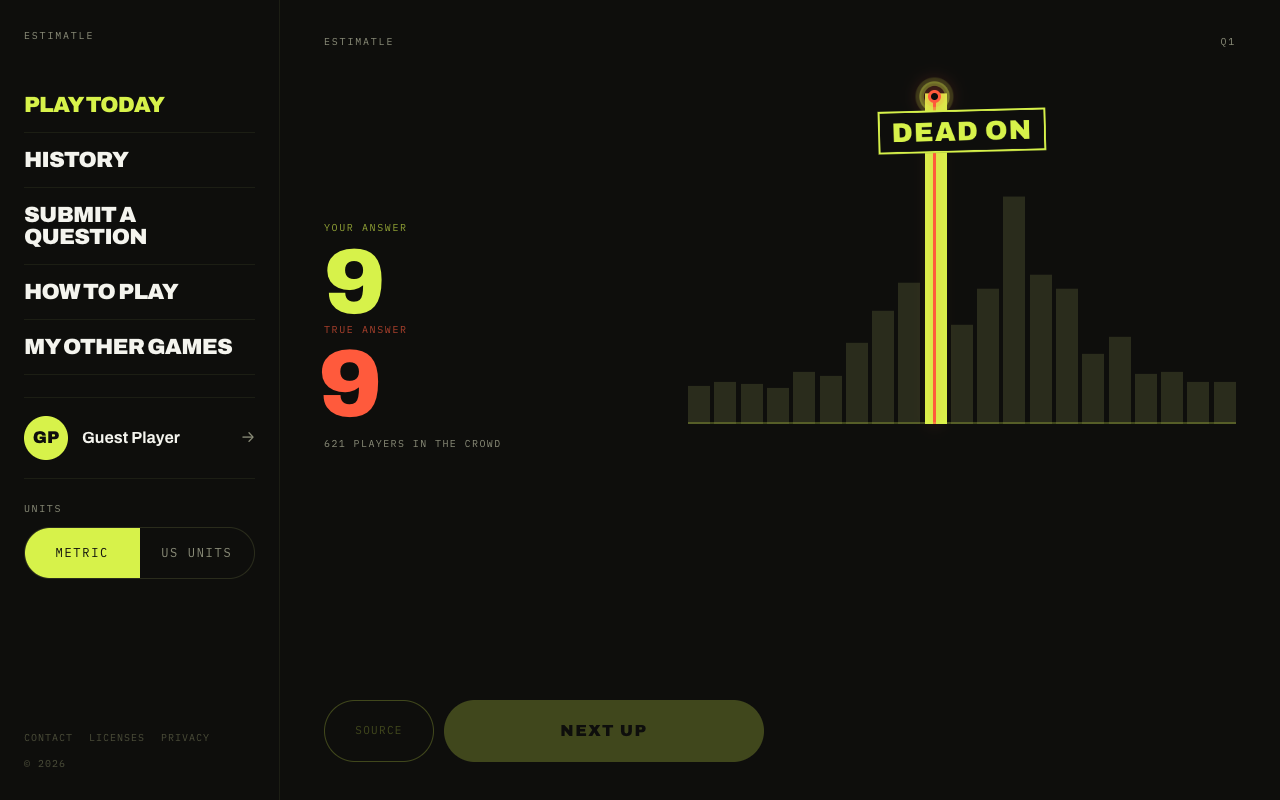
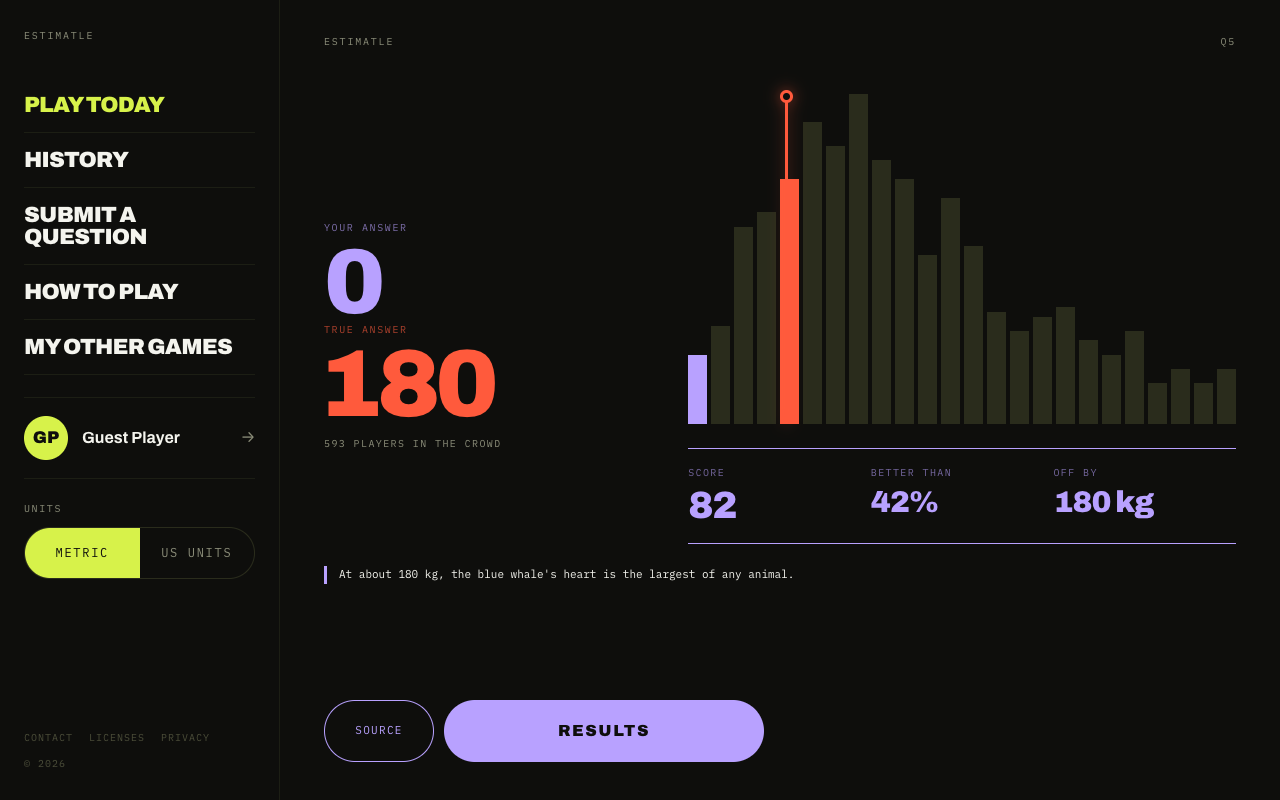
- Review the correct answer, your score and the distribution of other players' guesses. The reveal also shows how many players have answered and the share you beat. Answers include a source, and some have a short explanatory note.
- Finish all five questions to see your total, streak, average miss and question-by-question breakdown. The results screen includes a share button.
How does Estimatle scoring work?
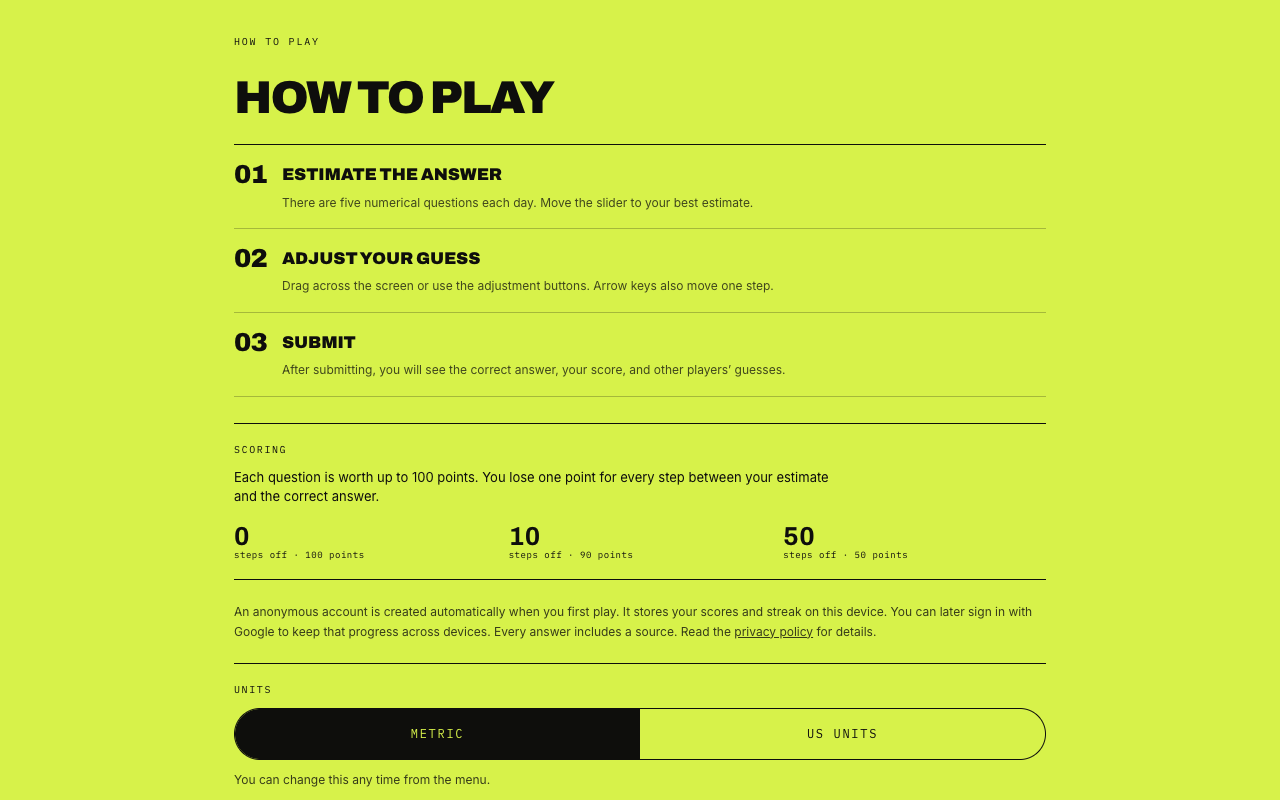
Each question is worth up to 100 points, with one point lost for every slider step between your estimate and the correct answer. A perfect five-question run totals 500 points.
For example, an estimate 10 steps away earns 90 points; one 50 steps away earns 50. These are examples from the game's instructions, not scores from our session.
The distinction is between steps and raw numbers. If a question uses steps of one million, a numerical miss of 10 million is 10 steps. Check the scale rather than assuming that one step always means one unit.
Getting a more useful estimate
- Choose familiar units. The sidebar offers metric and US units. Pick the system you normally use to avoid adding a conversion problem to the question.
- Start with a reference point. For a population question, for example, think of a place whose approximate population you know, then decide whether the answer should be larger or smaller. This gives you a reason for your estimate rather than an arbitrary number.
- Drag first, fine-tune second. Repeatedly tapping a step button is slow when you need to move a long way across the scale.
- Read the explanation after the reveal. The source and any accompanying note help explain the number you missed, rather than leaving you with only a score.
What the crowd histogram adds
In our session, the histogram made the reveal more interesting than the score alone. You can compare your estimate with the main cluster of guesses rather than judging it by the point total alone. That gives a useful distinction: you can be wrong alongside much of the crowd, or make an estimate that few others chose.
The mix of subjects asks you to draw on different reference points from question to question. Estimatle suits players who enjoy making an informed approximation even when they cannot recall an exact fact.
Do you need an account to save your progress?
No sign-up is required to start. The game creates an anonymous account automatically to store scores and your streak on that device. Its instructions describe optional Google sign-in for keeping progress across devices; we did not test cross-device syncing.
The gameplay observations above come from one short hands-on session.