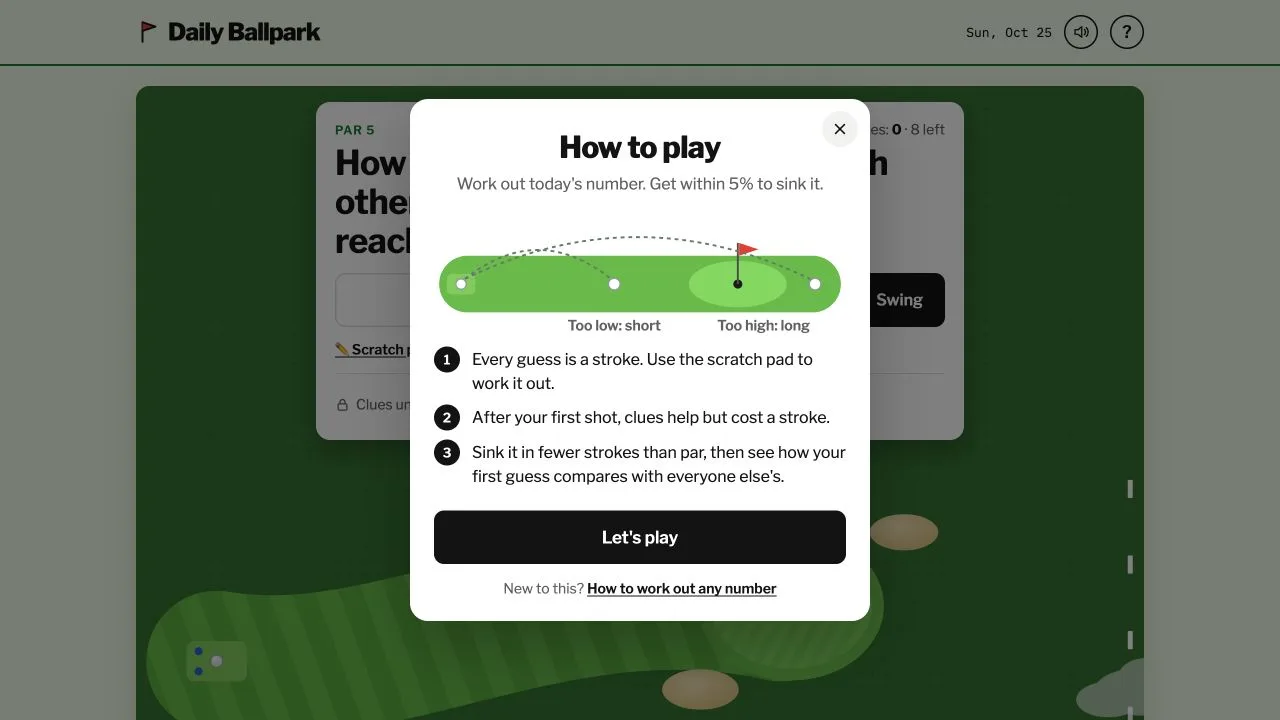

Daily Ballpark is a daily Fermi estimation game in which you reason out a numerical answer, with your score counted like golf strokes. Enter an estimate, read whether it falls short or goes too far, and get within 5% of the answer to sink the shot. In our October 25, 2026 desktop test, we finished the daily question inside an iframe in three strokes: two guesses and one paid clue.
Can you get the number under par?
The golf course is a visual explanation of your estimate. The rules say a low guess lands short of the flag and a high guess goes past it. You are typing numbers rather than aiming a club, so the challenge is deciding which assumptions to make before you press Swing.
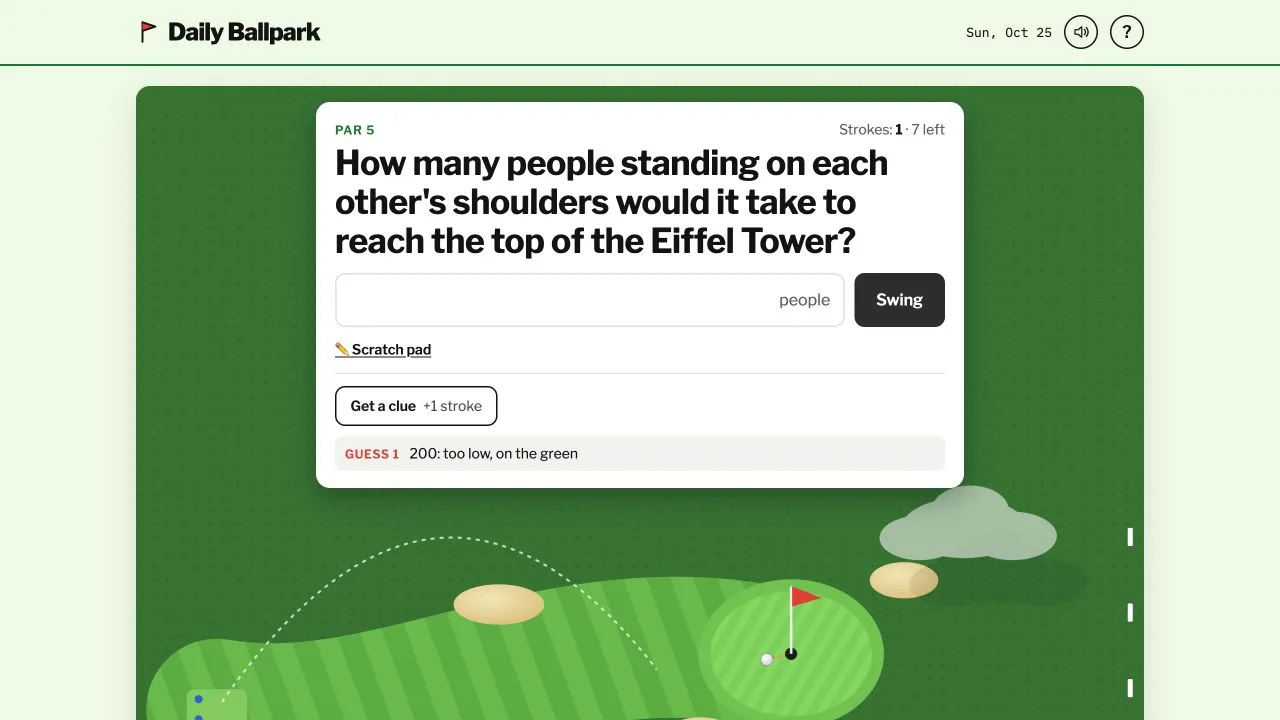
Our question asked how many people standing on one another's shoulders would reach the top of the Eiffel Tower. It showed Par 5, zero strokes and eight left at the start. Those are the settings we observed for this question, rather than a promise that every daily puzzle uses the same par.
We began with a rough height estimate divided by the extra height each person might add. The first guess, 200, received the feedback “too low, on the green.” That distinction mattered: the direction was wrong, but the wording suggested a nearby estimate rather than a completely different scale. We revised upward and completed the hole after taking a clue, without exhausting the available strokes.
Use the scratch pad before spending a stroke
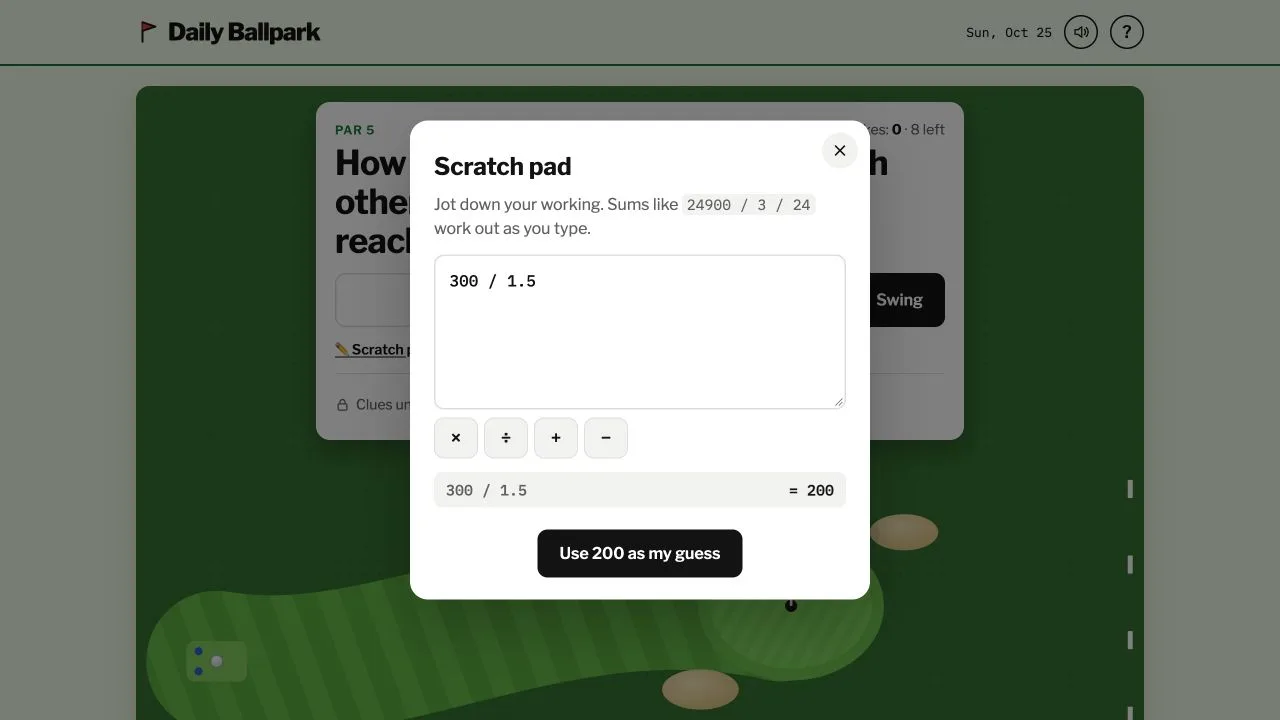
The scratch pad does more than store notes. We entered 300 / 1.5, watched it calculate 200, and selected “Use 200 as my guess” to transfer the result into the input. That transfer did not submit the shot; Swing was still a separate action.
A practical approach is to:
- Identify the quantity being estimated and its unit.
- Split it into a calculation using quantities you can roughly judge.
- Put the calculation in the scratch pad and check its scale.
- Transfer the result, then submit it with Swing.
- Use the feedback to reconsider the weakest assumption.
Our initial model was useful, but one rough input was too small. This is where the game becomes more interesting than recalling a trivia answer: you can understand why your calculation missed. The official Fermi estimation guide explains the same general approach through breaking a question into pieces, estimating them and checking whether the result is plausible.
Clues help, but they count toward your score
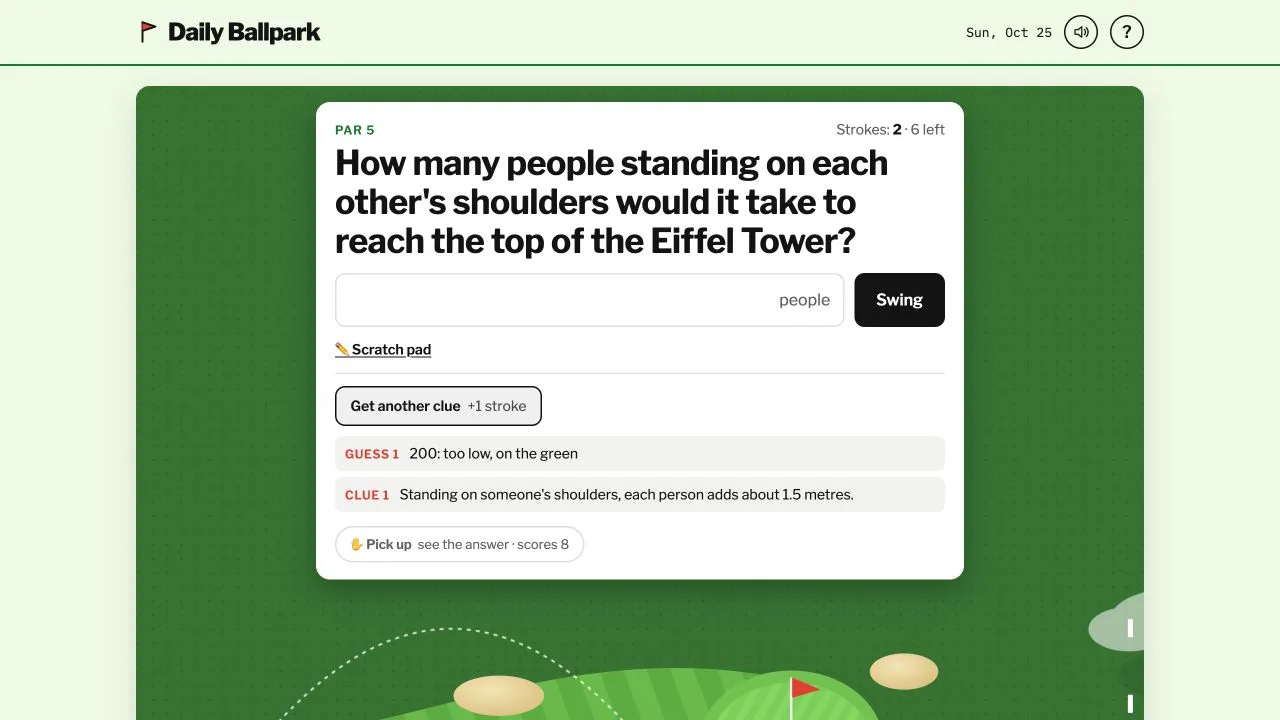
Clues unlocked after our first shot. Selecting one raised the stroke counter from one to two before we submitted another number. The clue supplied a useful assumption about the height added by each person, so it supported the calculation rather than immediately revealing the final answer.
Our next guess finished the hole at three strokes. Against this question's Par 5, the result was labelled “Eagle!” The lesson from this run is to weigh a clue against another speculative shot. A clue may be useful when an assumption is uncertain, but our single attempt does not establish an optimal strategy for every question.
A Pick up control also appeared and explicitly warned that revealing the answer would score eight. We did not use it, so that penalty was displayed rather than tested.
What happens after you finish?
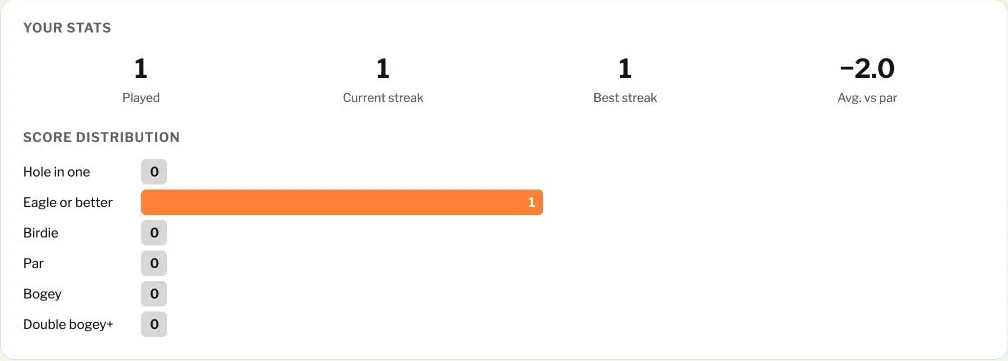
The result included a Challenge a friend button, a next-puzzle countdown, personal streak statistics and a score distribution. We also expanded “Napkin math” to see the game's worked calculation. We inspected the share button but did not send a challenge.
The calculation explanation gave the round a useful ending: it let us compare our assumptions with the game's model. Our review covers one daily question on desktop, including functional iframe play. We did not test a phone, a second day's puzzle or a reset across midnight, and we did not verify a reset timezone. The difficulty judgement therefore reflects this completed round, rather than the full range of future questions.