
What Amountle asks you to judge
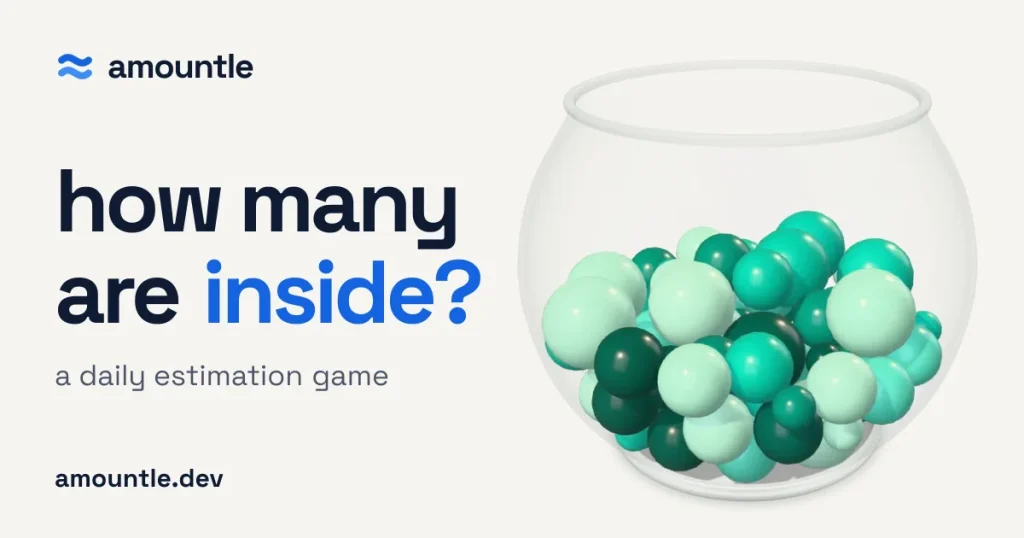
Amountle is a daily estimation game about judging how many objects fill a three-dimensional container. You inspect each pile, enter a whole-number guess, and see the actual count before moving through five rounds.
Made by Isaac Audet, it turns an everyday visual judgment into a surprisingly demanding puzzle. The objects in my practice session included cubes, faceted dice, balls, and rings. Their different shapes made the task more interesting than estimating the same kind of pile five times: gaps, overlapping pieces, and changes in object size all affected what I could see.
Commit to a number, then learn from the reveal
The basic input is straightforward: type your estimate and submit it. Dragging the container changes the viewing angle. The displayed controls also offer a shake action, although I did not establish how much that helps accuracy. Once I submitted a guess, the count appeared and the game advanced automatically; I could not keep refining that same pile after seeing its answer.
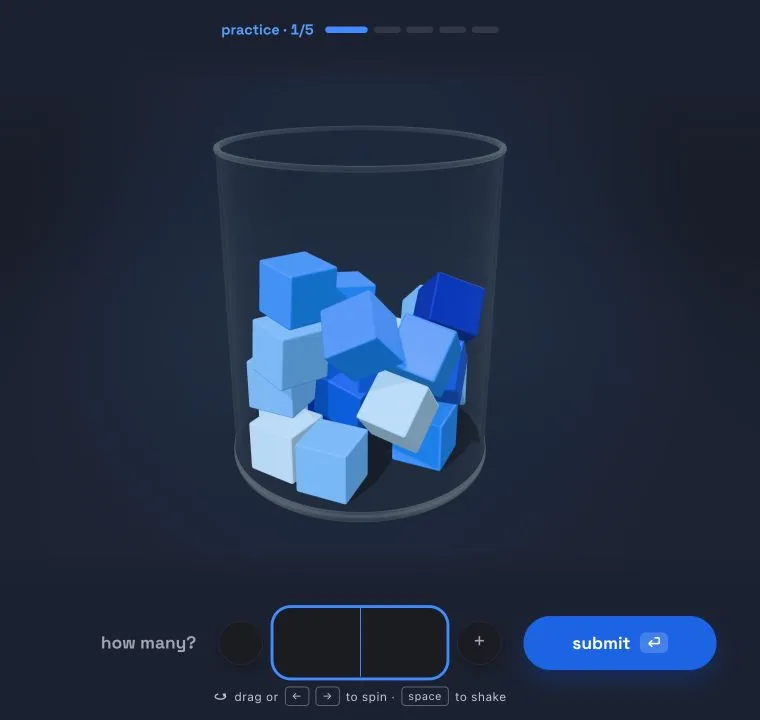
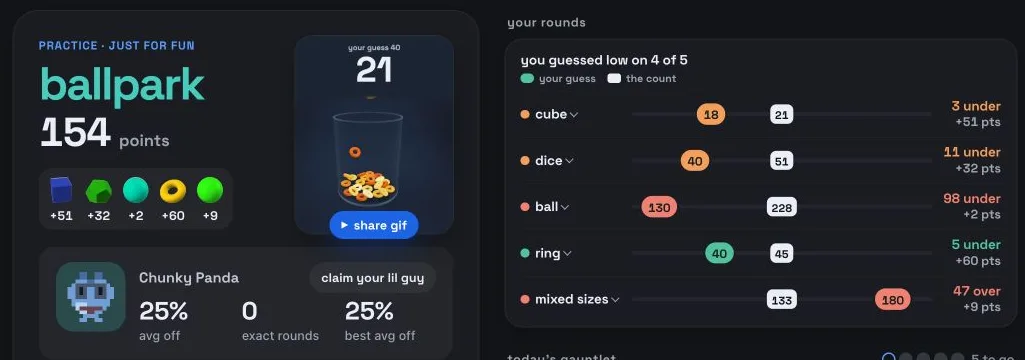
My first guess was 18 blue cubes. The actual count was 21, and the feedback showed that I was three short, 14% off, for 51 points. That immediately gave the number a useful context: being only three objects away still left a noticeable percentage error in a small pile.
The official rules give daily rounds a 15-second limit. They describe up to 100 base points per round, with an exact-guess bonus equal to one third of the object count, rounded to the nearest whole point. Practice removes the timer and does not affect the daily score. My observed scores are examples, not a way to reconstruct an undocumented scoring formula.
Hidden volume was my biggest mistake
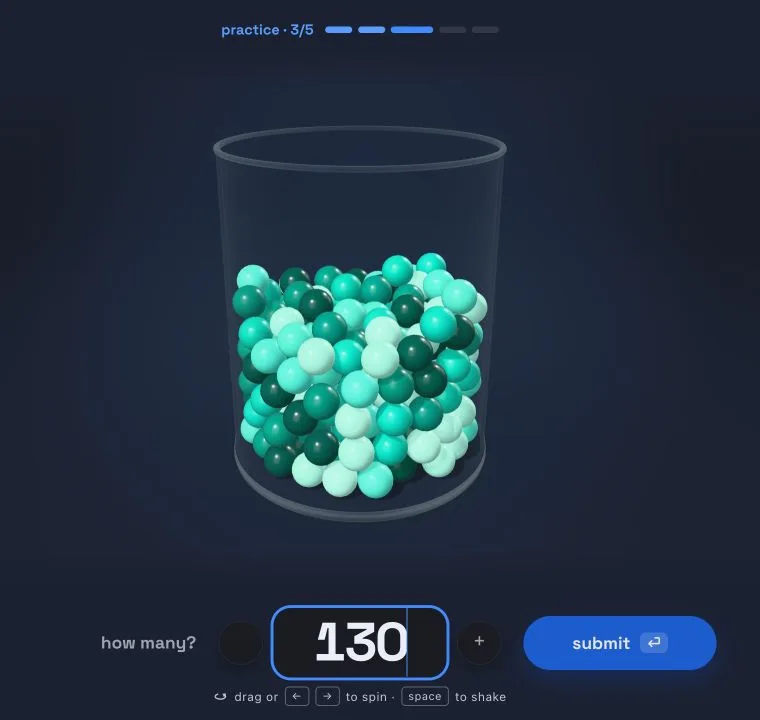
The second pile contained green dice. I rotated it and guessed 40; the reveal counted 51, an underestimate of 11, for 32 points. The next pile was much denser: I entered 130 for teal balls, but the game counted 228. That 43% error earned only two points. Looking at the front surface had left a great deal of the container's depth unaccounted for.
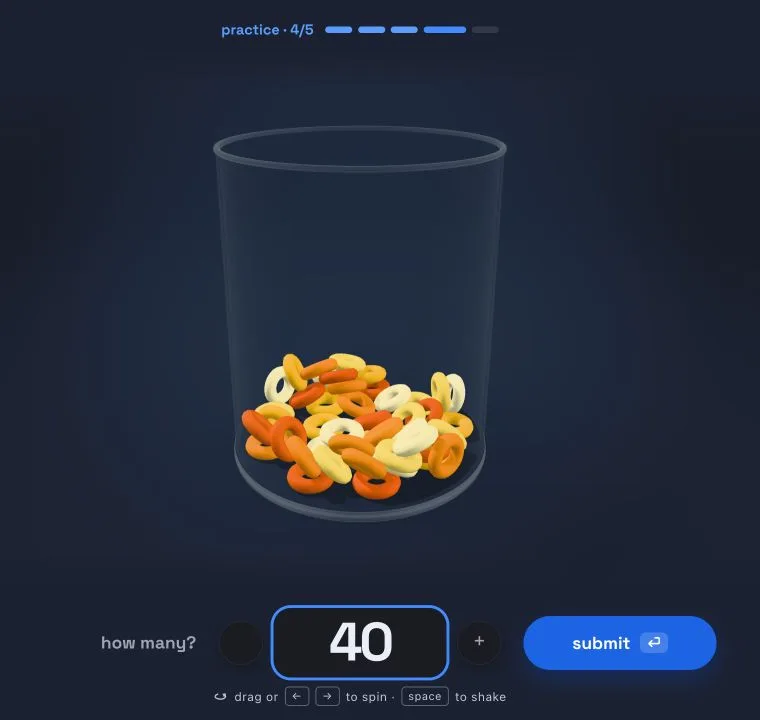
A later round of orange and yellow rings was easier for me to judge. After changing the angle, I submitted 40 against an actual count of 45 and received 60 points. This was a better result within this session, not evidence that rings are always easier than balls.
For the final pile, I reacted to my earlier underestimates by raising the guess to 180. The differently sized green balls actually numbered 133, so I overshot by 47 and earned nine points. Simply correcting upward was not enough. A more useful approach to try is to estimate a visible layer, consider how many layers sit behind it, and check whether the pieces are larger than in the previous round. Rotation helps inspect that judgment, but it does not remove the uncertainty.
Use practice to calibrate your eye
The completed practice result was 154 points, with 25% average error and no exact rounds. Its breakdown showed every guess beside the actual count and noted that I had guessed low in four of five rounds. That record was more useful than the total alone because it exposed a repeated bias and the final overcorrection.
I would start with untimed practice if the container is difficult to read. It leaves room to inspect another angle and understand the reveal before attempting the documented daily countdown. The site also lists Fill, Survival, and Over/Under, but this review does not assess those modes.
Testing covered one complete desktop practice session on October 25, 2026. I did not complete that day's daily challenge or test mobile controls, accounts, or saved progress. Research pauses make this session unsuitable as a typical completion-time estimate.