
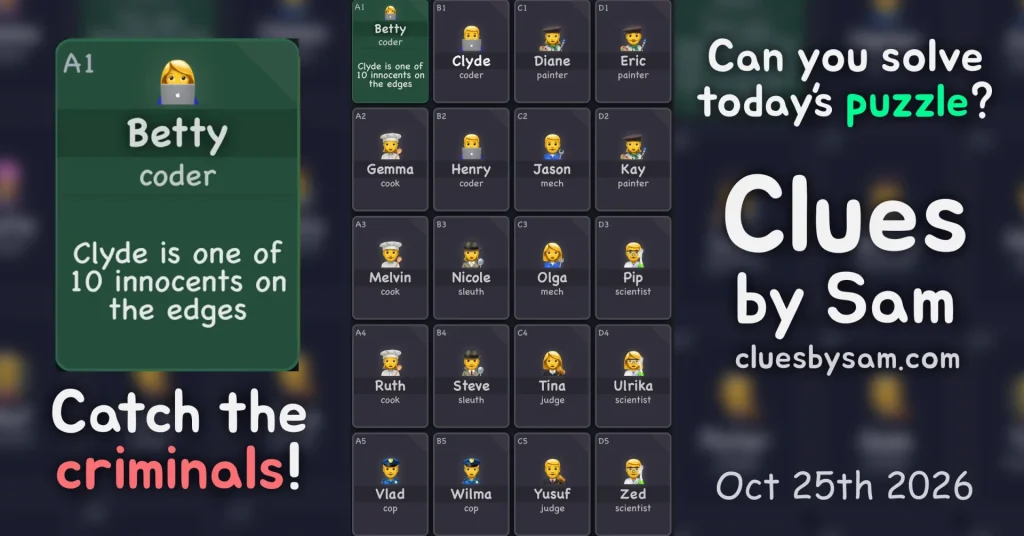
Clues by Sam is a daily logic puzzle in which you identify every person on a 4×5 board as innocent or criminal. Read the revealed statements, combine their constraints, and mark only identities you can prove from the information already available.
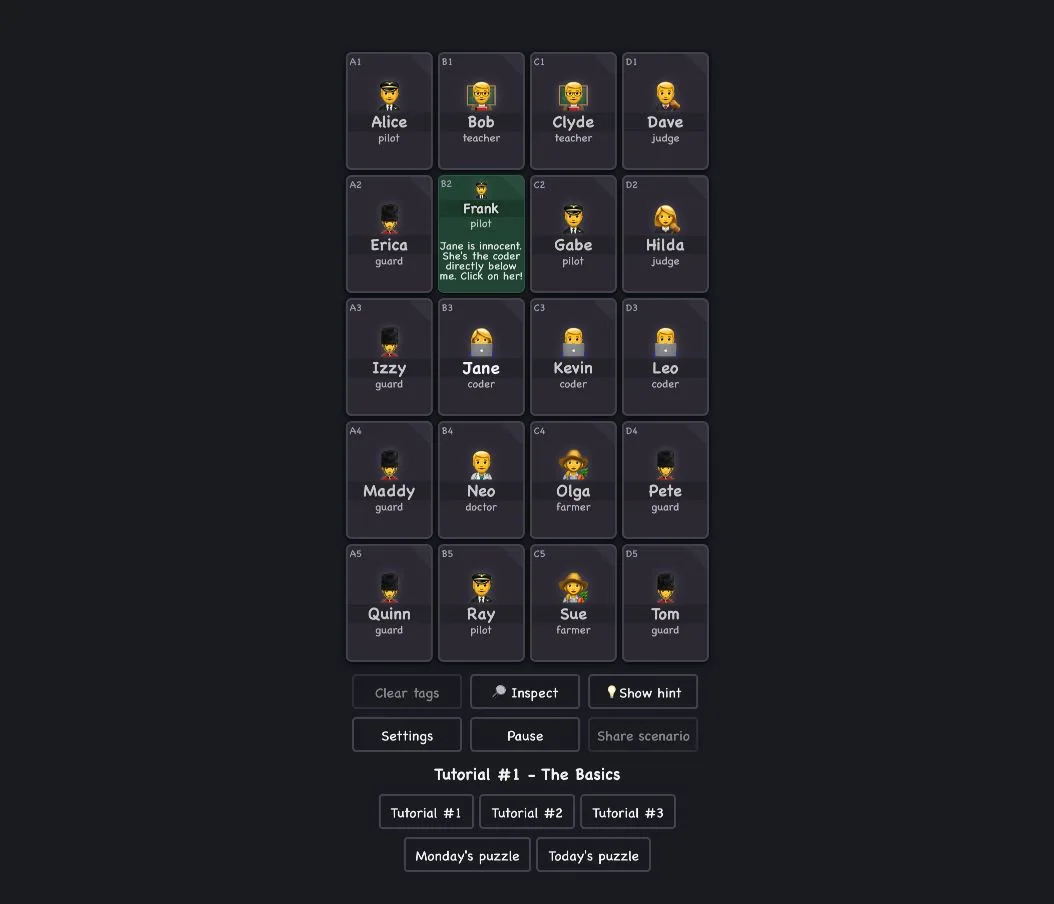
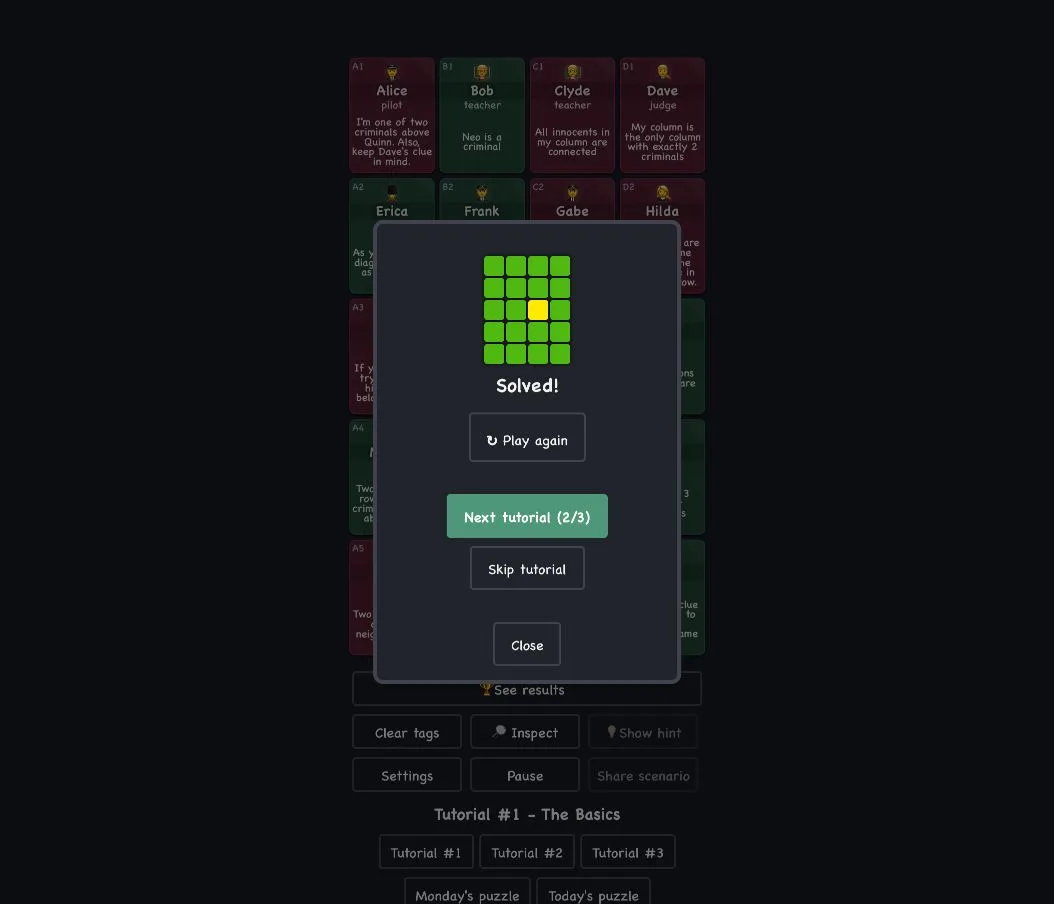
I completed Tutorial #1, “The Basics,” on desktop on October 25, 2026. Frank began identified as innocent; I made the other 19 identifications, deliberately tested one incorrect criminal mark, and reached the Solved screen without using hints. The examples below concern that tutorial, not today's daily answer.
Start with a statement you can prove
Select a person, then choose Innocent or Criminal. Accepted identifications reveal another clue, so each step changes what you can establish next. On my board, innocent cards turned green and criminal cards turned red. These are identity labels, not Wordle-style measures of how close a guess was.
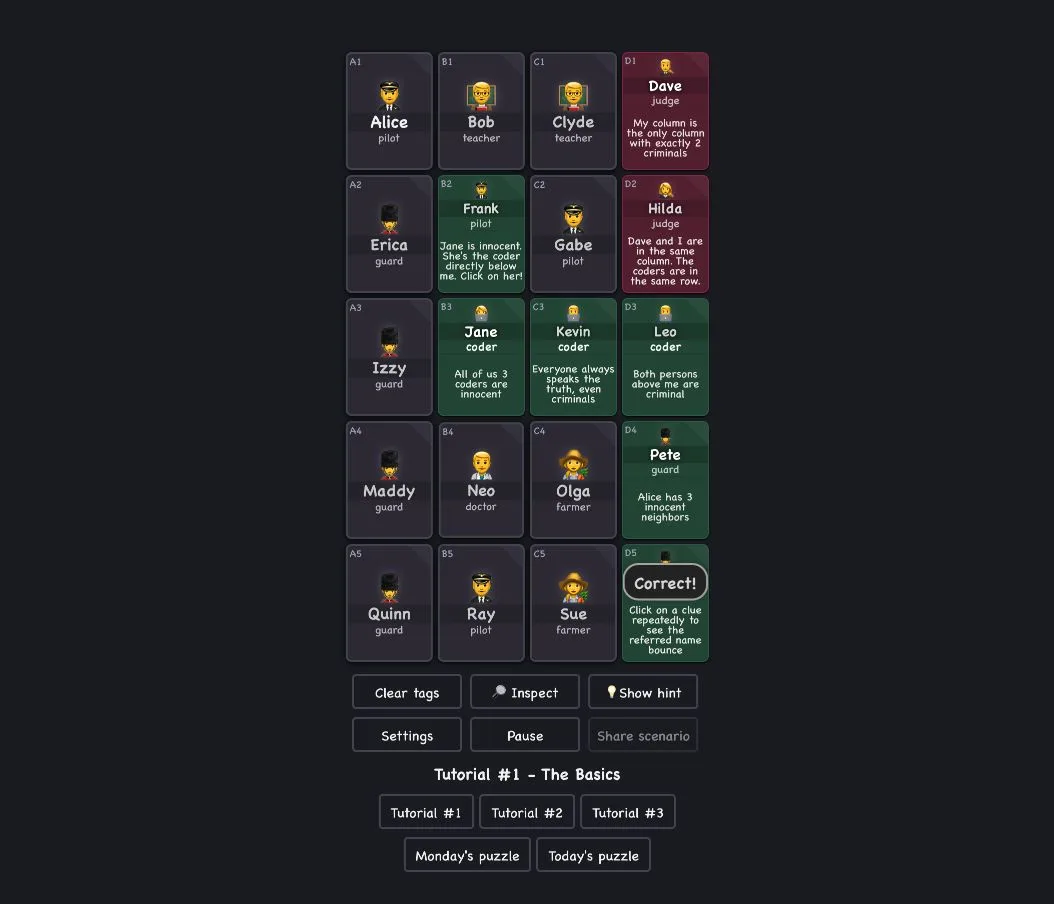
Frank's opening statement identified Jane, the coder directly beneath him, as innocent. Marking Jane innocent produced a Correct confirmation and revealed that all three coders were innocent. That let me identify Kevin and Leo through their shared profession, without assuming that jobs generally determine guilt.
The important rule is that criminals tell the truth too. Once a criminal's clue appears, you can use it just as you would an innocent person's statement. Treat the board as a system of reliable constraints rather than a murder mystery where you must decide which witness is lying.
Unlike Wordle, the task is not to spend a limited set of guesses narrowing an answer. Each identification needs a logical justification before you submit it.
Why did the game refuse my mark?
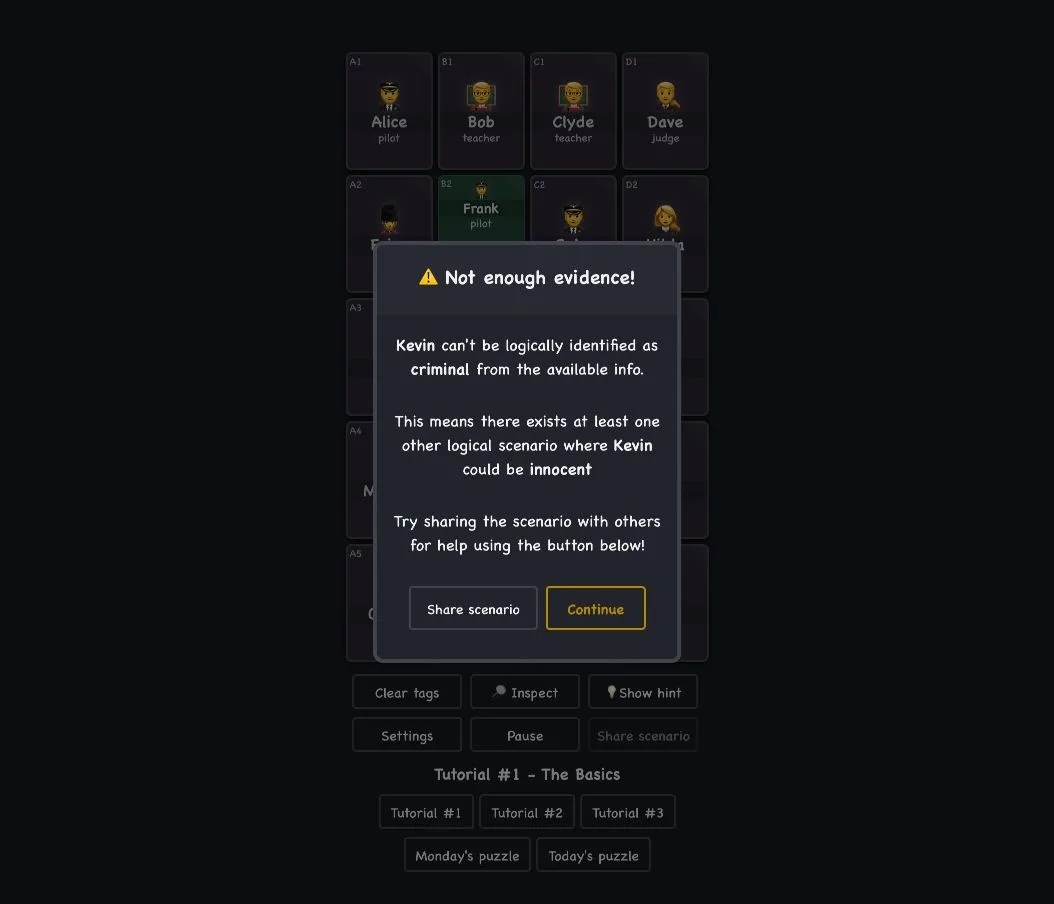
After revealing Jane's clue, I deliberately selected Kevin and chose Criminal. A “Not enough evidence!” dialog rejected the attempt and described an alternative scenario in which Kevin was innocent. It did not accept Kevin as a criminal or let that false identity become part of the board.
I continued, marked Kevin innocent, and received the correct confirmation. This made the feedback useful: the problem was my proposed deduction, and I could recover by returning to the available statements. In this case, Jane had already established the right answer directly.
Finishing later produced a result grid with 19 green squares and one yellow square at Kevin's position. That recorded the blemish even though the board itself ended fully solved. Don't confuse the result grid with the red and green identity cards used during play. This is one observed result, not a complete scoring specification.
Keep older clues in play
The most satisfying part of the tutorial came when a clue stopped being a direct instruction and became a restriction on another column. Dave established that his column was the only one containing exactly two criminals. Leo's statement identified the two people above him as criminals, filling that quota in Dave's column.
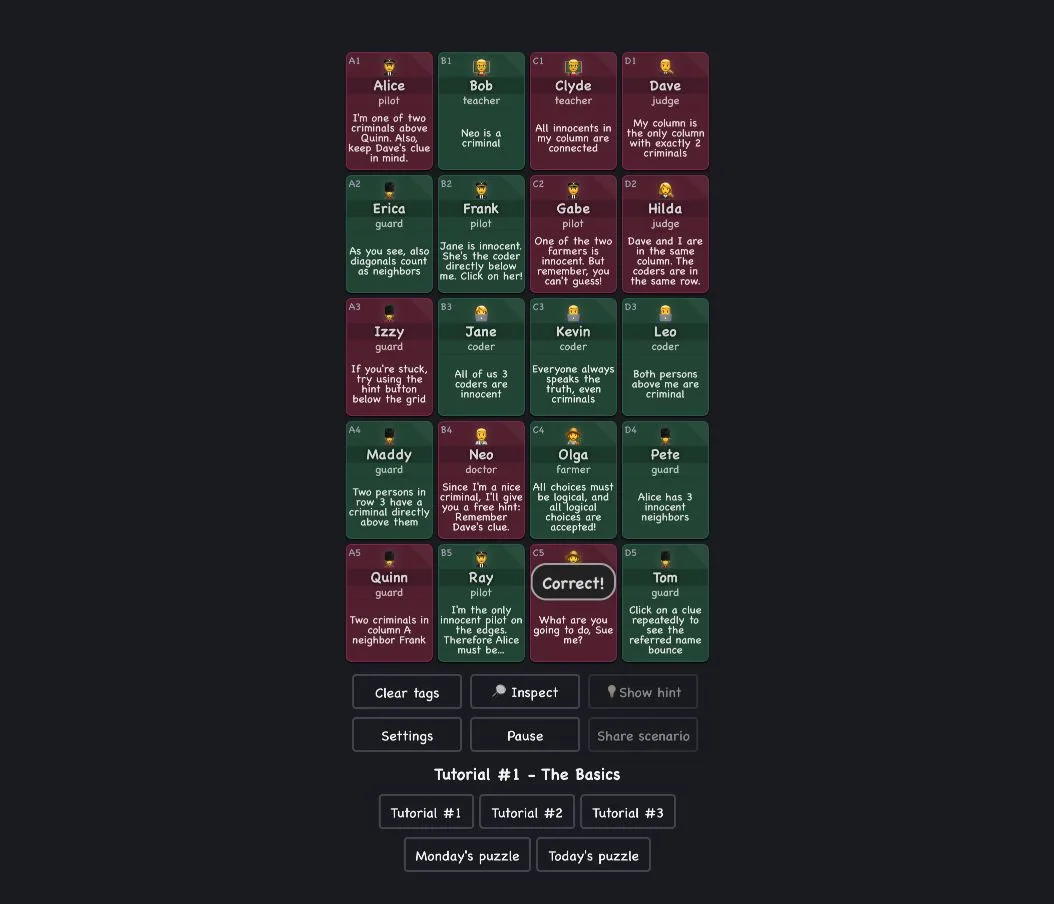
Later, Bob, Frank and Jane were innocent in column B, while Neo was criminal. Ray was its only unresolved person. Making Ray criminal would have created a second column with exactly two criminals, contradicting Dave. Ray therefore had to be innocent.
That deduction explains why rereading matters. A newly revealed statement may tell you to revisit a person whose clue looked finished several moves earlier. I found this more engaging than simply following names from one card to the next, although keeping those relationships in mind took more concentration.
Spatial wording also deserves care. The official rules count diagonals as neighbors, but describe connected groups through horizontal or vertical links. Alice's corner position made the distinction concrete: her three neighbors included Frank diagonally. Near the end, a separate connectivity constraint helped me decide which of the two farmers could be innocent.
What this tutorial establishes
The opening tutorial moves from explicit names to counts, exclusions and connectivity. It gave me a useful introduction to the game's vocabulary and made the refusal of an unsupported mark understandable. The interface also offered Inspect and Show hint controls; I did not test either assistance flow.
The daily page displayed October 25, 2026 as Hard, and the official schedule says puzzles become harder through the week. I opened that daily board but did not solve it, so the difficulty assessment here applies to the completed tutorial. I am not giving a normal solving-time estimate because the session included research and screenshot pauses.
The site displayed weekday puzzle links, an account prompt for the previous week's puzzles, and separate puzzle-pack offers. I did not test account access, paid packs, saved progress, mobile controls or the daily reset. Today's solution is not included in this review.