
Sonar is a daily fleet-finding logic puzzle built around coloured sectors. Find one enemy in every row, column and sector, keeping enemies apart even diagonally; single-click an ally and double-click an enemy.
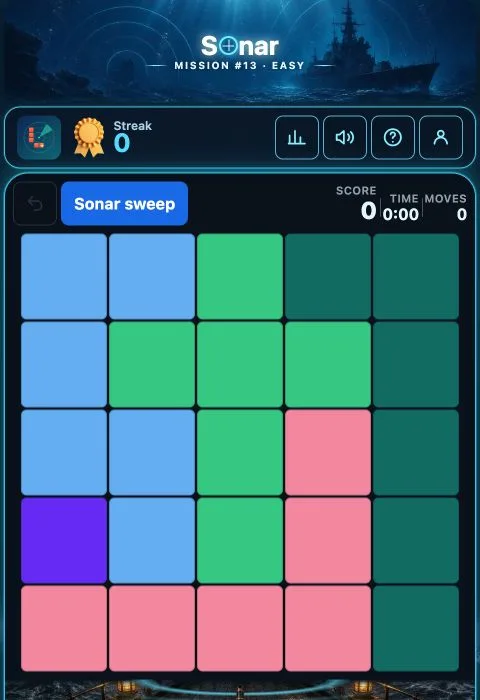
On 31 October 2026, we completed Mission 13 on Easy and a separate Easy practice board. The daily grid was five by five, and its tiny purple sector contained just one square: a useful first deduction without guessing.
Read the sectors before firing
A sector with only one possible square tells you where its enemy belongs. From there, combine the row, column and non-touching rules to eliminate neighbouring candidates. In our daily round, flagging the lone purple square awarded 100 points and increased Moves to one. Marking two other squares as allies added visible check marks while leaving both score and Moves unchanged.
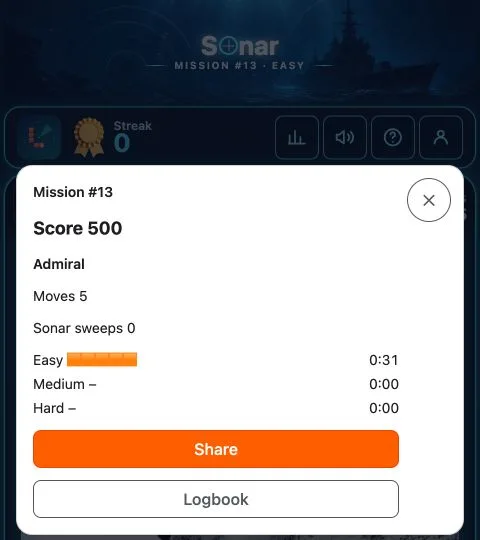
That distinction matters when reading the results: our five-move finish did not mean we had clicked only five times. We found all five enemies for 500 points, and the game ended while most ally squares were still hidden. You can use ally marks to organise deductions without needing to fill every safe cell, as this completion demonstrated.
Keep ally marks separate from enemy flags
The two inputs represent opposite decisions. In practice, we deliberately single-clicked the square that should hold an enemy, then double-clicked it correctly. The correct flag awarded 100 points, but the displayed total was only 50 after the preceding mistake. The tutorial documents a 50-point wrong-mark penalty, so an input mix-up has a measurable cost.
Undo removed a placed enemy flag in that same practice game, but the Moves counter stayed at one. Reflagging increased it to two. Do not treat Undo as a way to erase your shot count.
What a Sonar sweep actually explains
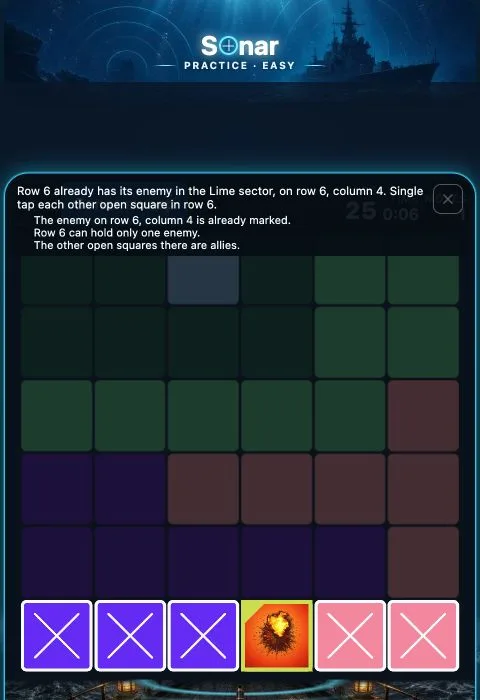
Our practice Sweep cost 25 points, reducing the displayed score from 50 to 25. It highlighted a row whose enemy was already marked and explained why every other open square in that row had to be an ally. We still had to make those marks ourselves: the help supplied a reasoned next step rather than finishing the row.
Try a practice board if you want to learn that interaction before protecting a daily score. Our fresh Easy practice grid was six by six, matching the tutorial's stated Easy size; the daily grid we received was five by five. The size mismatch is a reason to count the visible grid instead of relying on the Easy label. When a sector leaves you one candidate, mark that enemy first, then check its row and neighbours before spending points on a Sweep.