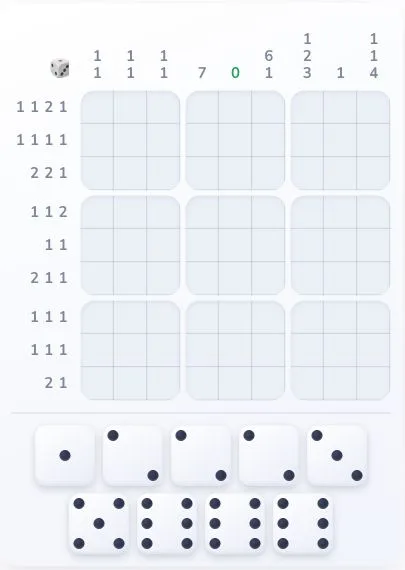

Pipcross is a daily nonogram built from dice: arrange whole faces so their dots form the numbered runs beside the grid. Click a die in the pool and then a board slot, checking the pip patterns rather than adding the dice values.
We completed Mini Daily #139 unaided on October 31, 2026. Its nine dice slots each contained a 3×3 pip pattern, making a single placement affect three row clues and three column clues. The deductions here concern that Mini’s fixed faces and desktop clicks.
The zero between “7” and “6 1”
Three neighbouring columns gave our Mini a foothold: “7,” “0” and “6 1.” The zero meant the middle of those lines had to remain completely blank. The right-hand clue required six consecutive dots, a gap, then one more dot, continuing across dice boundaries.
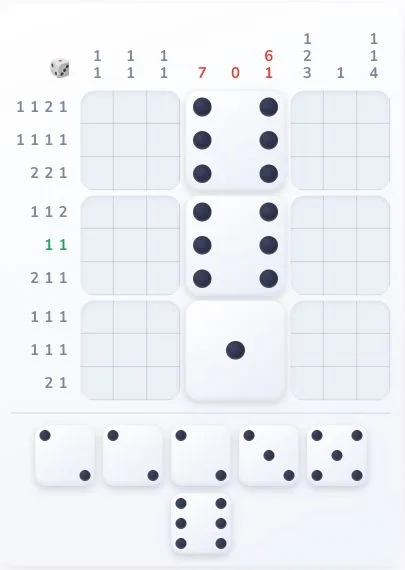
Two sixes, stacked in the middle dice column, supplied six dots down each outer pip column while leaving the centre empty. That satisfied the blank line but left the bottom slot unresolved. A three or five would put a dot in its centre and break the zero clue, regardless of how useful its other dots looked.
The one that made three clues red
We deliberately tried a one underneath those sixes. Pipcross accepted the die into the slot, then turned “7,” “0” and “6 1” red. The one interrupted the required outer-column patterns and occupied the supposedly empty centre.
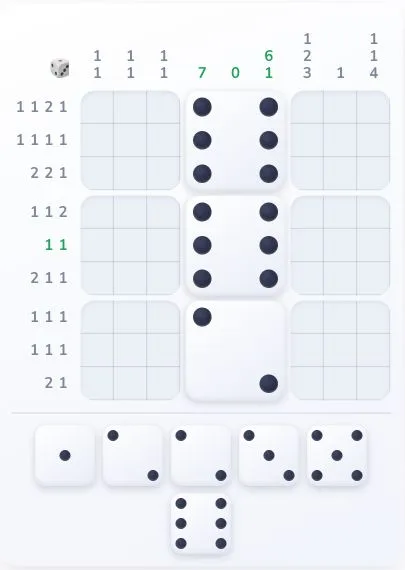
Undo returned it to the pool. Putting a two in the same slot instead turned all three clues green. The difference was visible in the faces: two corner dots preserved the blank centre and extended the outer patterns, whereas the single centre dot had done neither.
Green did not mean every slot on a line was filled. Earlier, with only a six placed in the middle row of dice, its horizontal “1 1” clue was already green. Empty neighbouring slots could still change that run pattern, so that colour alone could not settle their contents.
We then filled the outer slots. The top dice row’s clues turned green, followed by the middle row’s clues. The last remaining six went into the bottom-right slot and opened the solved panel. The useful check throughout was the same one exposed by our misplaced one: examine where a face leaves gaps, then check the lines crossing those gaps.