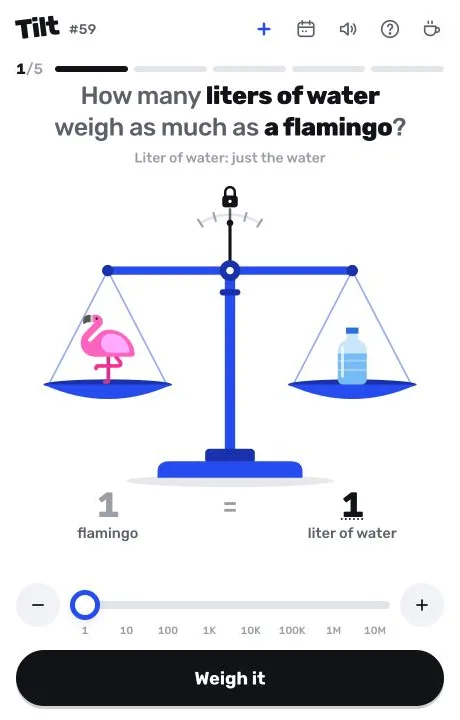

Tilt is a daily weight estimation game in which you work out how many objects on the right would balance one object on the left. Set a quantity, press Weigh it, and complete five rounds with up to 100 points available in each.
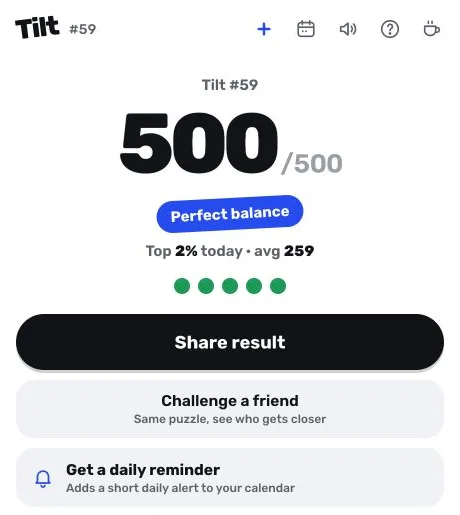
We completed daily puzzle #59 on October 24, 2026, in a desktop browser inside an iframe. Our five estimates earned 500/500, but several still received a “too heavy” or “too light” message. That distinction is useful: a perfect score did not require every estimate to equal the revealed answer.
Make your estimate before the scale moves
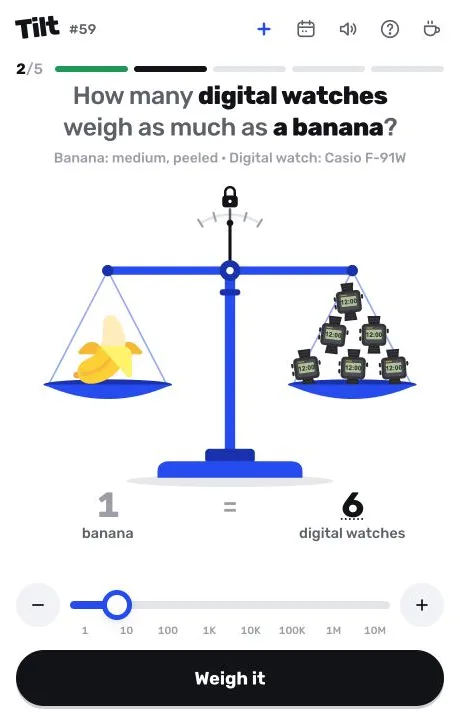
Each round names both objects and adds qualifying details beneath the question. In our run, these included a medium peeled banana, a specific digital watch model, and water without its container. Read that line before estimating; the illustration alone leaves out information that changes the comparison.
Drag the quantity slider, use the minus and plus controls, or tap the underlined number to enter an estimate. The slider spans orders of magnitude, from single objects to millions. It is useful for reaching the right scale, but a small movement can make a substantial numerical change. Even two presses of plus near the initial value took our first estimate from 1 to 1.2 rather than to 3.
The beam remains locked while you choose. Pressing Weigh it commits the guess and triggers the reveal; it is not a way to preview the balance. After each of our submissions, the game showed the objects’ representative weights, a comparison with our estimate, and the points earned. The next action was Next round, with no retry offered in that daily round.
Why “too heavy” can still mean full points
For the banana and digital watch comparison, we estimated roughly 120 grams for the fruit and about 20 grams for a watch. Dividing those estimates suggested six watches, so we submitted 6. The reveal said “1.1× too heavy” while also awarding 100 points and “Spot on.”
Those messages describe different things: the direction of the error and the score awarded for its size. Do not read a slightly tipped scale as an automatic failure. The developer’s scoring explanation says scoring uses relative error rather than a fixed number of objects, with more forgiving treatment for very large answers. Our single run does not establish the precise boundaries between scores.
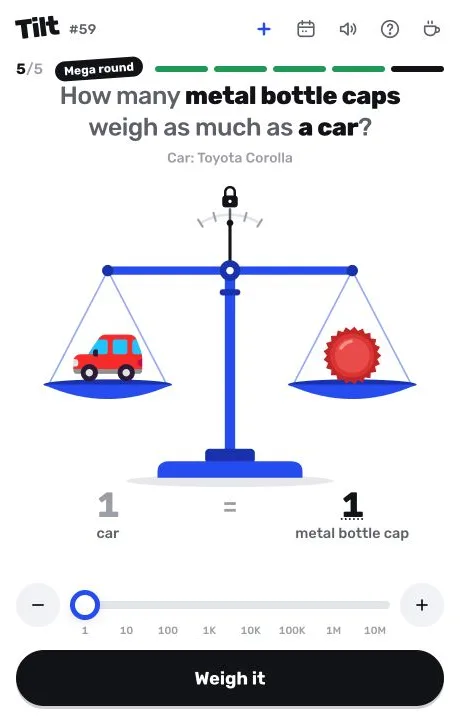
Later comparisons pushed our estimates from hundreds into tens of thousands. The fifth, labelled Mega round, paired a car with metal bottle caps. Working in kilograms for one object and grams for the other would have produced a wildly wrong estimate unless we converted them first.
Start with a weight you can picture
The most useful approach in this test was to anchor one object to a familiar approximate weight, estimate the other in the same units, and divide. Before choosing a precise quantity, decide whether the answer belongs around ten, a thousand, or a million. Then refine it.
The reveals made the unfamiliar comparisons interesting, but the illustrations did not supply missing weight knowledge. Our lion and whale rounds depended on rough remembered sizes. A good result on this particular set therefore says little about how easy another day will be. Compared with Wordle’s successive clues, this daily mode puts more emphasis on committing your initial reasoning.
Past puzzles and the limits of this test
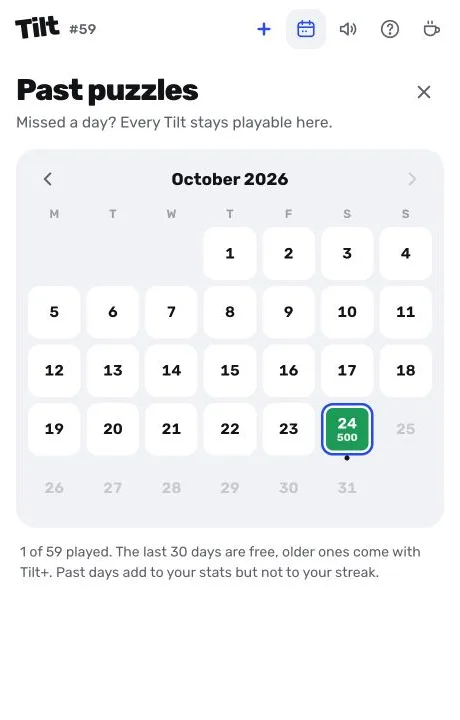
The calendar we inspected marked the completed day and stated that the last 30 days are free, with older puzzles available through Tilt+. It also explained that past days count towards statistics but not a streak. We inspected that menu without playing an archived puzzle.
The result screen offered bonus rounds, sharing, and a friend challenge. We did not test those flows, paid features, or mobile controls. This review covers one complete desktop daily puzzle; it cannot establish difficulty across the archive or how comfortably the large-number controls work on a phone.