
Crack a four-color sequence in Code Breaker, one of the daily games in the Ponder Club collection. Choose four pegs from six colors, submit the row, and use the feedback to find the hidden order. You get ten tries, and the tutorial says you can keep going after that. Our October 26 archive puzzle ended in six guesses, with a particularly useful mistake: getting all four colors right while putting every one in the wrong place.
Code Breaker’s dots describe the whole row
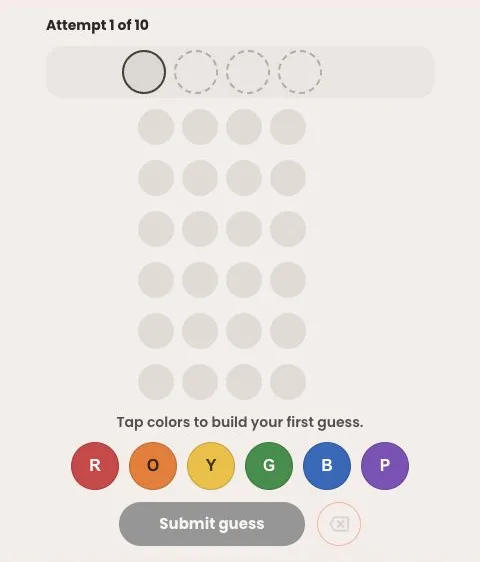
Tap colors in the palette to fill the four slots, then press Submit. The palette includes red, orange, yellow, green, blue and purple, with letter labels on the pegs. Colors can repeat, so finding four different colors is a possibility to investigate rather than a rule to assume.
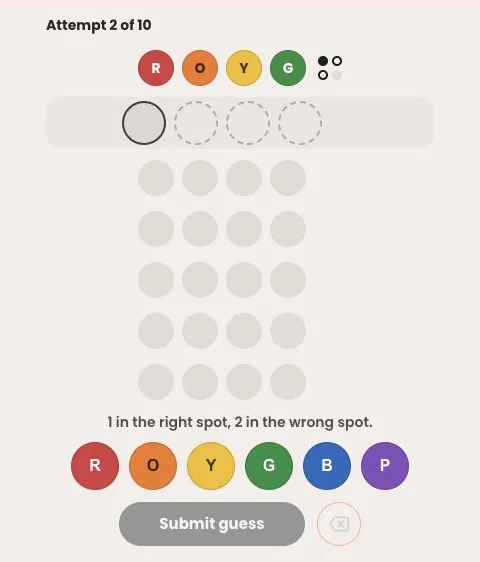
A black feedback dot means a correct color in its correct position. A hollow dot means a correct color in the wrong position; a pale dot represents an unmatched peg. The catch: the feedback dots never point at a slot. One black dot tells you something is correctly placed, but not which peg to keep.
Our opening row, red–orange–yellow–green, returned one exact match and two misplaced colors. That made three matches in total, but left both the missing color and the correct position unresolved. Taking the first black dot as confirmation of the first peg would have sent us chasing the wrong row.
Four correct colors can still need another guess
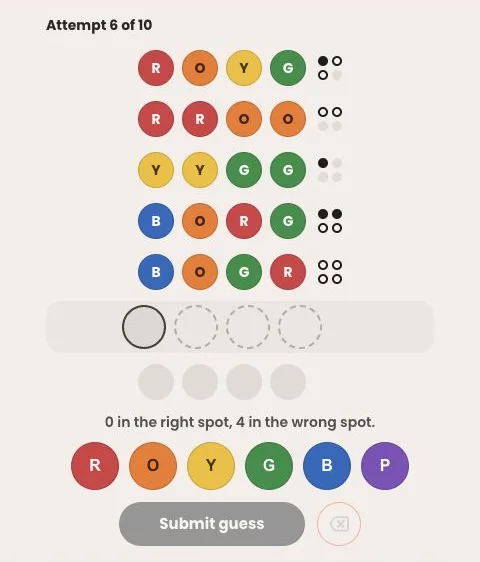
We followed with red–red–orange–orange, which produced zero exact matches and two misplaced colors. Yellow–yellow–green–green then returned one exact match and none misplaced. Those paired probes helped us narrow the composition, although repeated colors made the bookkeeping more demanding than simply crossing colors off a list.
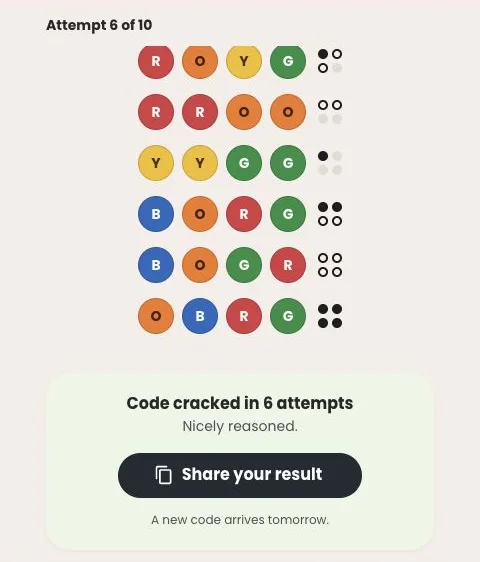
The turning point came with blue–orange–red–green: two exact matches plus two misplaced colors accounted for the entire row. We now had the color set and needed to resolve its order. Swapping the last two pegs produced blue–orange–green–red and four misplaced matches. That guess cost an attempt, but its feedback ruled out every position in that row.
Reconsidering the earlier rows led to orange–blue–red–green. Four black dots confirmed the solution, and the result read “Code cracked in 6 attempts.” The satisfying part was piecing several half-answers together, not being told which slot to try next.
Use the calendar to separate learning from the daily code
The archive calendar has a “next unplayed” option, which selected October 26 for us. That makes the archive a practical place to learn the feedback before tackling a fresh board.
Ponder Club’s official FAQ credits Calli & Eden at Flying Comet Games and states that new puzzles arrive at midnight Pacific Time. The collection also includes word, number and other visual games; the observations here concern Code Breaker.
For the next row, separate two questions on paper: which colors are present, and where can each still go? Once exact and misplaced matches total four, keep that composition and investigate order. Before submitting, check the proposed row against every earlier result, especially any row with zero exact matches. Our fifth guess shows why a plausible swap still deserves that check.