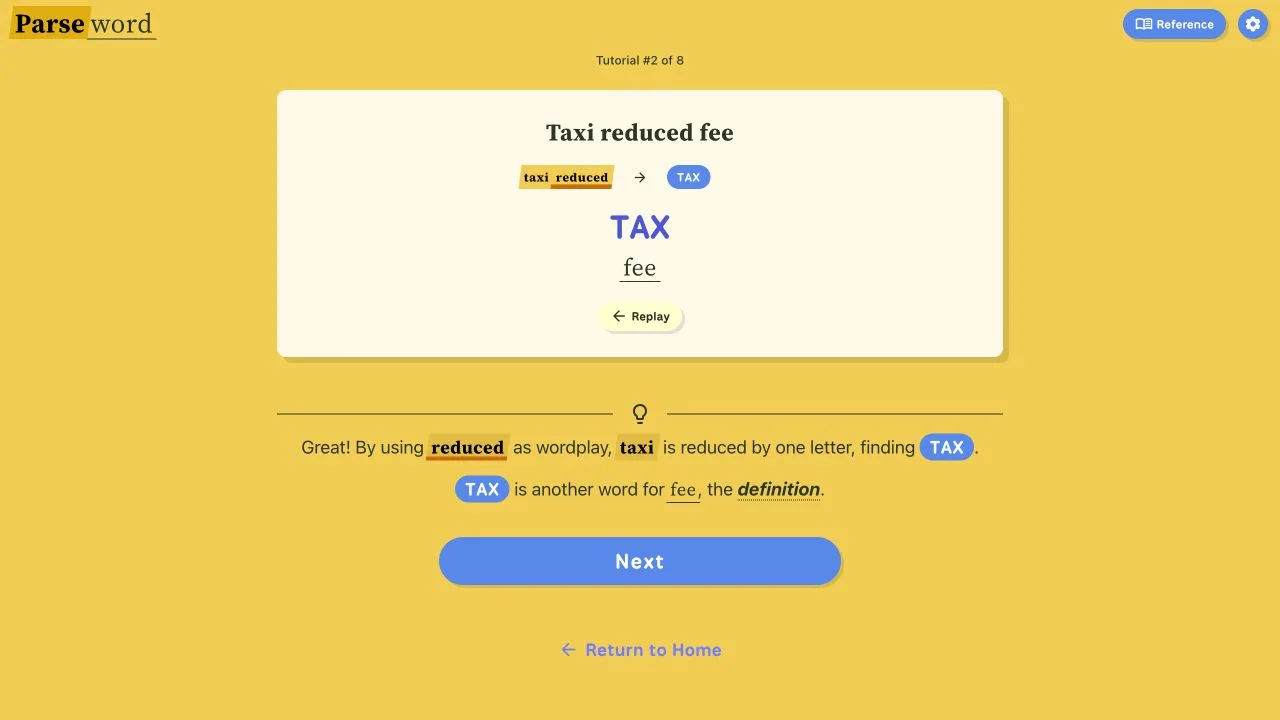


Parseword is a daily cryptic word game where you select words in a clue and transform them until they match its definition. To play, build the answer through the offered replacements and wordplay operations rather than typing a guess. In my session, the tiny phrase “Taxi reduced fee” became a complete lesson in removing a letter.
The game comes from Josh Wardle, Matt Lee, and Chris Dary, whose roles are listed on the official about page. Its connection to Wordle is a useful introduction, but solving here means explaining a clue, not testing letters against a hidden word.
Start by selecting the instruction, too
The tutorial's “Taxi reduced fee” is a useful worked example. I selected “Taxi reduced” together, then chose TAX from the blue option below. “Reduced” tells you to remove the final letter of TAXI. The remaining TAX matches “fee,” so the puzzle resolves into two equivalent parts.
That selection matters. You are choosing both material and an instruction, then accepting an operation the interface offers. Selecting a single word can expose different possibilities from selecting a whole phrase. If nothing useful appears, reconsider the span you selected before abandoning the idea.
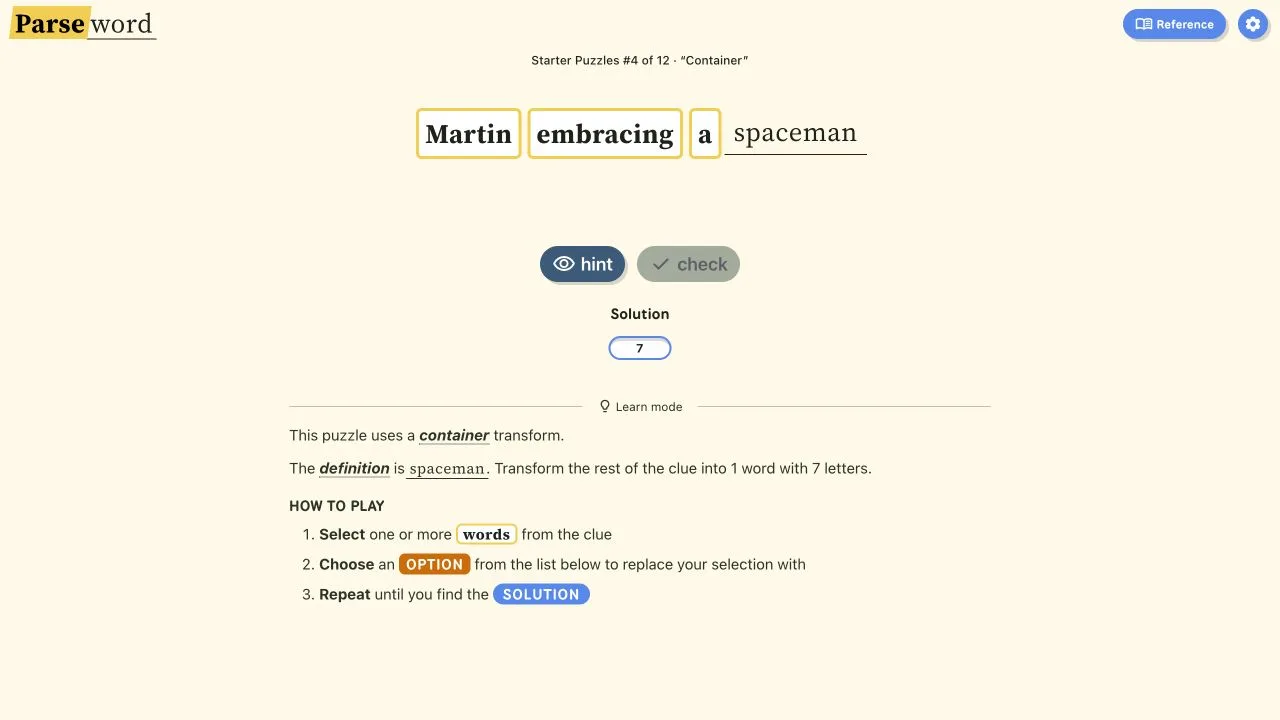
The yellow highlight marked my selected phrase; it was not a Wordle-style accuracy score. Blue pills were clickable replacement options. In Learn mode, an underline identified the definition, while the number beside the solution indicated its length. Once solved, the background turned yellow and a diagram explained the transformation.
When “embracing” means putting a letter inside
I next chose the Container starter puzzle from a menu of 12 practice puzzles. Its clue was “Martin embracing a spaceman.” Learn mode underlined “spaceman” and showed a seven-letter solution.
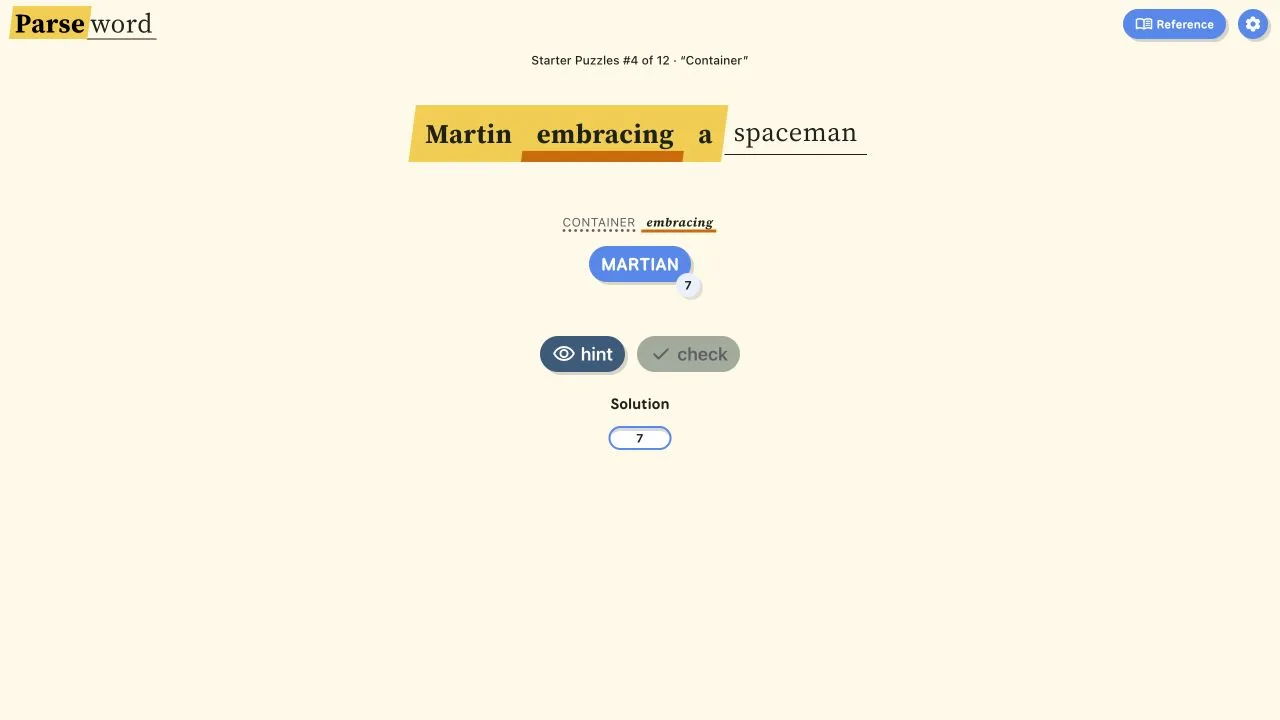
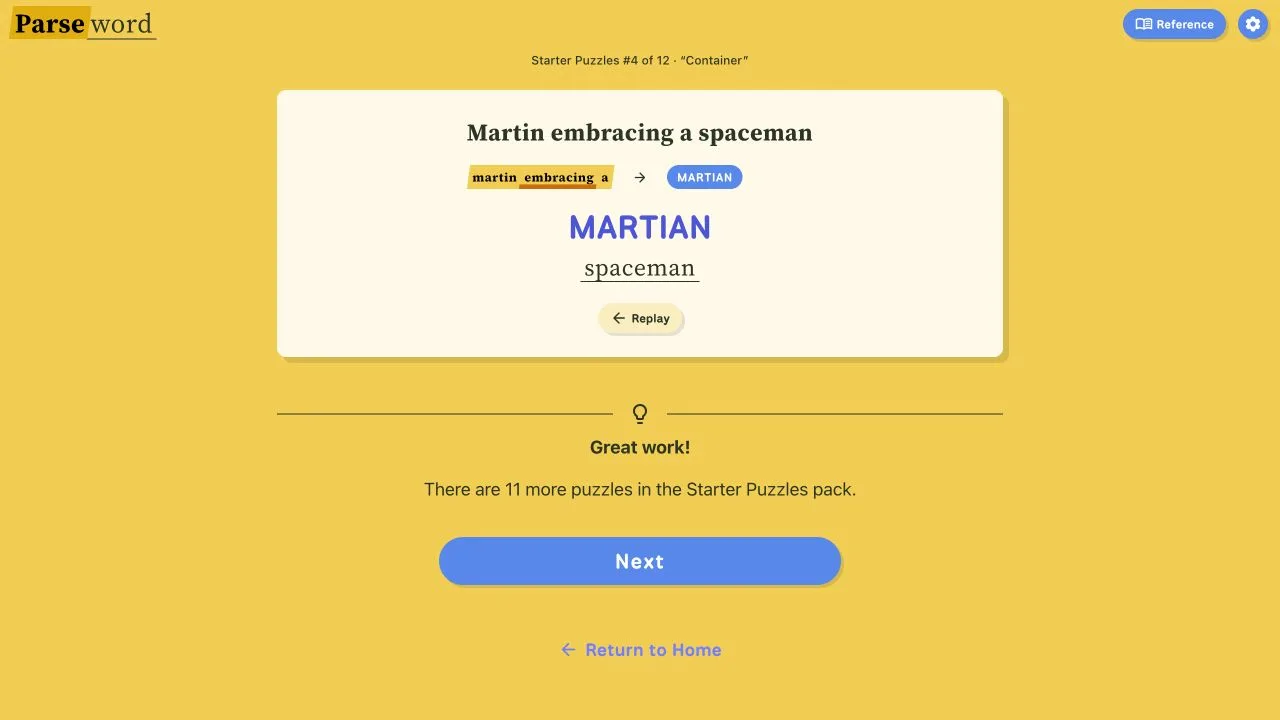
Selecting “Martin embracing a” offered MARTIAN. Insert A into MARTIN, between I and N, and you get MARTIAN: a spaceman. Choosing that option completed the round, with Replay and navigation to the remaining starter puzzles below the explanation.
This was the moment the format clicked for me. “Embracing” was doing mechanical work inside the sentence. Learning to spot that role felt more useful than simply knowing the answer. The compact example also made the container lesson easier to follow than jumping straight into a longer daily clue.
Learn mode helps you see the construction
I also finished a daily puzzle labelled Hard in Learn mode. It required a replacement, a deletion, and a final join. The result screen displayed 2m32s and “Perfect,” alongside a Learn Mode label. That is the game's session readout, not a reliable estimate of how long a new player will need.
The helpful part was seeing the intermediate words remain on screen before joining them. The friction was deciding how much of the original phrase belonged in each selection. English vocabulary alone was not enough; I had to read connecting words as possible instructions.
For a first visit, I would do the tutorial and a targeted starter puzzle before tackling the daily. Keep the revealed definition and length in view, and ask what operation could make the selected material fit both. I did not need to press Hint or Check in these completed rounds.
The official mode guide explains that Play removes Learn's extra guidance, while Challenge also hides solution length and some indicator hints. Those modes were checked in the documentation, rather than independently completed during this review.
Parseword FAQ
How do I type an answer in Parseword?
You do not enter a finished answer through a keyboard field. Select words and choose transformations to construct it. The official FAQ explicitly explains this requirement.
Can I play previous Parseword puzzles?
The official FAQ says the current week's puzzles are available from the home page, but previous weeks do not have a full archive. The separate starter collection provides practice; it should not be mistaken for an unlimited daily archive.
Do I need to understand cryptic crosswords first?
You can begin with the interactive tutorial and Learn mode. My completed tutorial and container round taught their operations directly, although the daily puzzle still demanded careful interpretation of the clue's wording.