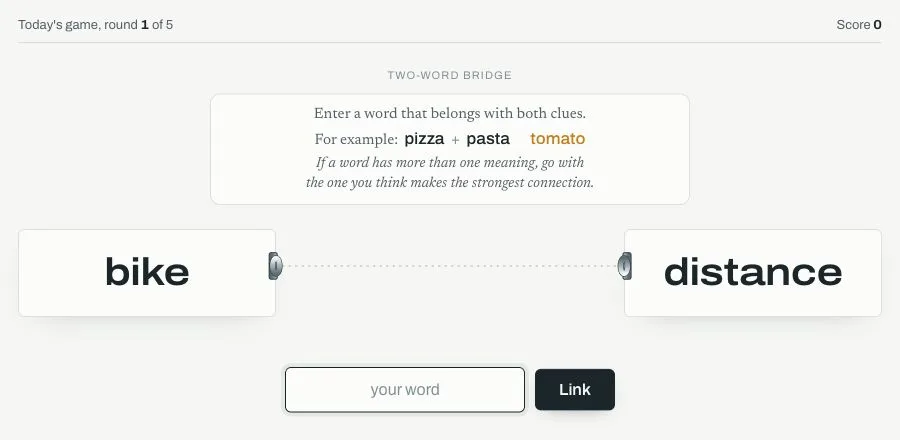

Chainle is a daily word-association game with five rounds and up to 5,000 points. Type one word connecting the displayed clues, then use the chains and score to see how closely your association fits.
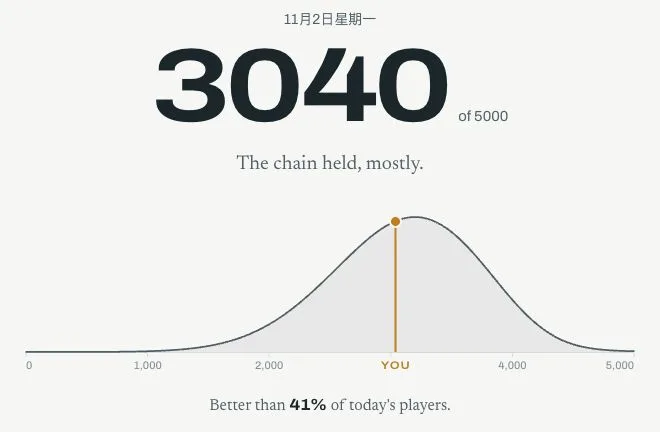
We completed the November 2, 2026 daily puzzle, number 75, unaided at 3040/5000, followed by an unlimited game at 3907/5000 inside a working iframe. The examples below come from that unlimited game, leaving the daily answers unspoiled. These two desktop games show how the feedback works; they do not establish a typical score or mobile experience.
How to submit a word that counts
The first three rounds ask for a word linking two clues. Round four adds a third clue, and round five asks for the nearest meaning to a single word. You get one accepted guess per round, worth up to 1,000 points.
- Read every clue before choosing your association.
- Enter one dictionary word and press Link.
- Inspect the per-clue chains, points and displayed strongest link before moving on.
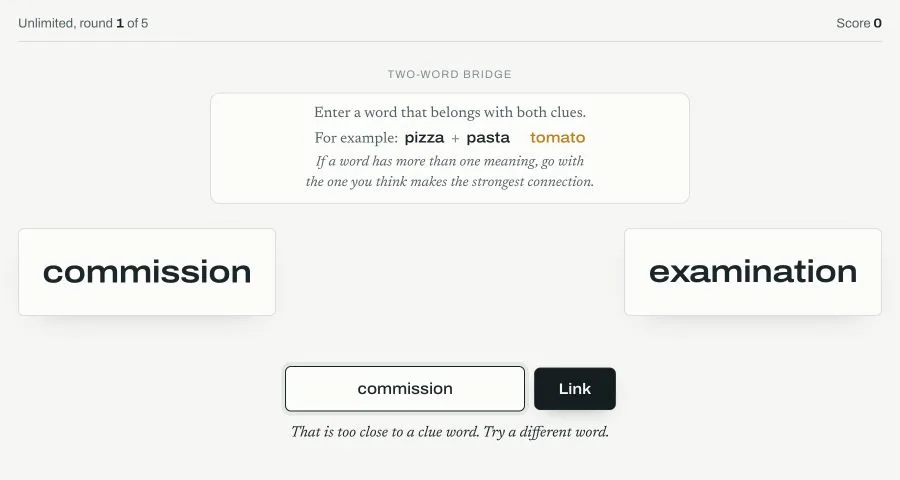
An invalid entry behaves differently from a weak accepted answer. With commission and examination, we deliberately repeated commission. The game rejected it as too close to a clue, left the score at zero and kept the input editable. Replacing it with assessment earned 881 points. Once accepted, our word led to Next round, with no retry offered.
The official input rules also exclude plurals, names and forms derived from a clue. Use a singular word rather than trying to squeeze extra attempts out of spelling variations.
What the chains tell you about your score
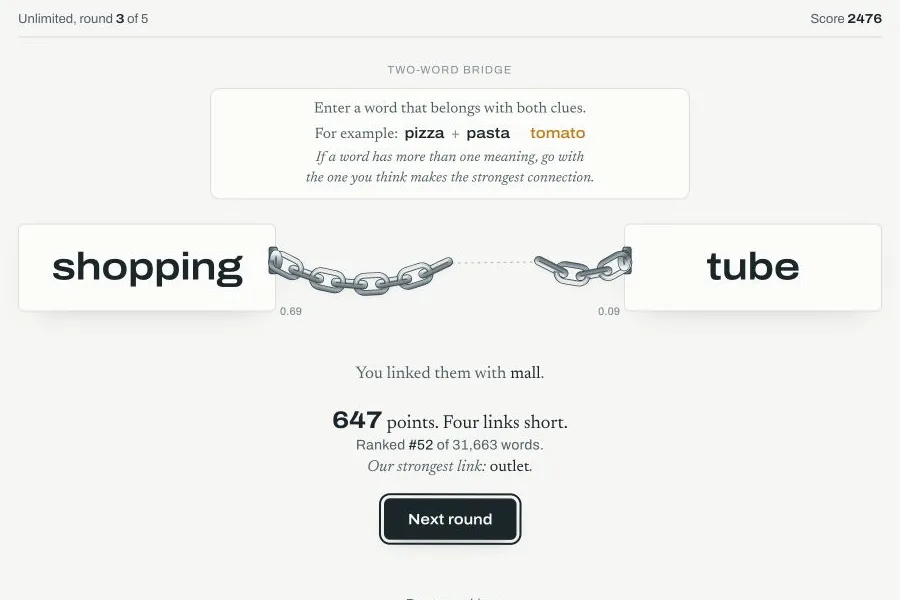
Our mall guess for shopping and tube earned 647 points. Its displayed similarities were 0.69 and 0.09: a strong connection to shopping could not carry the much weaker connection to tube. The game revealed outlet as its strongest link.
By comparison, building between temple and infrastructure scored 948, with similarities of 0.30 and 0.34. Those more balanced figures made the result easier to understand. Before submitting, try explaining your candidate's relationship to each clue separately, especially the one you initially overlooked. These examples support that check, rather than proving a universally best strategy.
The official scoring explanation says each clue is assessed separately and balanced connections are rewarded. There is no unique correct answer: a word matching the best known connection can earn full points too. Three-clue rounds soften the weakest connection, which helps explain why our session guess for episode, terminal and user still scored 496 despite a displayed 0.00 for terminal.
A plausible association can still disappoint
In the daily game, our second-round association earned only 118 points; the next earned 829. That swing was the main friction: we could explain our thinking, but the scoring did not necessarily value the same relationship.
The developer's explanation of word meanings notes that meanings are blended and uncommon senses can register weakly. Read a low score as feedback about this scoring system, rather than proof that your connection makes no sense. The revealed strongest link gives you something concrete to compare with your own choice.
Daily play or more practice?
Our unlimited game kept the same five-round sequence and ended with a round-by-round breakdown. It is the useful next step if you want to test another association after a daily mistake, instead of dwelling on an accepted guess you cannot repair.
According to the official mode rules, unlimited uses random clues and leaves daily results untouched; the shared daily puzzle changes at midnight New York time. Choose practice for more experiments, or stop after the daily set if comparing the same five decisions is the appeal.