
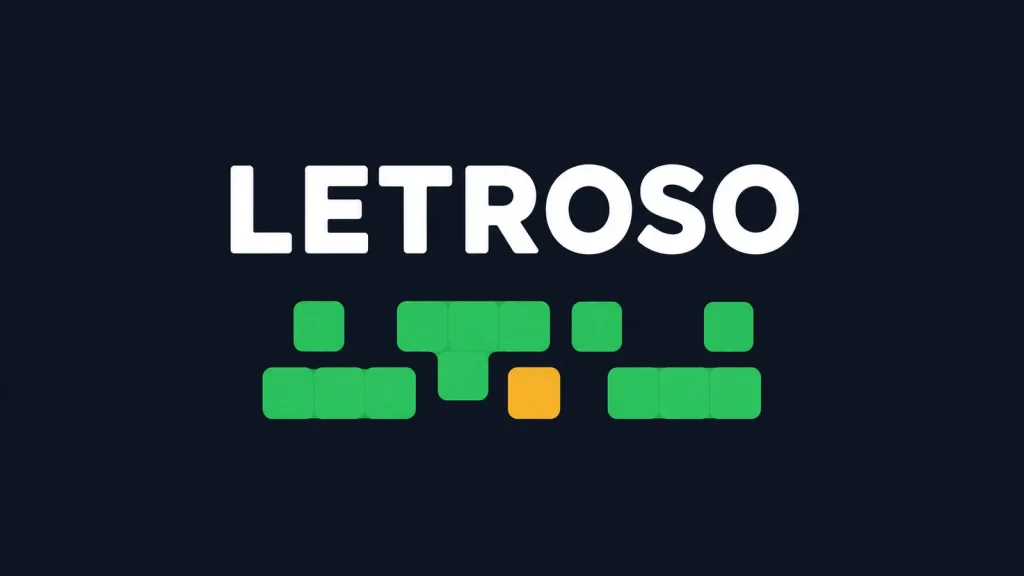
Letroso turns letter order into a puzzle
Letroso is Daydash’s daily word puzzle about finding a secret word of up to ten letters without knowing its length in advance. You submit words, then use letter colors, connected blocks, and rounded ends to work out the answer’s structure. In our English archive test, a five-letter opening revealed a useful three-letter block, but it did not tell us where the answer began.
We tested on October 27, 2026, completing the October 26 historical puzzle in three accepted guesses. This was an archive solve, not completion of the current daily challenge. The examples below describe the clues without revealing the solution.
Read the blocks before you count positions
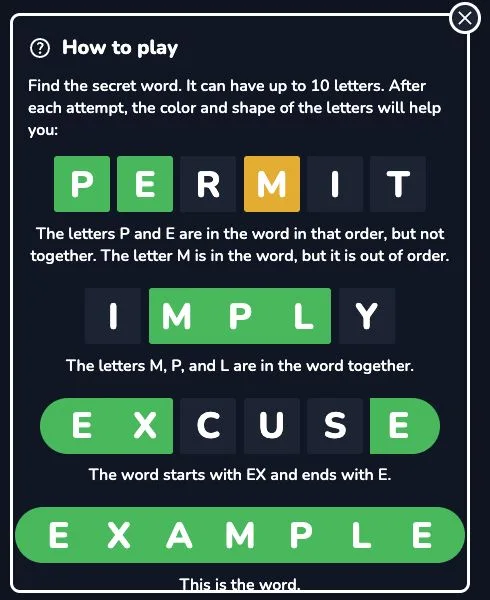
The official tutorial makes a distinction that matters immediately: green letters can be in the right order while still being separated in the secret word. A connected green block means those letters occur together. Rounded outer ends can establish the beginning or ending of the answer. Yellow marks a letter that belongs in the word but is out of order.
The tutorial demonstrates this with EXAMPLE. Its PERMIT row places P and E in order but apart, while M is out of order. Another example connects MPL into one block. EXCUSE then demonstrates the EX beginning and E ending. These are teaching examples, not clues to the current daily word.
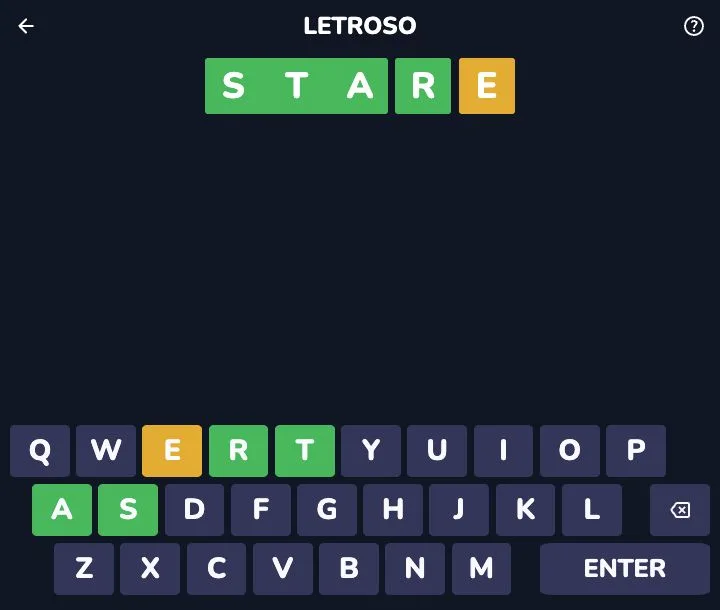
Our first accepted guess, STARE, produced a connected green STA block, a separate green R, and a yellow E. The useful reading was that STA belonged together, R came later with a gap, and E needed reconsideration. Treating the green tiles as fixed Wordle squares would have sent us in the wrong direction: the opening did not establish a five-letter answer or a word starting with S.
A rejected word changed the next move
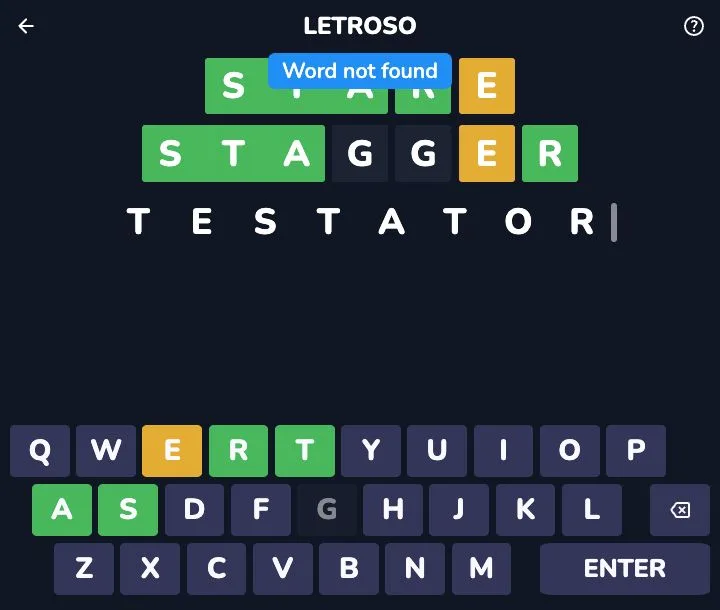
We next entered STAGGER using the on-screen keyboard and pressed Enter. Both G tiles were dark, while STA remained connected and E remained yellow. That removed the proposed G letters from this particular line of investigation, but it did not solve the placement of E.
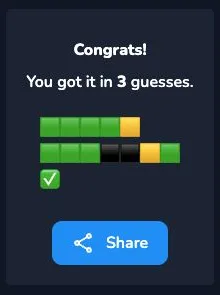
Our next candidate, TESTATOR, received “Word not found.” It stayed in the input row instead of becoming another scored guess. We deleted it with the keyboard’s delete control and tried a different word that put E earlier and preserved the confirmed block. That submission completed the puzzle, and the result card reported three guesses with a colored share summary and a Share button.
This distinction between a rejected entry and an accepted wrong guess is helpful when learning the interface. It also sets a limit on dictionary advice: an English word you know may still be absent from this game’s accepted list. Our test does not establish which spelling variants or inflections it accepts, or a general rule for repeated-letter allocation.
Use the archive to learn the visual language
The home screen offered a dated Daily game, Previous games, and a separate Unlimited entry. We reached the tested archive puzzle directly from the previous day’s button. That gives newcomers a practical way to study the feedback without using the current daily word as their first experiment.
The most useful habit from this round was to preserve confirmed letter blocks while reconsidering everything around them. A gap deserves as much attention as a green letter, and a yellow letter can require moving earlier rather than merely swapping neighboring positions. Our three-guess result is one puzzle’s outcome, not an expected solve count or proof of an optimal opening.
Coverage was limited to one English historical round in a desktop browser. We did not test Unlimited play, mobile devices, accounts, saved progress across sessions, paid features, or the daily reset time. Setup and investigation interrupted the session, so no normal-player solve duration is claimed.