

Kinda Hard Golf is a daily physics golf platformer built around climbing a course of small ledges and flag platforms. You drag from the ball to aim and set power, then release to launch it toward the next landing while keeping your stroke count down.
Our second attempt reached 43 strokes without finishing the hole. We became remarkably good at visiting the same ledges twice. That is a confession about our aim, not proof that the course is impossible, and the small breakthroughs were enough to keep us trying.
A golf swing that becomes a platforming jump
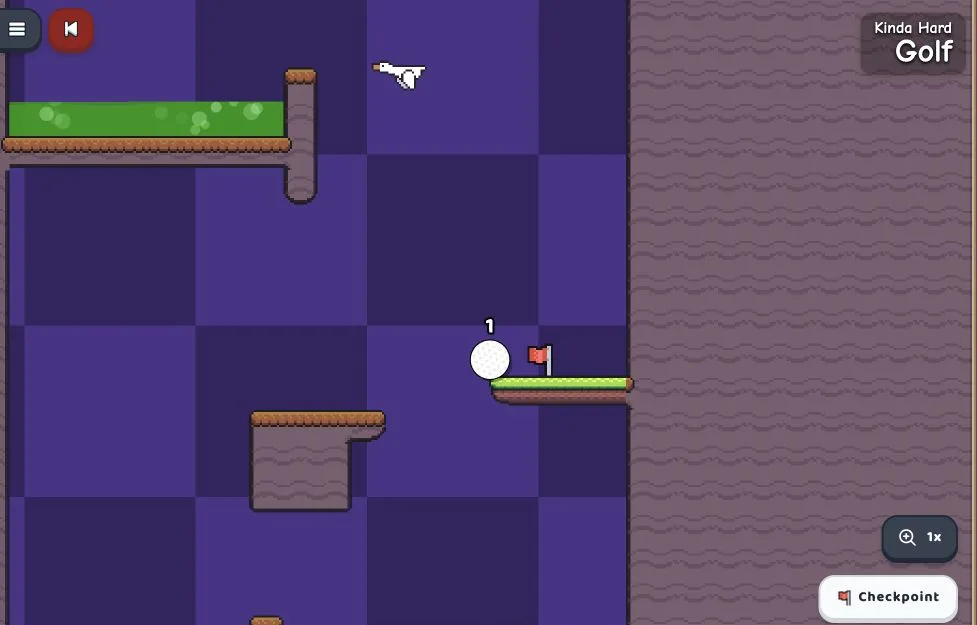
Pulling down and left sent our opening shot up and right onto the first flag platform. The number above the ball changed to one. The drag direction worked like pulling back a slingshot: aim away from the direction you want the ball to travel, then release.
Changing the drag distance let us vary the shot, but more power did not reliably mean more progress. An upward attempt could hit a platform's underside and drop us back below it. Clearing an edge was only half the problem; the ball still needed to settle somewhere useful. A landing near the edge could turn into another fall before we had a stable position for the next shot.
The tested course had purple walls, green pools and flying birds. During the second attempt, an early shot produced an impact near a bird and dropped us back down. Later failures came from much less dramatic mistakes: choosing the wrong angle, hitting a projecting lip or rolling off a narrow green.
Checkpoints save the climb, but keep the strokes
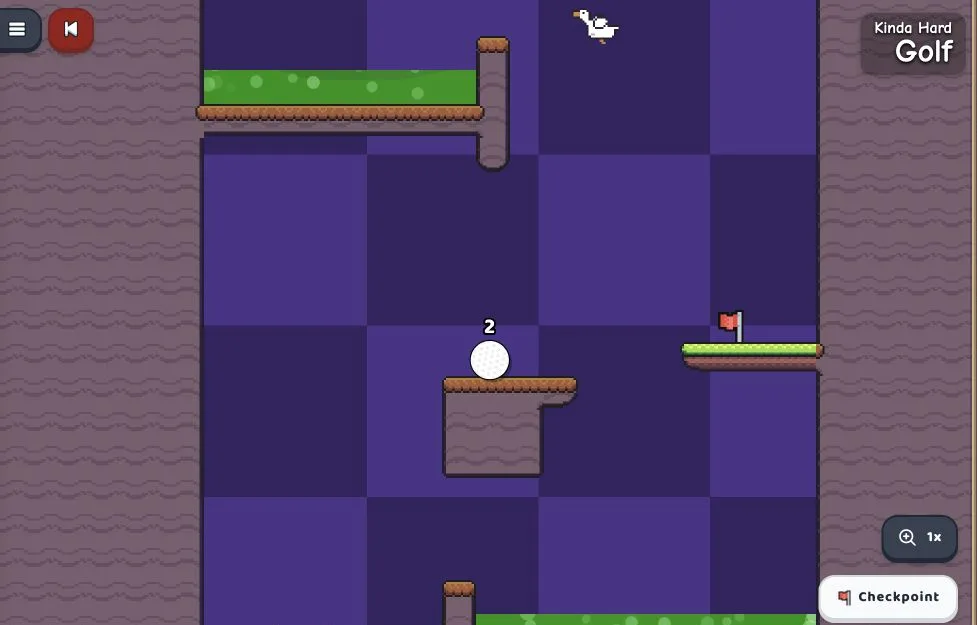
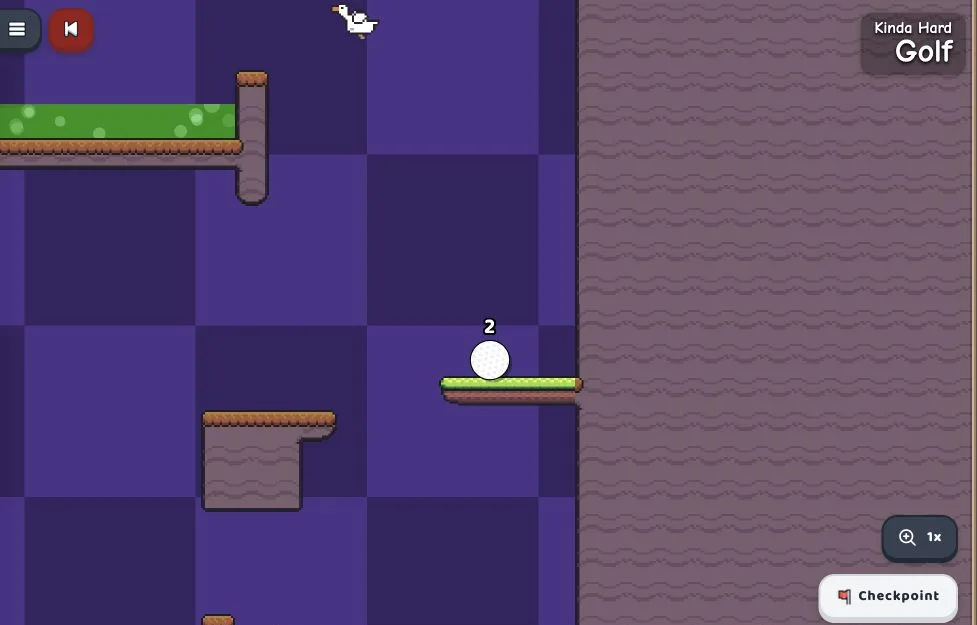
After a missed shot in our first attempt, the checkpoint control returned the ball to the saved flag platform. The counter stayed at two. It recovered our position without erasing the shot we had just wasted.
That made experimentation manageable. We could try another angle without always replaying the opening, although the counter kept recording our misses. We eventually reached higher checkpoints, and returning to one of those confirmed that the saved position had advanced too.
A flag is therefore a useful intermediate target in this climb. Reaching a higher ledge feels good; securing a checkpoint gives that progress more practical value. We did not establish a universal penalty for every hazard or test how the harder mode changes recovery.
The shot that finally changed our approach
The breakthrough came on the third stroke of our second attempt. A strong shot toward the right wall rebounded onto a higher brown ledge. Trying to force a direct upward route had repeatedly left us underneath the terrain; using the wall opened another approach.
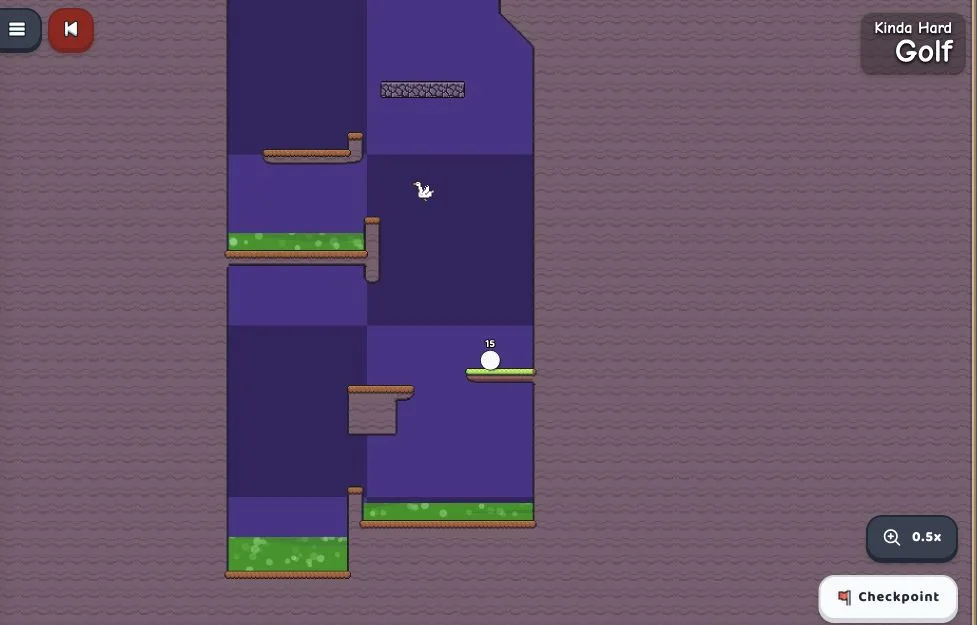
It was not an instant solution. We repeatedly reached a stone platform and then struck the underside of the next overhang. On stroke 20, an adjusted upward-left shot finally reached another checkpoint. A later climb through a narrow passage secured a still higher green platform, before further attempts carried us onto another brown ledge.
The useful lesson from those attempts is to plan a resting place as well as a flight path. Watch where the ball actually stops, let it settle, and change the next shot in response. Our successful bank was evidence of one workable adjustment, not an optimal route for every daily course.
How much difficulty did we actually test?
We played on desktop on October 25, 2026. The selected daily hole was labeled October 24, No. 570, par 19, with Kinda Infuriating Mode unchecked. We stopped the second attempt at 43 strokes; there was no completion panel or explicit game-over result.
This review covers that unfinished daily hole. We cannot judge the difficulty of the full rotation, the finish sequence or the harder mode from it. Investigation and pauses also make our elapsed session unsuitable as a completion-time estimate. Mobile controls and progress saved across sessions remain untested.
If repeated near-misses make you want one more carefully adjusted shot, this course gave us plenty of those moments. If they make you close the tab, take our increasingly expensive tour of the same platforms as a useful warning about the patience this particular hole demanded.