
Globle is a daily country guessing puzzle by Trainwreck Labs. You enter country names and use their heat colors and border distances to locate a mystery country in as few guesses as you can. In our October 25, 2026 desktop test, a practice round took eight guesses, with a colder detour through Mexico before the clues led into the Caribbean.
Read the border distance, not the size of the country
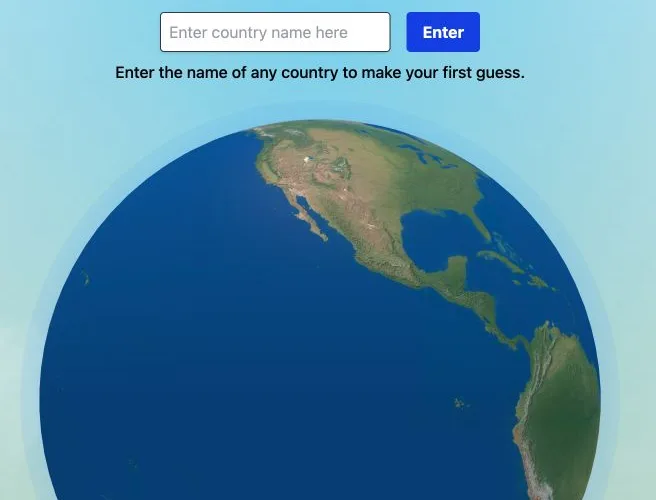
Start by typing a country into the input and submitting it with Enter. The globe colors the guess, and the feedback supplies a warmer or cooler message. The help screen explains the central idea: hotter colors mean closer guesses. A correct answer turns green.
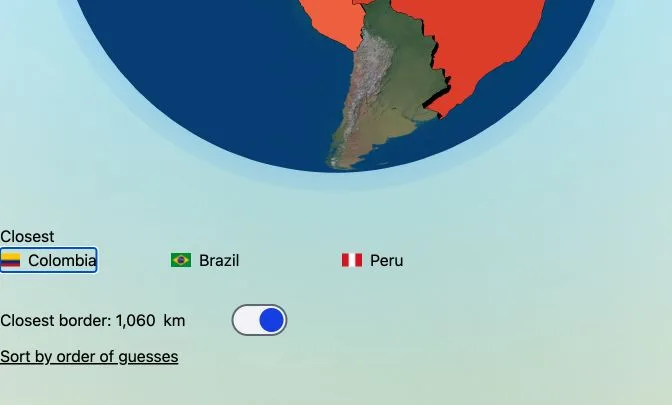
The number needs a little more care. According to the official distance explanation, Globle measures the minimum distance between land borders along Earth's surface. Water borders and a country's territories are excluded from that calculation. This is not a comparison between capital cities, so a large country's nearest edge can matter much more than its center.
Our opening guess, Brazil, produced a closest-border distance of 1,360 km. Peru then received “cooler” feedback, but the closest-border number stayed at 1,360 km. That unchanged figure did not mean Peru was equally close: it still described our best guess so far. Colombia improved the figure to 1,060 km and received “warmer” feedback.
A Caribbean search with one unhelpful detour
Mexico was our fourth guess. It was cooler than Colombia and did not improve the closest-border figure. That was a useful mistake: shifting north had not helped, so we tried a country off South America's northern coast instead.
Trinidad and Tobago cut the distance to 735 km. Dominica brought it down to 230 km, and Antigua and Barbuda reduced it again to 85 km. The eighth submission solved the practice puzzle and changed the distance to zero. These were actual feedback steps, rather than distances estimated from looking at the map.
The satisfying part was the change in scale. Brazil and Mexico tested broad regions; the later guesses required distinguishing neighboring islands. Small Caribbean outlines were harder to read on the globe, so the written country list became especially useful. We did not encounter a direction arrow in this round: the useful signals were colors, warmer or cooler feedback, and the distance readout.
That sequence is an example of adjusting to feedback, not a proven best opening strategy. One solved practice puzzle cannot establish which first country minimizes guesses across all answers.
Check what the guess list is measuring
The list can switch between distance sorting and submission order. In the distance view, the label reads “Closest border.” After we selected guess order, it changed to “Most recent guess distance.” This distinction matters when reviewing a poor guess: the latest country's distance and your closest country's distance answer different questions.
Use the ordered list to reconstruct your route when the globe becomes crowded with colored countries. In our round, it made the Brazil, Peru, Colombia, Mexico sequence easy to compare before the island guesses. It also showed abbreviated names such as “Tr.T.” alongside the colored markers.
Practice without using today's answer
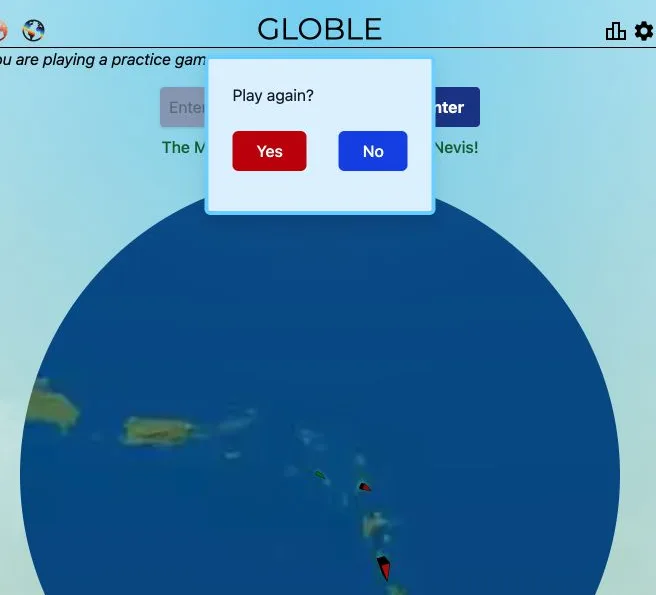
Practice was accessible from Settings. After the completed round, the “Play again?” control opened another practice puzzle; we submitted Canada there to confirm that fresh input worked. Our first round continued beyond six guesses, so Wordle's familiar six-attempt expectation did not describe that session.
All examples here come from practice, and we did not solve the daily challenge. Ads occupied space around the desktop game, particularly beside the lower guess list. Mobile controls, account backups, saved statistics, and the daily reset schedule were not tested. We also did not measure normal solving time because the session included screenshot capture and interface checks.