

FoodGuessr is a food geography game in which you identify a dish’s country or region from photographs, ingredients, and a written description. The site offers daily challenges alongside a separate Classic Solo game, where I completed five rounds using a searchable country picker.
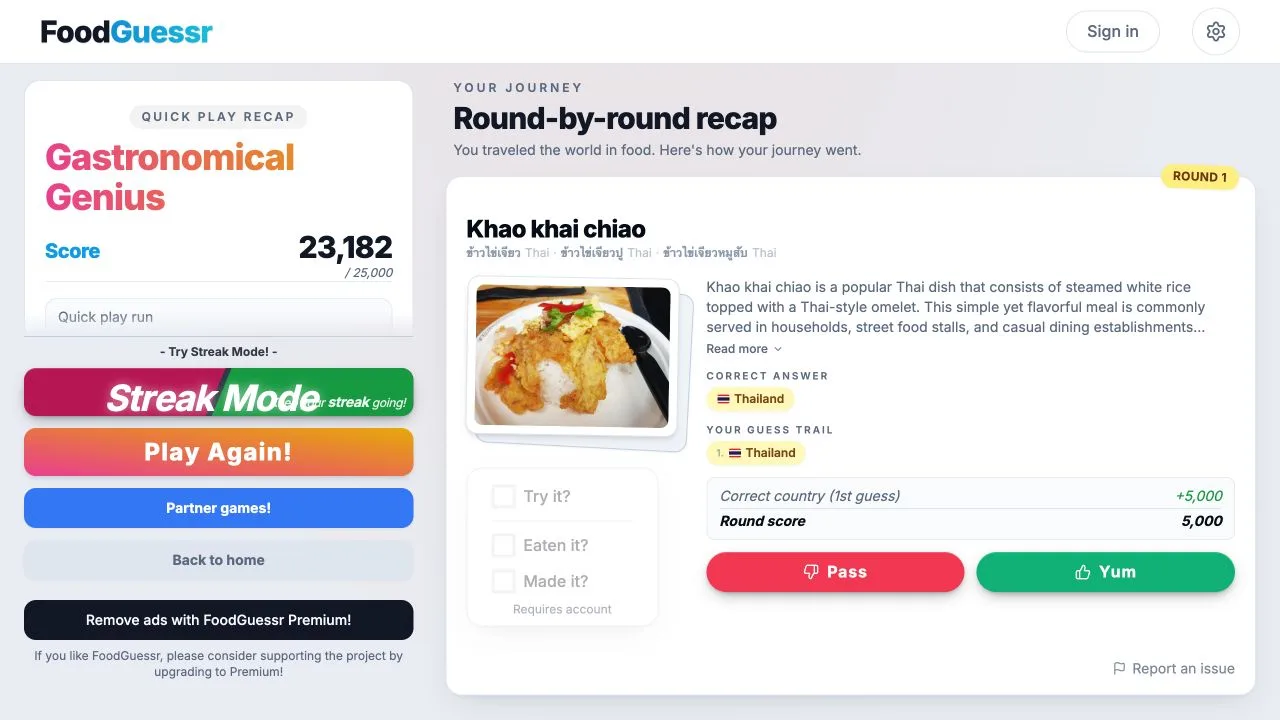
My desktop test on October 25, 2026, was a no-time-limit Quick Play run, not the daily challenge. It finished at 23,182 out of 25,000 points, with two rounds requiring corrections. Those mistakes were the most useful part of the session: they showed how food recognition gives way to geographic deduction when an ingredient list fits several cuisines.
Read the recipe before choosing a country
In the Solo setup, I selected five rounds with no time limit. Each dish allowed five guesses. The photograph, ingredients, and description were available immediately; the dish name was initially hidden. I typed a country into the dropdown and selected the matching entry to submit it.
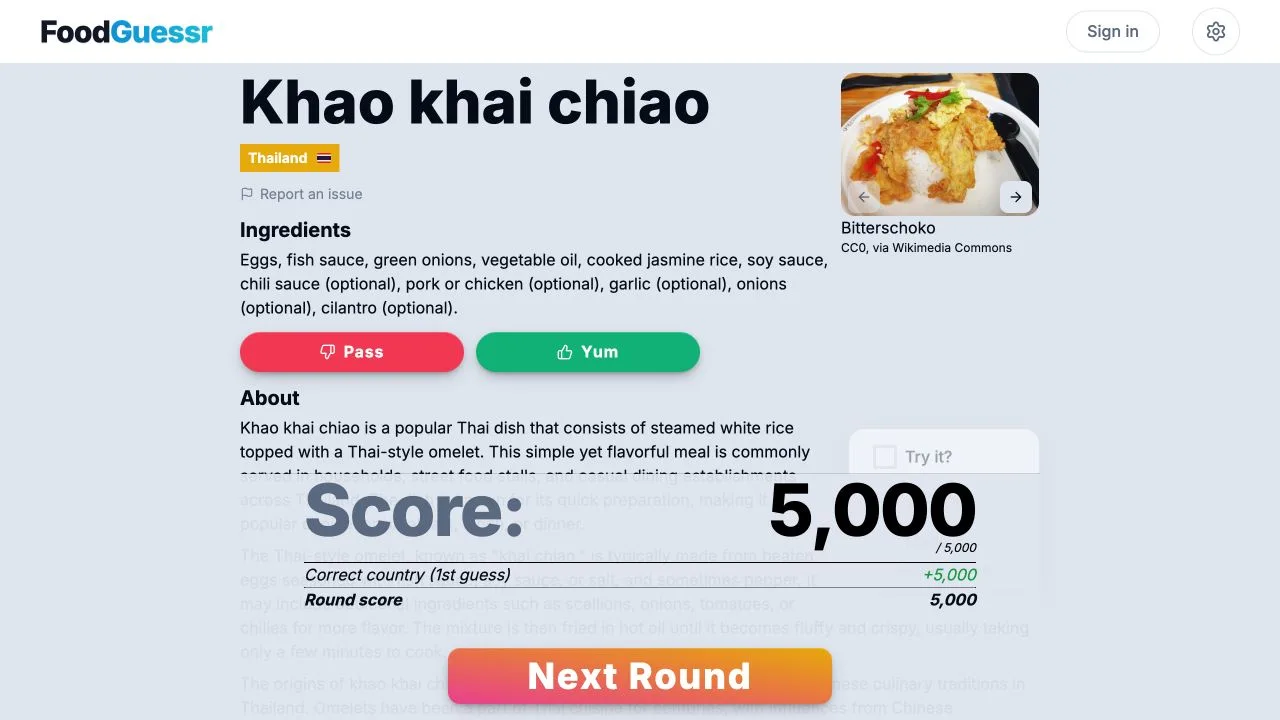
The opening plate showed an omelet over rice. Eggs alone would have been a weak clue, but fish sauce, jasmine rice, and the description of crisp edges gave me a more specific combination to work with. Thailand was correct on my first attempt, revealing Khao khai chiao and awarding 5,000 points.
This is where the format worked best for me. Looking carefully at the preparation was more useful than naming the most obvious food in the picture. Another round paired red wine with cola and described an equal-parts drink associated with festivals. I chose Spain immediately and received another full score. The five-round selection included drinks as well as plated food.
What two misses reveal
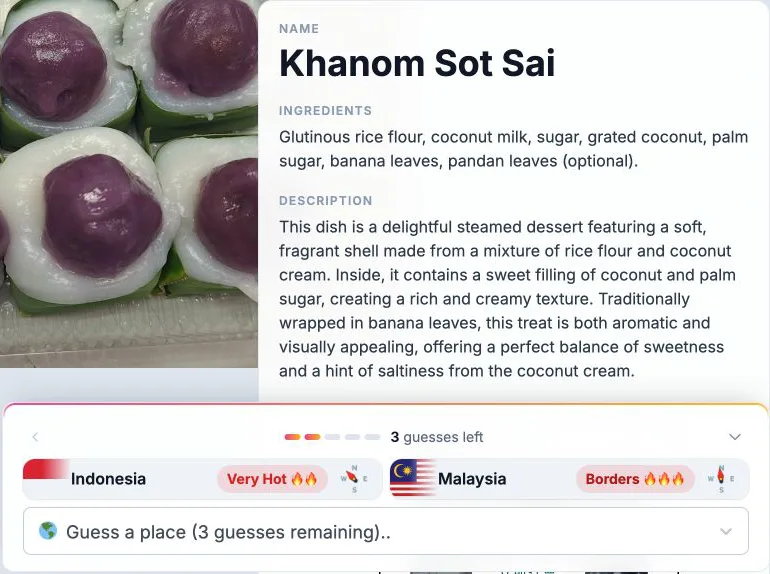
The coconut dessert was harder. Its glutinous rice flour, coconut milk, palm sugar, and banana leaves suggested Southeast Asia without giving me a single confident country. I tried Indonesia and received “Very Hot” feedback. Malaysia then returned “Borders,” with a compass alongside the guess history.
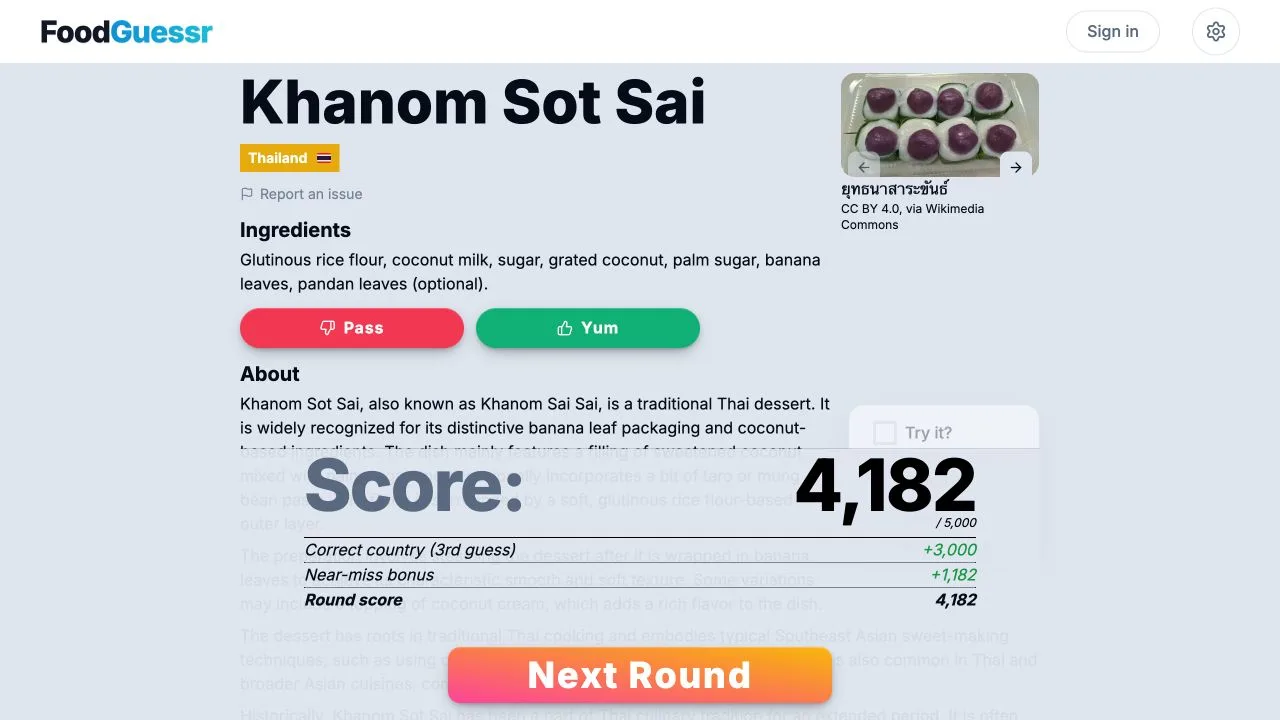
After that second wrong answer, the hidden name became Khanom Sot Sai. I combined the revealed name with the neighboring-country feedback and chose Thailand on my third attempt. That solved the round with three guesses used.
The important distinction is that the name unlocked after two misses; the ingredients and description had already been visible. Waiting for a fuller recipe would not have helped. When several countries fit the food clues, use the warmth reading and compass to reconsider location, then bring the newly revealed name into the decision.
Close mistakes can preserve points
The help panel describes a 5,000-point first answer, with 1,000 fewer base points for each additional guess and some points recoverable through close misses. My dessert result made that distinction visible: 3,000 points for the third-guess solution plus a 1,182-point near-miss bonus, totaling 4,182.
A later biscuit round felt much less certain. Flour, sugar, eggs, and butter did little to separate possible countries, and Denmark was a poor opening guess. The game returned “Cold” feedback with a compass pointing southwest. I switched to Brazil and solved Tareco on my second attempt for 4,000 points. That second choice was still speculative; the feedback narrowed my thinking without turning the generic ingredients into an obvious identification.
Reading the score breakdown is worthwhile because a third-guess solve can retain more points than the base award suggests. This session does not establish the exact distance-to-bonus formula.
Know which run you are comparing
The final rose hip soup led me to Sweden on the first guess. After all five dishes, the result screen explicitly labeled the session “Quick Play Recap” and said community statistics were only shown for daily games. Its round-by-round guess trails made it easy to revisit where points were lost.
I played without signing in or making a payment. Ads appeared during the run, including beneath the clue panel. This review covers one desktop Classic Solo session; the daily challenge, other game types, multiplayer, mobile controls, account features, and premium benefits remain untested. Investigation pauses also mean the session provides no useful typical completion time.