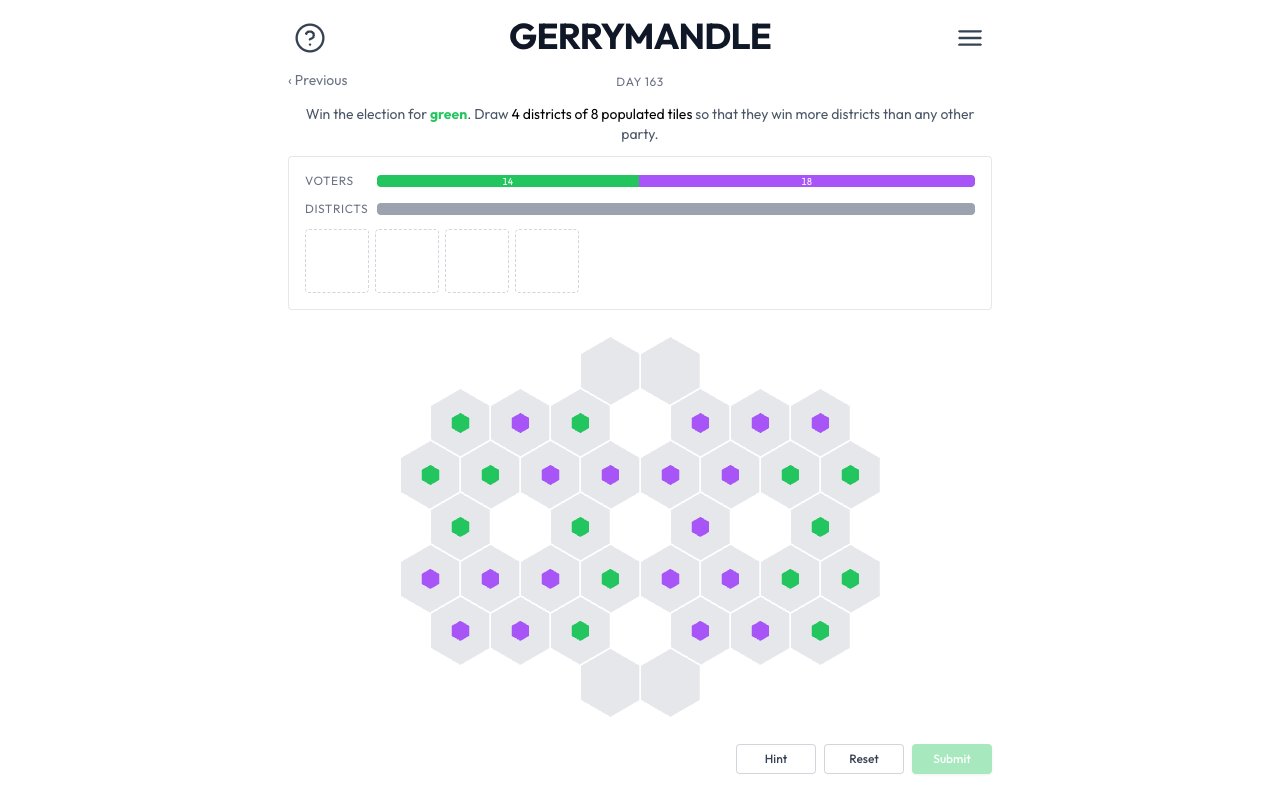

Gerrymandle turns electoral map-rigging into a daily logic puzzle. You get a small hex map dotted with green and purple houses, and your job is to draw district lines so green wins more districts, even when green has fewer voters. It is a quick, free browser game with a new map every day, and it doubles as a hands-on lesson in how gerrymandering actually works.
How to play Gerrymandle
Each puzzle gives you a map, a target number of districts and a voter split. The puzzle we played, Day 163, asked for four districts of eight populated tiles each, with 14 green voters against 18 purple.
- Click adjacent hex tiles to group them into a district. Each district must be one connected shape, with no islands.
- Keep building until every house on the map belongs to a district. All districts are the same size, and some tiles are empty land with no voters.
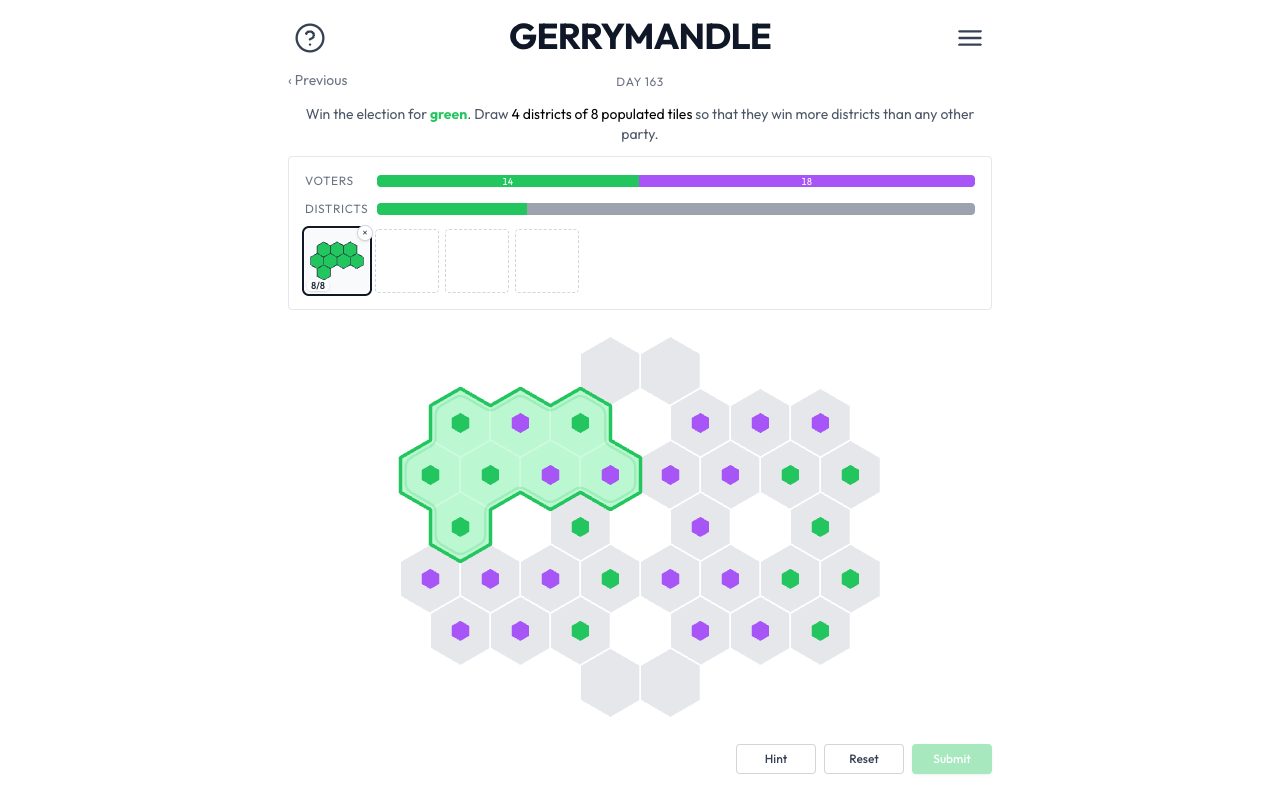
- Watch the top panel: it shows the voter split, a bar that fills as districts are drawn, and a thumbnail of each finished district with its "8/8" count.
- Remember the win rule: a party wins a district by having more houses in it than any other party, and a tie means nobody wins it.
- Press Submit when you think your party wins more districts than anyone else. Reset clears the board if you want to start over.
A tutorial is offered on the first visit, and the site has a Previous button and a puzzle archive for earlier days.
Tips for Gerrymandle
- Pack your opponent. Put as many purple houses as you can into one or two districts that purple wins by a landslide. Every extra purple vote in those districts is a wasted vote.
- Crack the rest. Spread the remaining purple voters across other districts so they fall just short in each one.
- Win narrowly. Your own districts only need one more green house than purple. A big green margin wastes green voters you could use elsewhere.
- Count before you click. Since every district is the same size, work out how many green houses each winning district needs before you commit to a shape.
- Use ties. A tied district goes to nobody, which can be enough to stop purple from outnumbering you in seats.
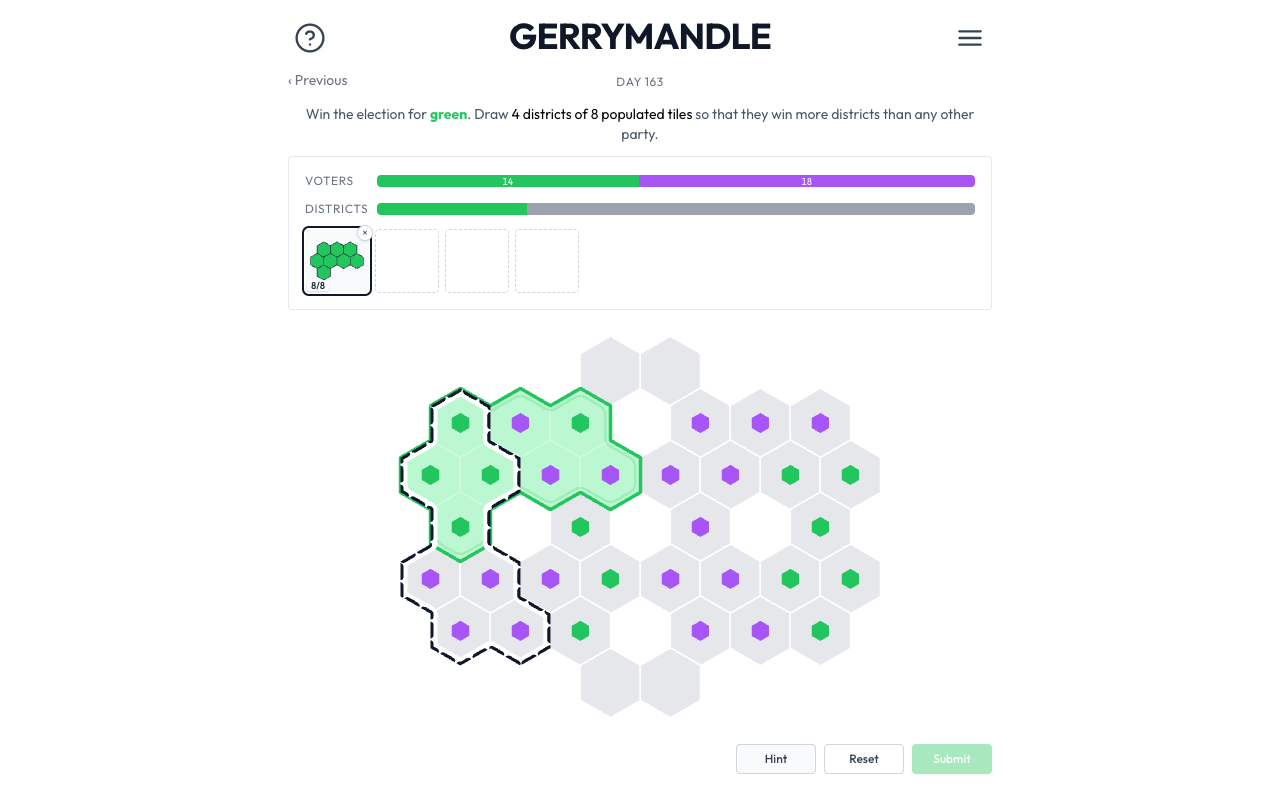
- Lean on Hint when stuck. It outlines a suggested district on the map with a dashed line.
First impressions
The idea teaches itself. Below the board, the site explains packing and cracking: crowd your opponent into a few landslide districts, then spread the rest thin. Once that clicks, every map becomes a small counting puzzle about where the purple votes can be "wasted". The board is clear and the rules are short.
Our first district was 5 green to 3 purple, and the hint quickly showed that the smarter move was to pack purple voters together instead. Expect a couple of attempts before the logic feels natural.
Gerrymandle FAQ
Is Gerrymandle free?
Yes. The site describes Gerrymandle as a free daily gerrymandering puzzle, and it plays in the browser with JavaScript enabled.
How often is there a new Gerrymandle puzzle?
There is a new puzzle every day, according to the official site.
Can I play past Gerrymandle puzzles?
Yes. The site has a puzzle archive, and the game has a Previous button for earlier days.
What happens if a district is tied?
Nobody wins it. A party only takes a district by having more houses in it than any other party.
Does Gerrymandle explain real gerrymandering?
Yes. Alongside the game, gerrymandle.com has pages on what gerrymandering is, its history, real gerrymandered maps and recent redistricting news.
This review is based on a short hands-on session. We'll add more after more daily runs.