
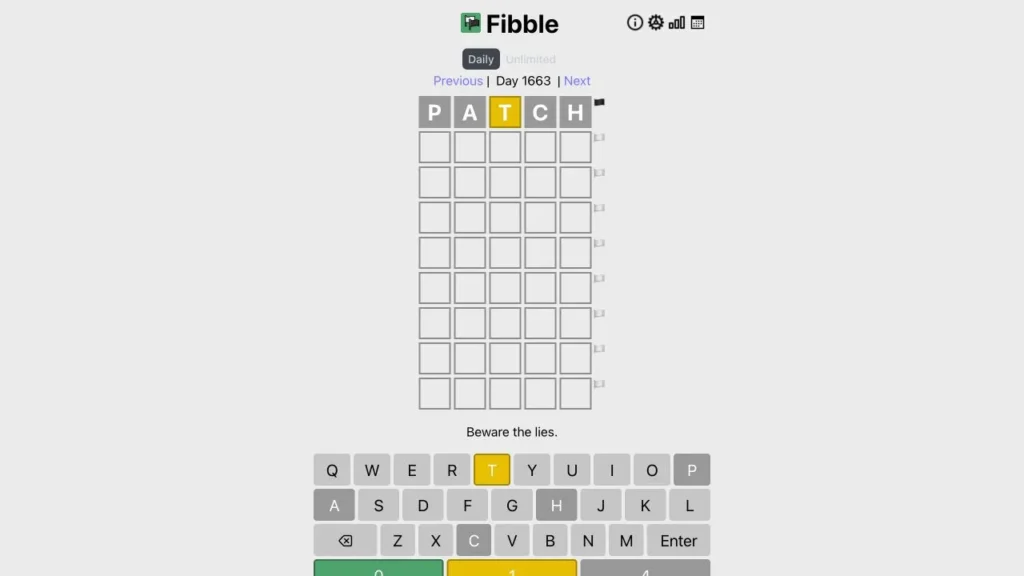
Fibble is a daily five-letter word puzzle in which exactly one color clue in every row is a lie. You must find the answer while deciding which feedback to distrust; an Unlimited mode is also available. In my completed test of an older daily puzzle, SEVEN produced four green tiles and still led me down the wrong path.
The official game credits K & R Garfield with Fibble and keldor with the code. In a creator interview, Kelly Dornhaus confirms coding the rules suggested by K & R Garfield.
How to read a Fibble row
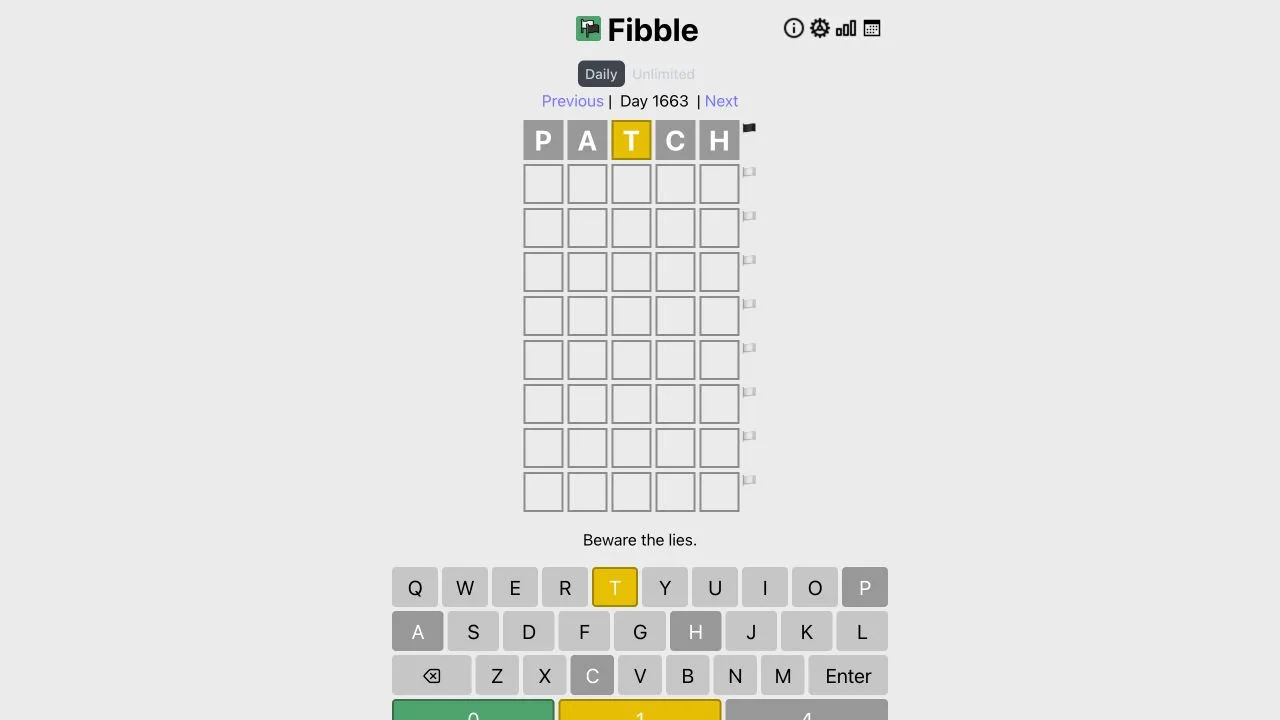
The board supplies an opening word, so you start with clues rather than an empty grid. Type a five-letter word and press Enter to submit. The familiar color meanings apply: green indicates the correct letter and position, yellow means the letter belongs elsewhere, and gray means it is absent. Exactly one tile per row misreports that feedback, including in the supplied opening row.
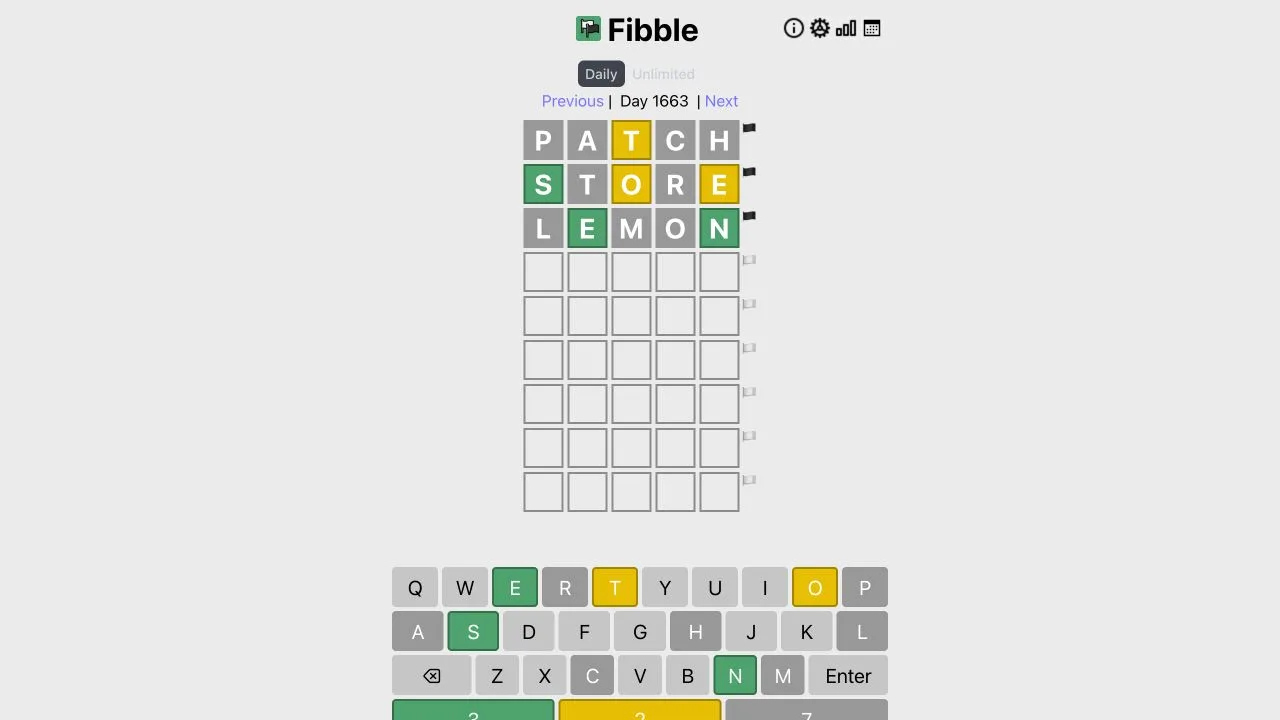
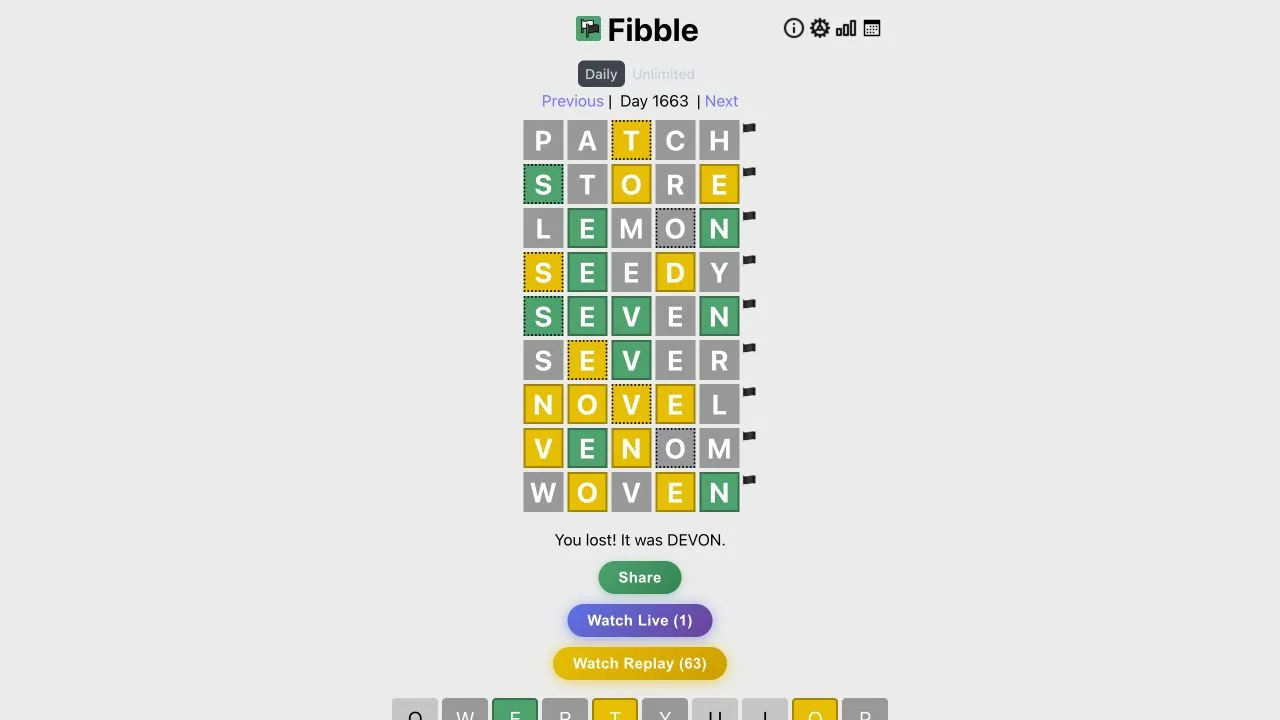
My opening word was PATCH, with a yellow T and four gray tiles. STORE then showed a gray T, a green S, yellow O and E, and a gray R. That T disagreement was a reason to investigate, rather than permission to discard either entire row. Each row still contained four truthful tiles. I followed with LEMON, which showed green E and N, but also a gray O despite the earlier yellow O.
The useful question is whether a possible answer would make exactly one tile false in each previous row. If it needs two lies in a row, reject that possibility. If it makes a row entirely truthful, it also fails the rule. Repeated letters need particular care: a gray copy does not automatically rule out every occurrence of that letter.
When four greens still mislead
After SEEDY, I tried SEVEN and saw green S, E, V and N. I treated the apparent S start too confidently. Later guesses, including SEVER and VENOM, did not rescue that assumption, and WOVEN used my final attempt. The game revealed the answer and outlined the lying tiles with dotted borders.
That ending made the mistake easy to inspect: the reassuring green S had been false. Fibble's challenge, in this test, came from keeping several explanations alive while resisting a familiar Wordle habit. A green square feels settled even when the rules explicitly say otherwise.
I also tried submitting SEVEN a second time. The game rejected the duplicate without spending another attempt. After the loss, Share copied the result successfully; I did not publish it anywhere.
Mark suspicions before trying hard mode
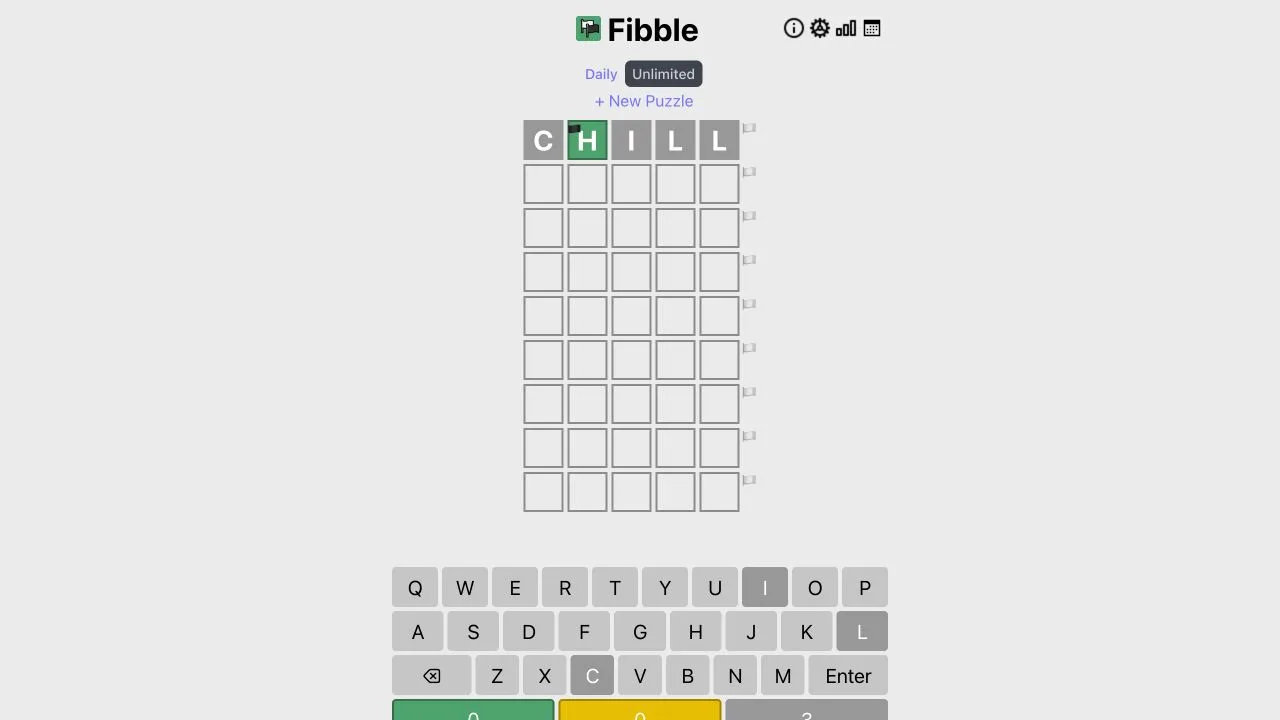
The flag controls provide a practical memory aid. In an Unlimited board beginning with CHILL, I selected the row's flag control and marked the green H as suspicious. This placed a black flag on the tile; it did not reveal whether my suspicion was correct. The instructions also describe right-clicking or long-pressing to highlight tiles you consider settled.
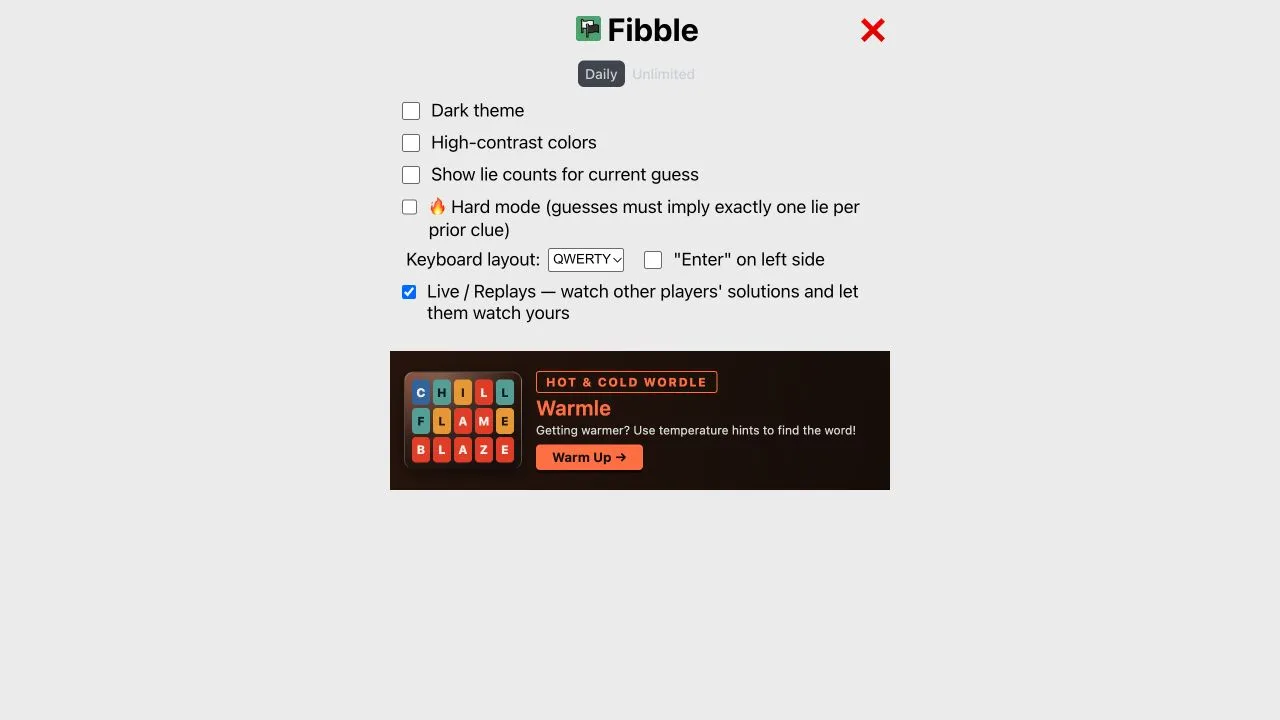
Settings include a lie-count option and a hard mode described as requiring guesses to imply exactly one lie per prior clue. I inspected those descriptions but completed my round with both options off. My advice after that loss is to write down or flag competing explanations before adding more guesses.
Daily play, Unlimited and older puzzles
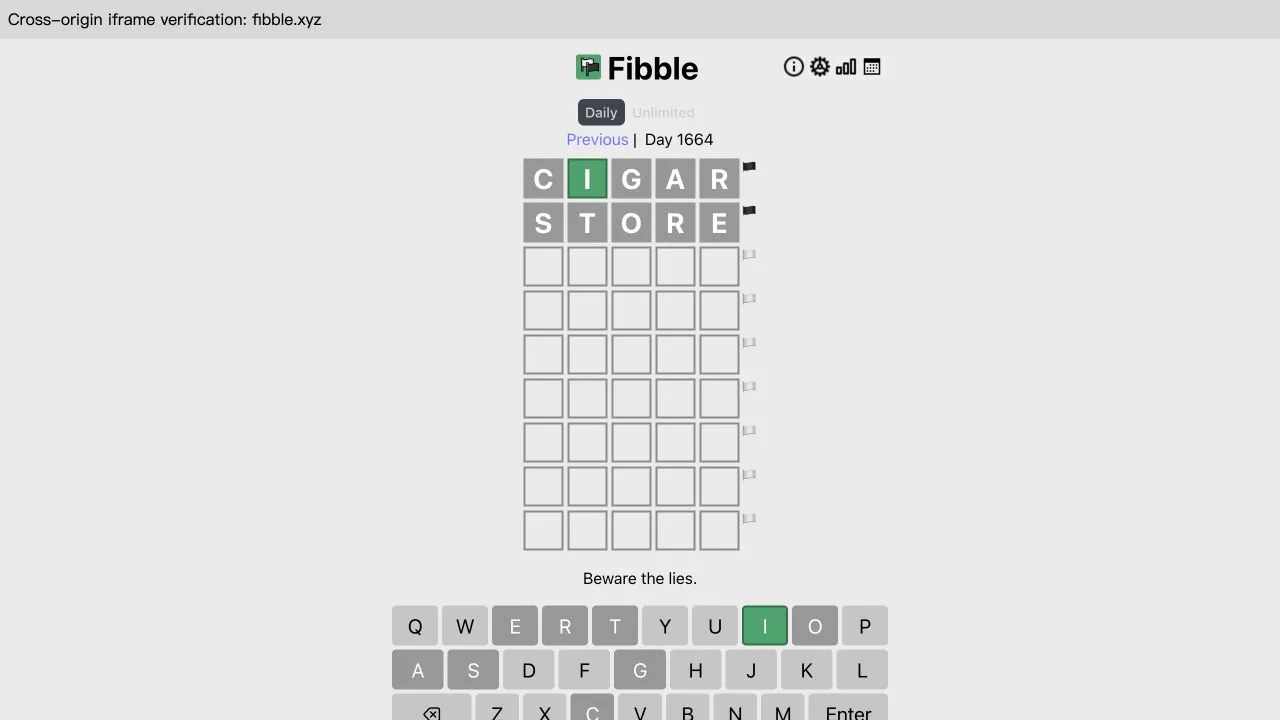
The Daily tab offers the shared puzzle, while Unlimited opens a separate board with a New Puzzle link. The Calendar and Previous controls let me select an older daily puzzle, which I used to avoid revealing today's answer. The official instructions say the lie positions are the same for everyone, giving daily players a common deduction problem to compare.
Fibble FAQ
How many guesses do you get in Fibble?
I had eight submitted guesses after the supplied opening word: nine rows altogether. The eighth unsuccessful submission ended the round.
Can a green tile be a lie?
Yes. Green, yellow and gray feedback can be false. In my completed round, a green S was one of the lies revealed at the end.
Does Fibble have an Unlimited mode?
Yes. Select Unlimited above the board. It provides a separate puzzle and a New Puzzle control, alongside the daily game and its calendar.