
Wordgy is a daily word chain puzzle about familiar phrases and compound words. You fill five missing words between two given endpoints, making each neighboring pair fit together. In a historical round, I got stuck on the perfectly familiar phrase “deep sea” because this particular chain needed a different continuation.
Build phrases, then follow the chain
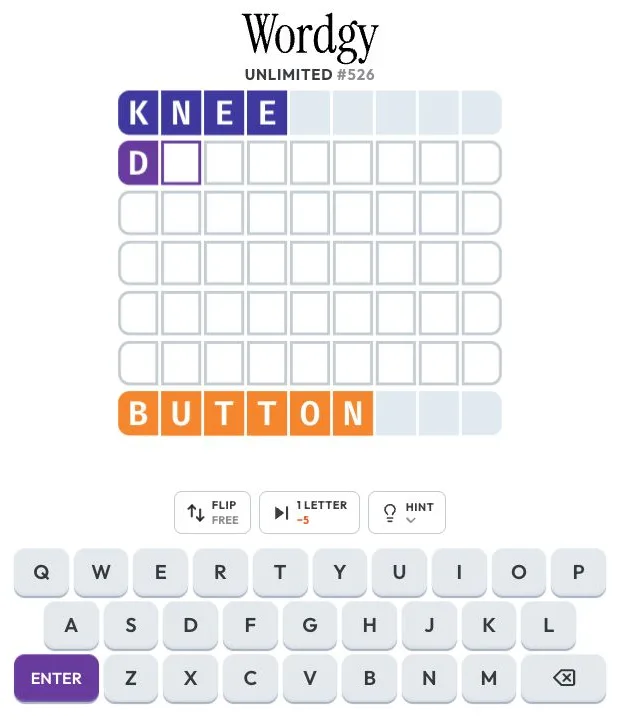
The opening board supplies its top and bottom words, with five empty rows between them. The active row begins with a revealed letter. Type the remaining letters and press Enter to submit; there is also an on-screen keyboard. You are looking for connections such as CHAIN REACTION and REACTION TIME, the example used in the rules.
That middle word matters twice: it finishes one phrase and begins another. This makes the puzzle more constrained than a free association exercise. A connection that sounds natural in isolation may still lead away from the intended chain.
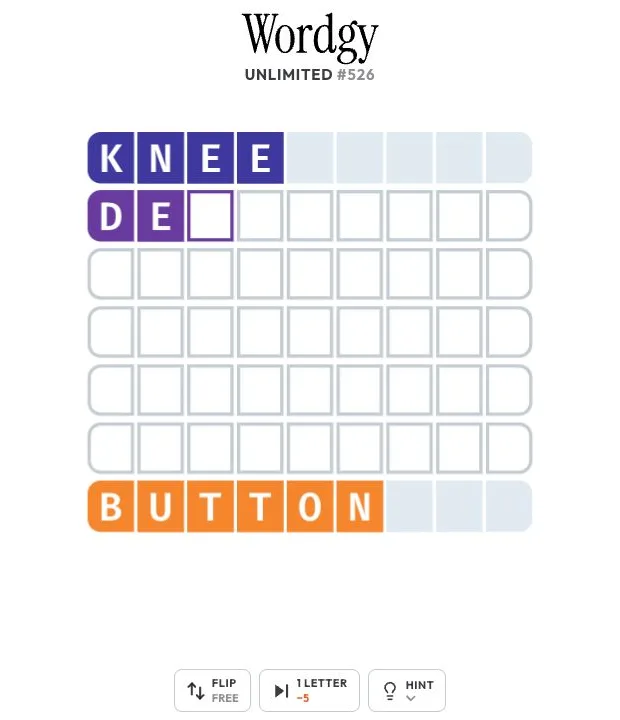
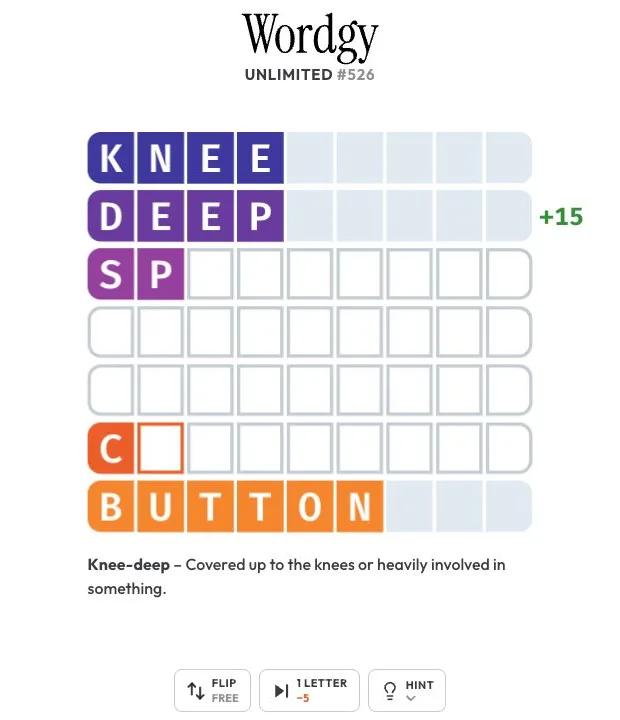
Historical puzzle #526 began with KNEE at the top and BUTTON at the bottom. I tried DROP after the initial D. The game rejected it, cleared the guessed suffix and revealed E, leaving DE as the next starting point. Completing DEEP worked, and the board supplied a short explanation of “knee-deep.”
The following row began with S. SEA seemed reasonable after DEEP, but it was rejected and the prefix became SP. SPACE eventually fitted. That sequence is the clearest lesson from my round: read a rejection as information about the target, rather than proof that the phrase you imagined does not exist. I did not test a broader dictionary or alternative-spelling policy.
Flip before spending points
The free Flip button switches the active end of the chain. It preserved my progress at the top and let me work backward from BUTTON, where a C was waiting. Thinking of words before BUTTON changed the question enough to get me moving again.
It still took an adjustment. CUFF was rejected, leaving CA. A Length hint then exposed a four-letter answer, which helped me reach CALL. Both Ls were accepted normally. Solving that connection opened the next word above it, so the two approaches could meet in the middle.
The useful habit here is to try both directions before buying more information. A blocked row may feel much easier once another adjacent word becomes visible. This worked in my completed round; it is a practical starting approach, rather than a guarantee of the fewest guesses.
Choose the information you actually need
The tools offer different kinds of help. Length shows how many letters the target contains and cost three points when I used it. The menu also offered a 50/50 option to gray out 13 letters for three points, although I did not activate that option.
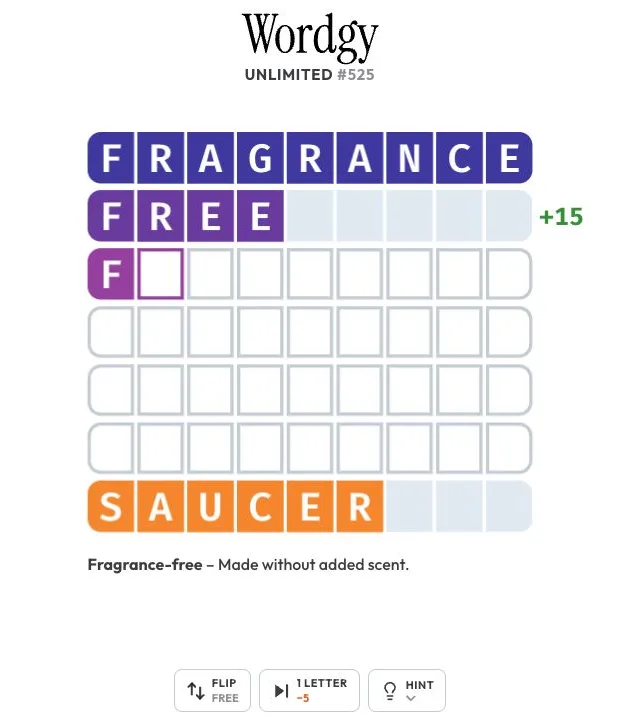
In a separate, unfinished sample of historical puzzle #525, I used 1 Letter. Its confirmation said revealing the next letter costs five points, the same as guessing wrong. It changed F to FR; entering EE completed FREE after FRAGRANCE. The accepted answer came with an explanation of “fragrance-free.”
Those explanations make the links easier to understand after acceptance. The decision before acceptance is less forgiving: use a length clue when word size is the obstacle, or a letter reveal when you need a firmer prefix, while remembering that either affects the available points.
Daily entry, historical practice
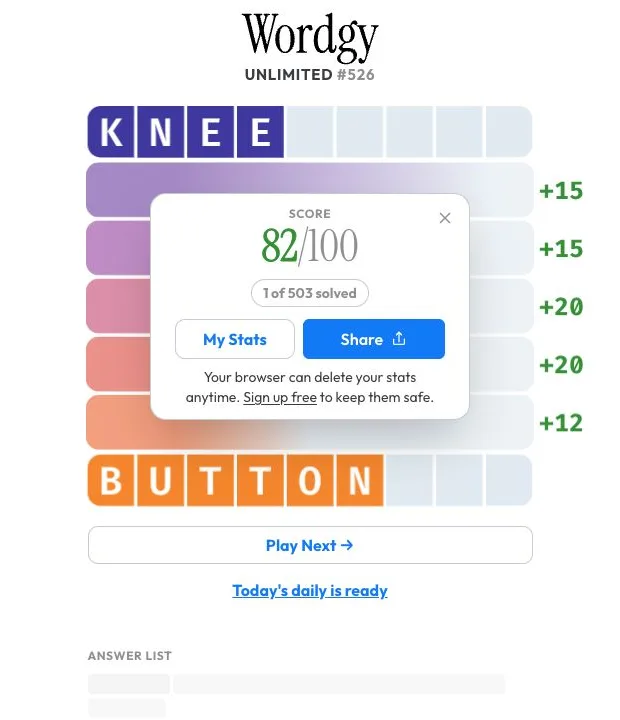
The site presents a daily puzzle alongside Unlimited and an archive. I completed #526 through the historical route and saw the result panel and Play Next control. That supplies a way to learn the format without treating an old puzzle as today's challenge.
Testing took place on October 27, 2026, in a desktop browser. Coverage was one completed historical chain and a short second sample; today's daily, mobile controls, account features and reset timing were not tested. The session included investigation and pauses, so it does not provide a useful completion-time estimate.