
Spotle is a daily music-artist guessing game in which you identify one hidden act from a pool the site labels as 1,000 artists. You type artist names and use six attribute comparisons to find the answer within ten guesses. I completed the September 6, 2026 archive puzzle in nine guesses; it tested music knowledge through career facts and colored feedback, rather than asking me to recognize a song from a clip.
How do the six clues narrow the artist?
Search for an artist, check the suggestion you are about to select, and submit it. Spotle then shows that artist's debut year, member count, popularity rank, gender, genre, and nationality. Green means an exact match. Some fields offer a yellow near match, while arrows on the year and rank tiles point toward the hidden act. The site's rules define debut as the first studio album, EP, or mixtape, and popularity as an all-time stream ranking.
My opening Taylor Swift guess matched the target on Solo, Female, Pop, and USA. Its 2006 debut pointed earlier; its #2 popularity rank pointed toward a less popular artist. Those four greens were useful, but they did not make the answer obvious. Lady Gaga and Katy Perry retained the same four matches, and Britney Spears and Whitney Houston pushed the debut range backward. The feedback was most helpful when I treated each row as a constraint, rather than a vague hot-or-cold score.
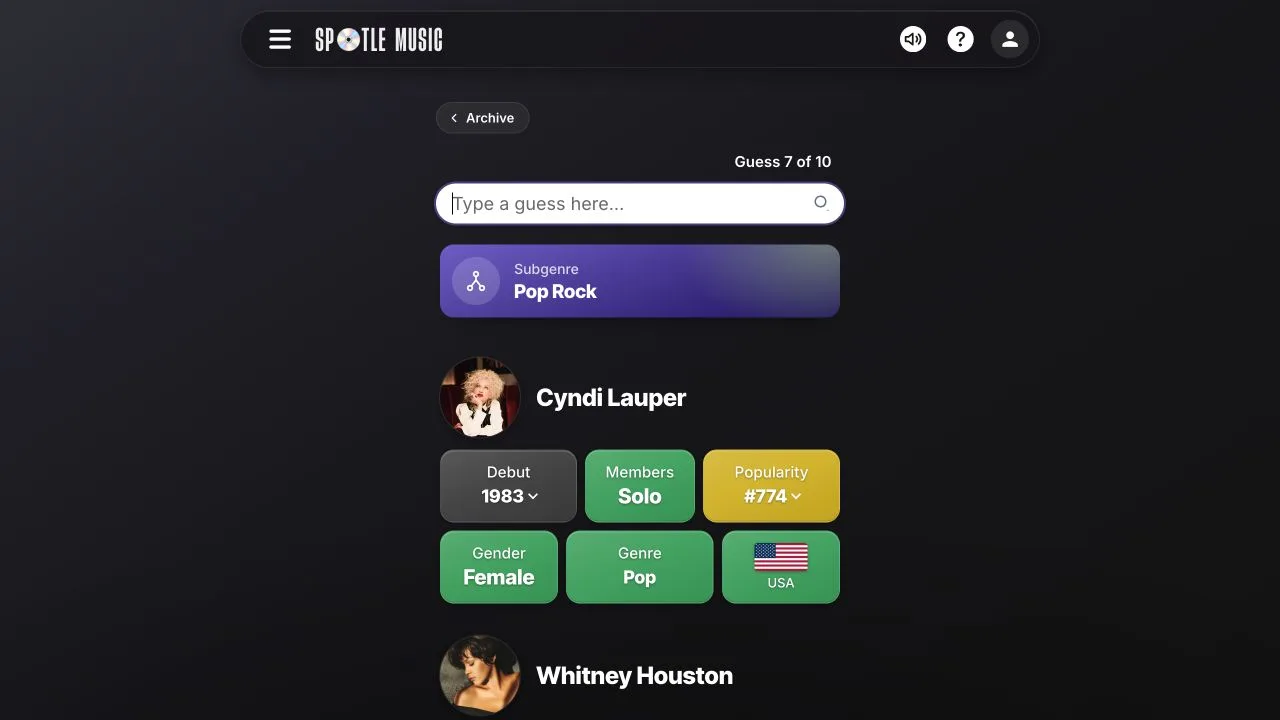
The yellow tiles are more precise than they first look. On guess six, Cyndi Lauper's #774 popularity rank was marked close, within 50 places, with an arrow toward lower popularity. Later, Pat Benatar's 1979 debut was close, within five years, and the arrow pointed earlier. Together these observations gave me a much tighter year and rank window for this particular puzzle. They do not establish a universal opening strategy; they show why reading the small arrows matters.
What happens after the sixth guess?
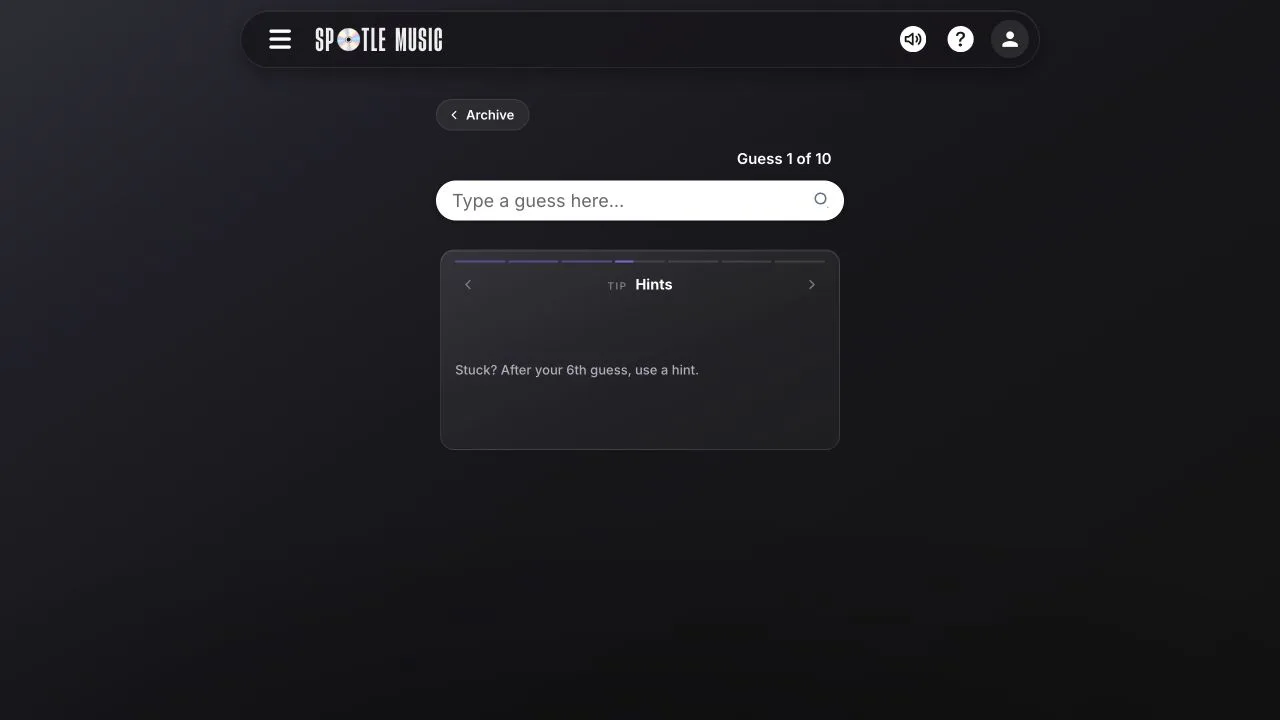
Spotle offered one free hint after my sixth guess. The choice was Subgenre, Collaborator, or Billboard, and the rules said the hint would not cost a guess. I chose Subgenre and got “Pop Rock.” That was a useful extra filter after several broad Pop matches, although it did not name the artist for me. The choice itself is worth considering: if the genre is already green but several candidates remain, a narrower style may help; a collaborator or chart fact might serve a different shortlist better.
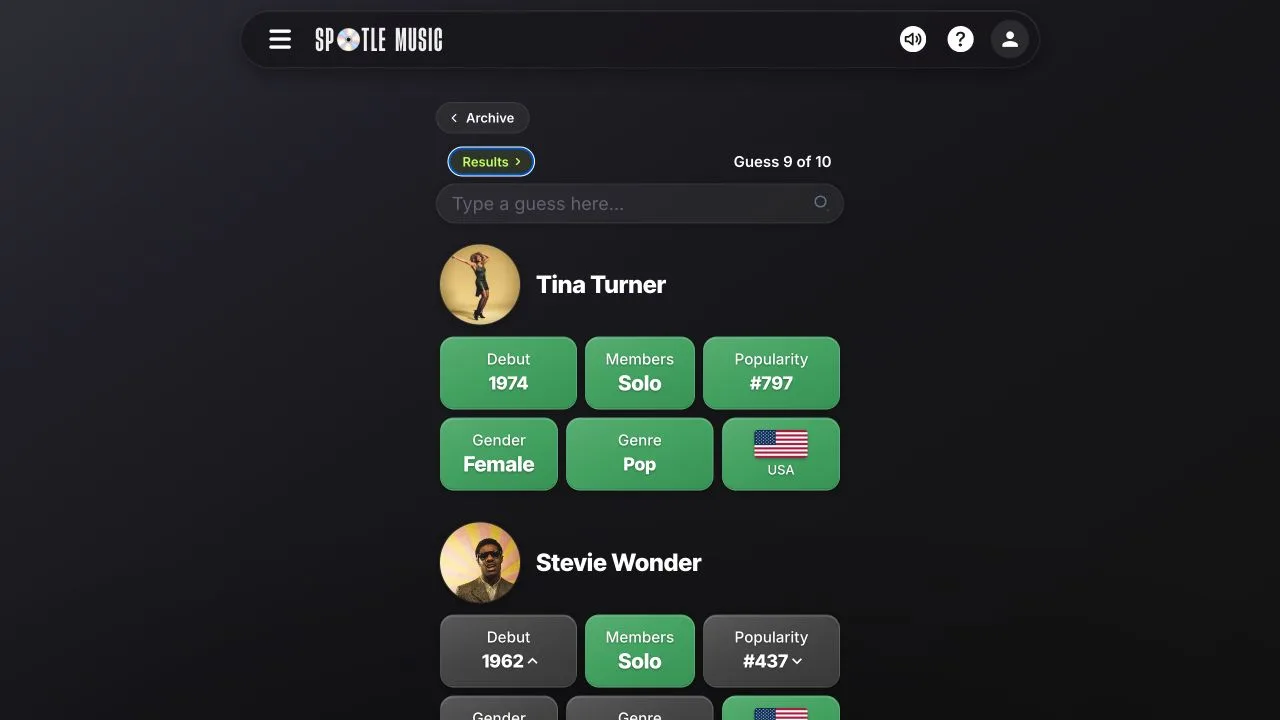
My next guess, Pat Benatar, supplied the near debut year but had Rock instead of the target's Pop label. The following turn was my own avoidable mistake. I meant to search for Stevie Nicks, pressed Return too quickly, and Spotle selected Stevie Wonder from the suggestions. That spent guess eight and produced a Male/R&B mismatch. The autocomplete is convenient, but verifying the highlighted name before submitting is a practical way to protect a limited turn.
Is the archive worth trying?
I solved the historical board on guess nine, with the final row turning all six attributes green. That late finish felt earned because the year, rank, and subgenre clues eventually converged, while the mistaken selection left little room to recover. The interface also showed a dated Archive with older puzzles, so you can learn the clue language on a past board before attempting the current daily one. My test covered one complete archive game on desktop, not today's challenge; I did not verify the daily reset hour, mobile behavior, accounts, or saved progress.
Spotle will suit players who enjoy placing musicians in time and comparing career profiles. In the historical round I played, no song excerpt was offered as a clue, so familiarity with discographies and artist categories mattered more than identifying a melody by ear. The single genre label can also make an otherwise plausible guess feel far away, which is another reason to weigh the numeric and nationality clues together instead of following one tile alone.