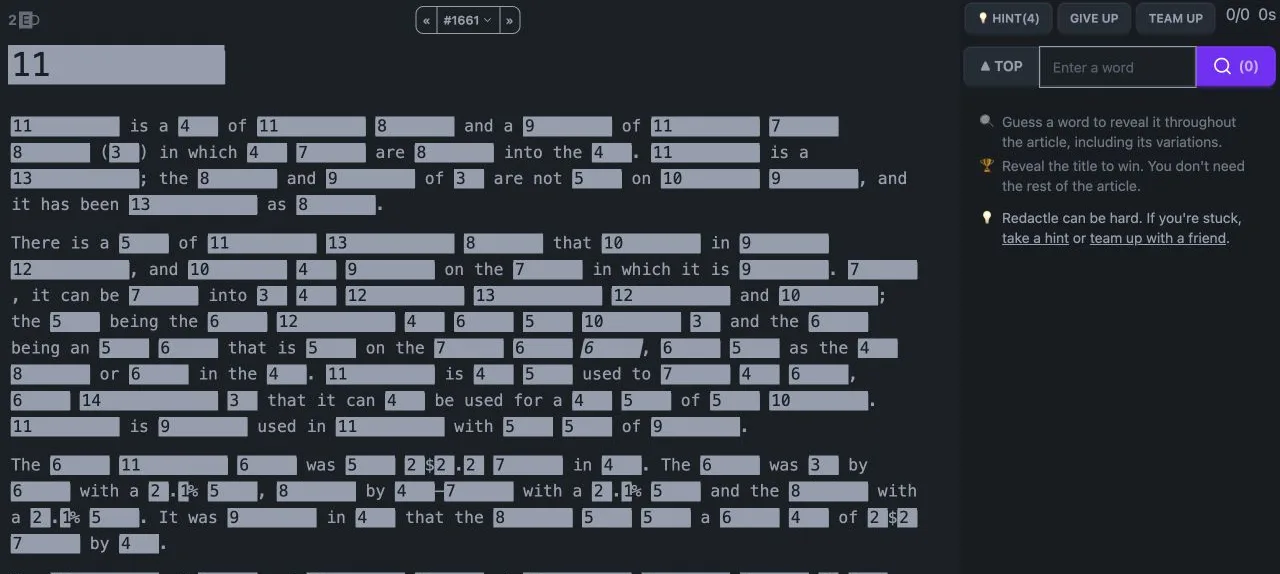

Redactle is a daily Wikipedia deduction game with most of an article hidden behind redactions. You enter words to uncover matching text, then identify the article's title to solve the puzzle. In our October 25, 2026 desktop test, an earlier puzzle turned from an opaque wall of numbered blanks into a recognizable subject after one useful noun.
Read the sentence before guessing the subject
The opening screen already gives you something to investigate: word lengths, punctuation, paragraph structure, and small connecting words. Historical puzzle #1661 had an eleven-letter title. Its first sentence contained two conspicuous stretches of text joined by “and,” but almost all the useful nouns were missing.
That structure matters because you are reconstructing an explanation, rather than simply listing things that might be Wikipedia articles. Look at where a missing word sits. Is the article defining a process, describing a person, or placing something within a larger category? Treat that as a working hypothesis, then choose a word that could help distinguish those possibilities.
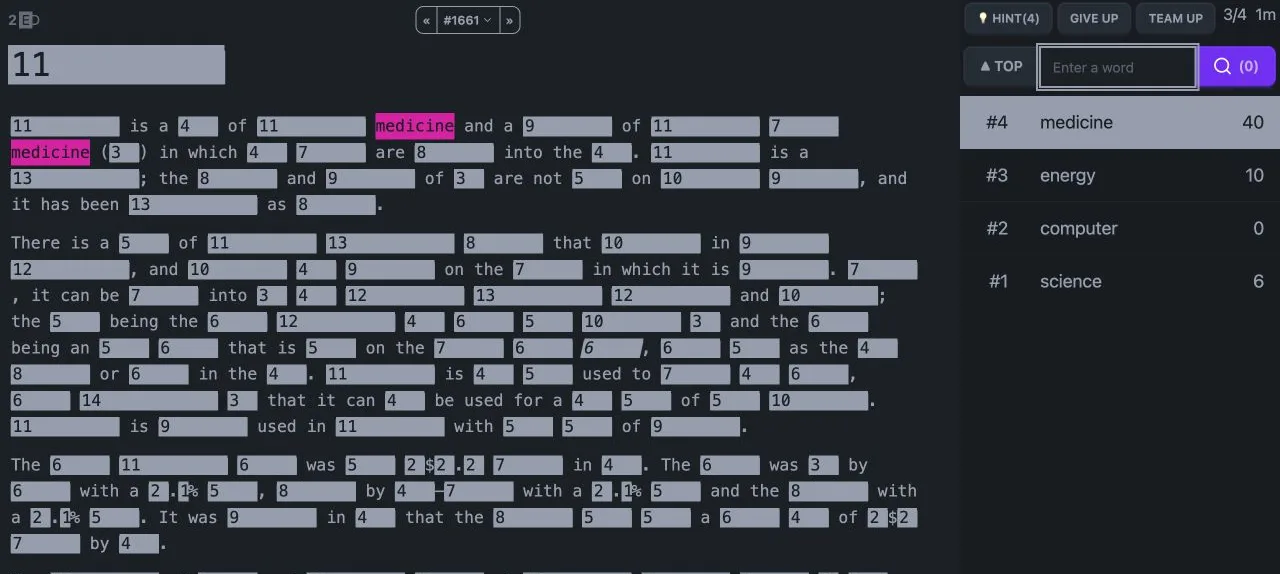
Our first guess, “science,” produced six matches. “Computer” produced none, and “energy” produced ten. Those broad guesses gave some information, but they did not make the opening definition readable. The breakthrough was “medicine”: forty matches, including two conspicuous appearances in the first paragraph. Their positions were more useful than the total alone.
A hit count is evidence about the text
Type a word into the guess box and submit it. The history records the guess and its match count; matching words become readable in the article. In the tested dark appearance, the currently selected matches were pink, making them easy to pick out against the gray redactions.
A zero is useful feedback too. “Computer” remained in our history with zero matches and counted toward the guess total. It was not a warning that the word was invalid. Equally, ten matches for “energy” were not a semantic closeness score. Read the revealed passages before deciding how strongly a guess supports your theory.
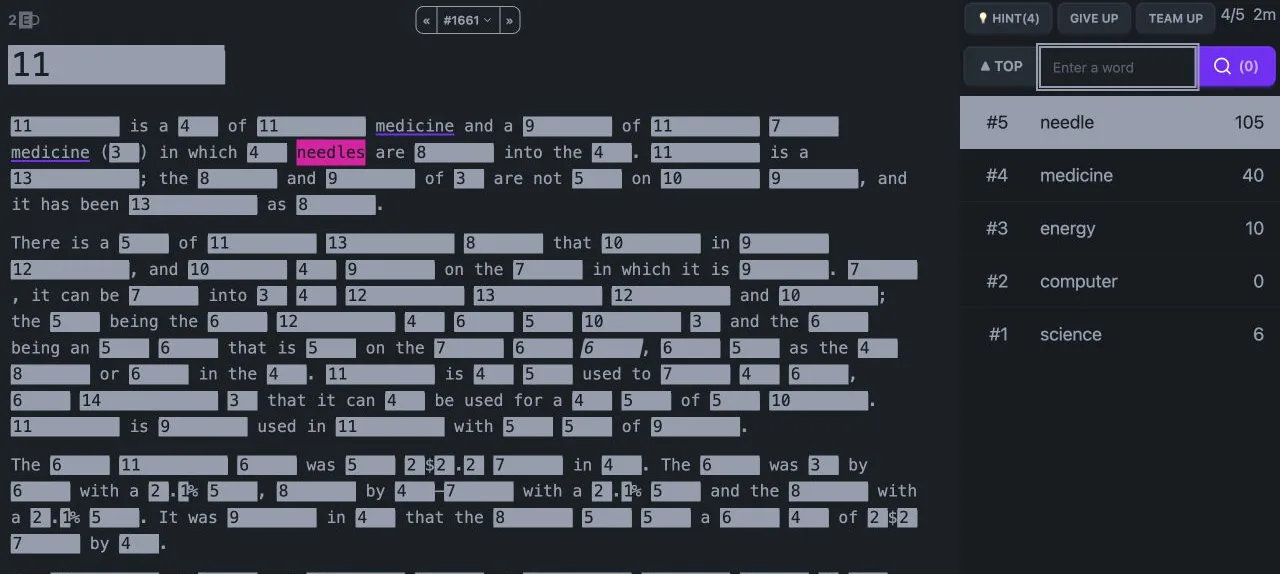
The next input showed why word forms matter. We entered the singular “needle,” received 105 matches, and saw “needles” revealed in the opening sentence. You therefore should not assume every remaining plural requires a separate guess. This demonstrates one accepted singular/plural relationship; it does not establish that every synonym, abbreviation, or spelling variation will work.
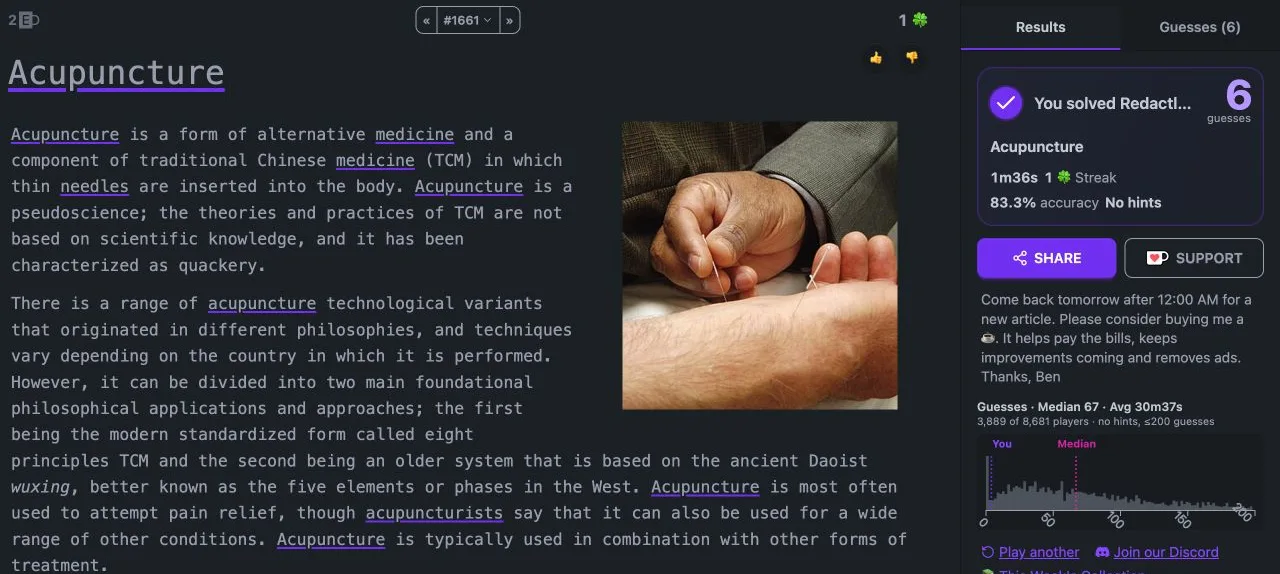
From there, the definition and eleven-letter title length pointed to a specific subject. Entering its title on guess six ended the puzzle and revealed the article. You do not have to uncover every word first.
What the result tells you
The result card reported six guesses, 83.3% accuracy, and no hints. Five of our six guesses had found text, which makes the accuracy figure understandable in this run. It is a different measure from how much of the article we uncovered.
The satisfying part was the change from broad topic hunting to reading a particular definition. For a first attempt, try an earlier puzzle and follow the location of your hits instead of chasing the largest number. Our previous-puzzle arrow opened #1661 normally. This was a historical solve, not a completed daily challenge, and the session included testing pauses, so its timer is not a reliable estimate of a typical player's session.
The current site's About page identifies Ben Brady as its operator and John Turner as the creator of the now inactive original Redactle. It also documents additional modes, but this review covers one historical main puzzle and basic input in the daily puzzle's embedded view. Mobile controls, accounts, progress synchronization, paid features, and the daily reset boundary were not tested.