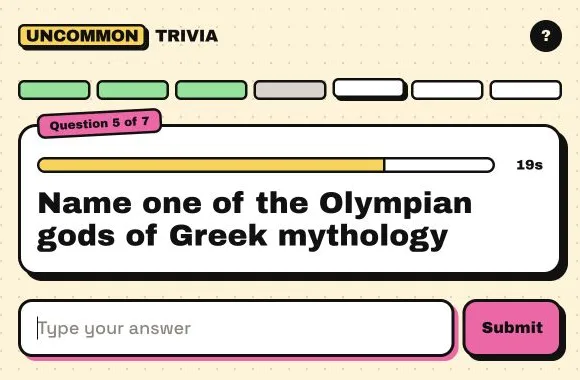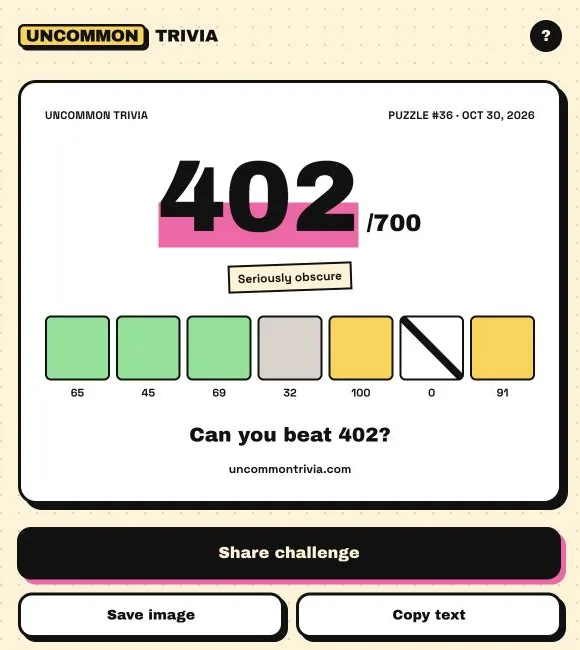

Uncommon Trivia is a daily trivia game where rarer correct answers earn more points. You type one answer to each of seven categories, with 25 seconds and a single submission per question. Our October 30, 2026 desktop round finished at 402/700, with two Legendary scores and one answer rejected by the game’s list.
Rarity means Wikipedia readership
The official scoring rules rank accepted answers using the median of their monthly English Wikipedia page views over the previous six full months. Correct entries earn between 10 and 100 points, making 700 the maximum across seven questions.
That definition matters when choosing an answer. You are estimating how much an answer’s Wikipedia page is read; the documented formula does not use the proportion of today’s players who chose it. An answer that feels obscure to you can still earn a middling score.
Our second submission earned 45 points, despite our expectation that it would be a strong rarity pick. Its feedback reported 37k monthly views and said it was rarer than nine of the 23 other answers. The fifth earned 100 points with 32k views, beating all 12 alternatives in that category. The scores are relative to each category’s answer pool, so those two readership totals cannot be compared as a universal points scale.
After each accepted submission, the game showed the rarity tier, points, monthly views and three rarest alternatives. We could read that explanation before pressing Next and starting the following question. That pause made the feedback useful without spending the next question’s timer.
A rejected answer spends the question
The sharpest setback in puzzle #36 came on the sixth question. Our entry returned “Not on our list” and zero points. The next available action was Next, rather than another attempt. Our final question then earned 91 points, bringing the complete sequence to 65, 45, 69, 32, 100, 0, 91.
That failure changes the advice: keep a familiar fallback in mind while considering something more obscure. With one submission, chasing rarity also means taking a risk on the accepted list. Our rejected entry establishes that boundary in this round; it does not measure how complete every category is.
The rules describe tolerance for one small typo in unambiguous answers of at least five characters. We used ordinary typed entries, so that documented allowance should not be treated as a tested guarantee for an unfamiliar spelling.
The result card keeps answers hidden
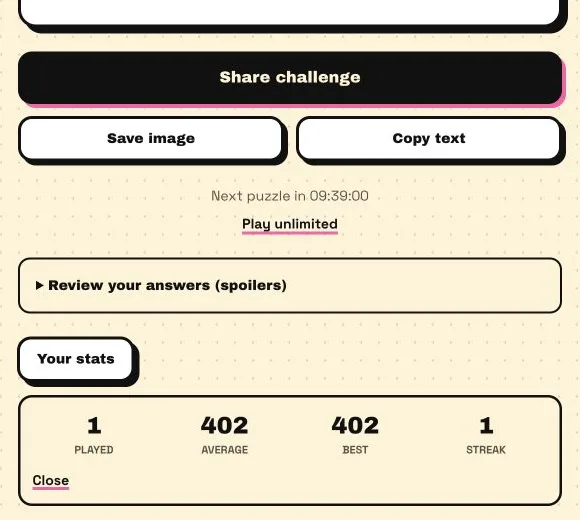
Our finished card displayed “Seriously obscure”, seven colored score tiles and the 402-point total. Specific answers stayed inside a collapsed section labelled “Review your answers (spoilers)”. The stats panel showed one game played, an average and best of 402, and a streak of one.
The daily round was completed without solution help. It is the basis for the score examples here; mobile typing and the archive were outside this test. The rules also describe an Unlimited mode for extra random rounds and a daily reset at 00:00 UTC. For learning from a missed category, read the three rarest alternatives before moving on: they explain what the accepted list rewarded, even when your own intuition about rarity was off.