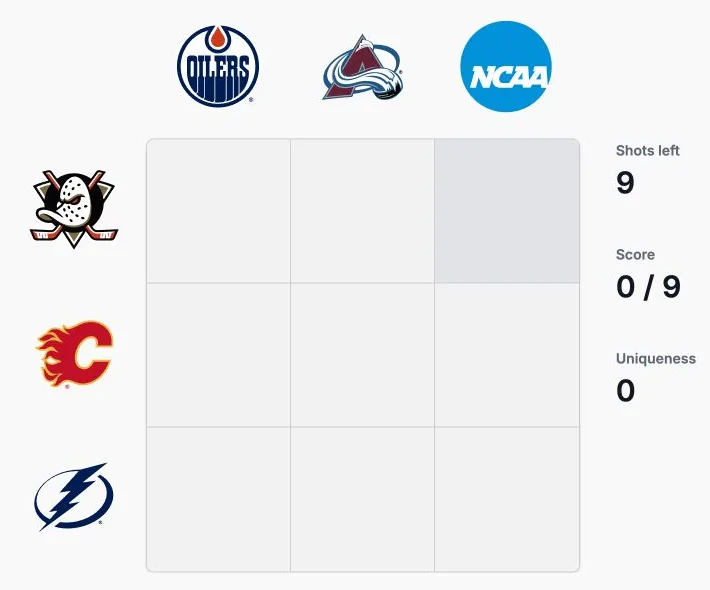

Puckdoku is a daily hockey trivia game built around a three-by-three player grid. In Classic mode, you fill each square with a player who satisfies both its row and column, starting with nine shots for nine spaces. The difficult part is remembering a career that fits both labels, even when the search box readily finds the name you have in mind.
A search result is not a valid answer
Our desktop test on October 25, 2026 used the live Classic puzzle identified by its stats link as October 24. Its rows were Anaheim, Calgary, and Tampa Bay; its columns were Edmonton, Colorado, and NCAA. That created two kinds of recall: players connected to two NHL teams, and players connecting an NHL team with college hockey.
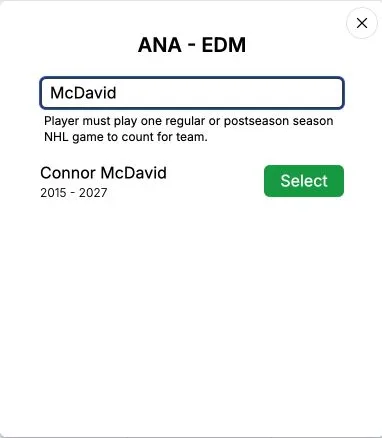
Select a square, type a surname, then choose a player from the results. The selection window repeats the intersection above the search field, which helps when moving between similar team combinations. It also displays a reminder that a player needs at least one regular-season or postseason NHL game to count for a team.
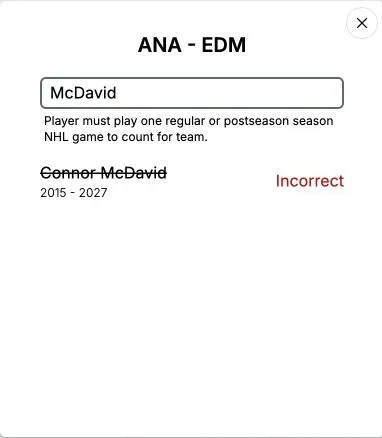
We deliberately selected Connor McDavid for Anaheim–Edmonton to check an invalid submission. His name appeared in search with a Select button, but submitting it produced a red “Incorrect” label and a strikethrough. The shot counter fell from nine to eight while the board remained empty. Search is a player lookup, so appearing there does not certify eligibility for the selected square.
A replacement selection was accepted in that same square and displayed 12%. Later correct selections filled and locked their cells. Searching another surname returned several different players, making the final choice of person an important step rather than a formality. Read the full result before selecting, especially when relatives or namesakes appear together.
Nine shots, then a separate chance to finish
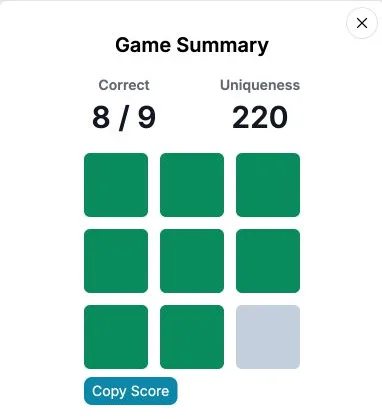
Each submitted selection costs a shot, including an incorrect one. With nine starting shots and nine cells, an error leaves no spare attempt for a perfect initial completion. Our test reached eight filled squares after nine submissions, with the final NCAA intersection empty. The summary showed 8/9, eight green blocks, one gray block, and a uniqueness total of 220.
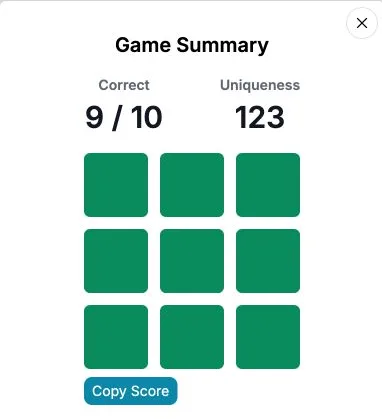
The menu offered Keep Going. Using it reopened the remaining square, and one more accepted selection completed the grid. The subsequent Game Summary showed 9/10 and uniqueness 123. A separate winner prompt showed 9/9, so the clearest account is nine correct selections from ten total attempts after continuing. Finishing through Keep Going should not be confused with completing the original nine-shot challenge.
This distinction makes experimenting less frustrating: the initial result remains meaningful, while a mistaken choice need not stop you from resolving the last connection. It also explains why a fully green summary can carry a denominator larger than nine.
Check eligibility before chasing uniqueness
The instructions say a player can be used only once. They also distinguish team membership from stricter category intersections: for a team paired with an award or season statistic, the achievement must belong to that team in the relevant season. Two statistical categories need not have been achieved in the same season, and a traded player's season totals are not combined across teams. Those are documented rules; our grid tested team and NCAA intersections, not award or statistical thresholds.
The rules describe uniqueness as the sum of selected-player percentages, with 100 added for each empty square, and say lower is better. Treat that as the game's stated scoring explanation, not a formula deduced from our final total. Individual accepted selections in our session displayed percentages ranging from 2% to 39%; those figures belong to that session and do not establish permanent rarity.
For this board, a useful approach was to separate remembering a name from checking the actual intersection, then resolve the team connections we knew before spending a shot on uncertain college history. One completed grid supports that practical caution, not a universally optimal strategy. The interface leaves room to think, but it cannot supply the hockey knowledge the categories demand. This review covers desktop Classic play only; other modes, mobile controls, account persistence, and paid features were not tested.