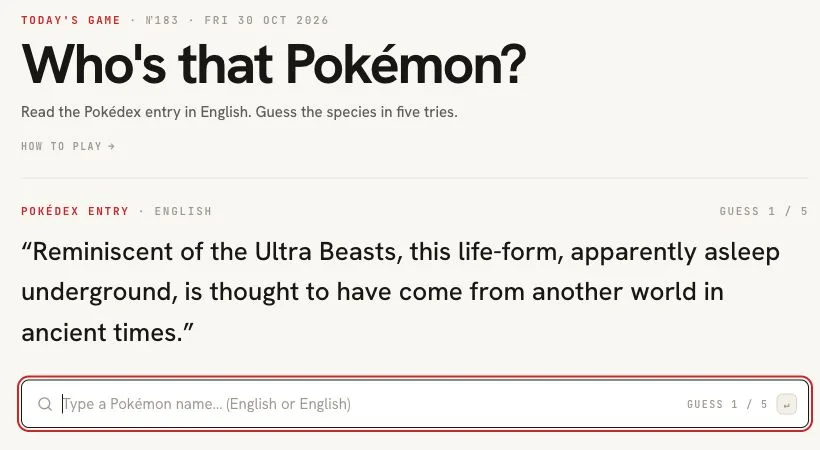

Pokelingo’s daily “Who’s that Pokémon?” riddle asks you to identify a species from a Pokédex entry within five guesses. Type a name, select a suggestion, then use type, generation and height feedback to refine the next attempt. We completed English puzzle #183 on October 30, 2026, in two guesses; the first wrong species supplied more useful information than the entry alone.
Turn the entry into a shortlist
The opening clue described an ancient, otherworldly life-form and mentioned Ultra Beasts. We tried Nihilego. Typing the name brought up a suggestion showing its number and Rock/Poison typing; selecting that row immediately submitted it. Check the suggested species before clicking, because that selection spends a guess.
Nihilego was wrong, but its row gave us three different constraints. Rock and Poison were crossed out, generation 7 had a green check, and the height of 1.2 metres had an upward arrow. For our next candidate, we therefore kept generation 7, discarded those two types and looked for a taller species that still fitted the description. The second selection solved the riddle.
That combination is the useful part: recognising a phrase gets you started, while the comparison row can correct a plausible but mistaken association.
Read arrows alongside the numbers
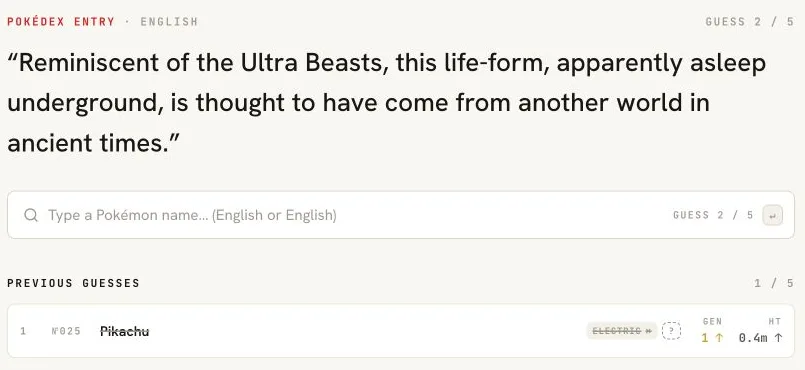
The number in a wrong row describes your submitted Pokémon. The arrow tells you which way to move from it. In a separate iframe check, Pikachu produced an upward generation arrow beside 1 and an upward height arrow beside 0.4 metres. Electric was also ruled out. Those clues pointed toward a later-generation, taller candidate with different typing.
We also typed an unrecognised string and pressed Enter during that check. No suggestion or guess row appeared, and the counter stayed at 2/5. Selecting a recognised species, rather than merely entering text, was what advanced our tested attempts.
Language choice and the next puzzle
We played in English. The official guide documents nine supported languages and accepts either English names or names in the chosen language. That gives language learners a way to read the entry without also having to produce the translated species name. Our submitted names were English in both the original round and the iframe check.
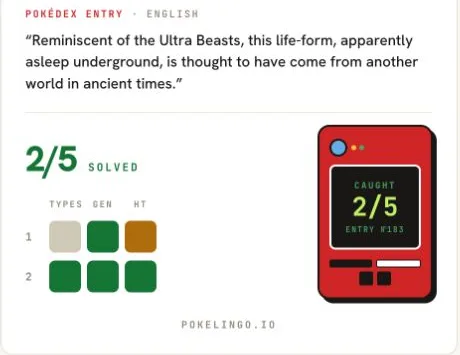
Our signed-out daily round reached a result card showing 2/5 and coloured feedback rows. The guide says past puzzles require signing in, so the archive is not an immediately available signed-out practice route. For the daily attempt, keep returning to the wording after each row: a matching generation narrows the field, but the description still has to fit the species you choose.