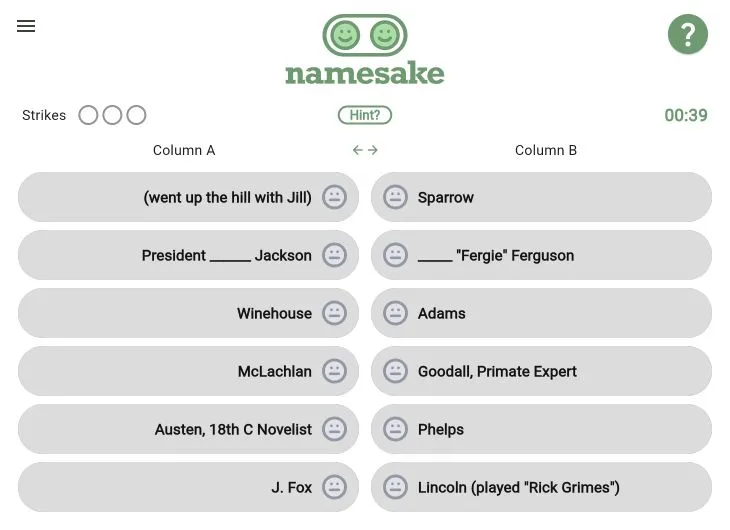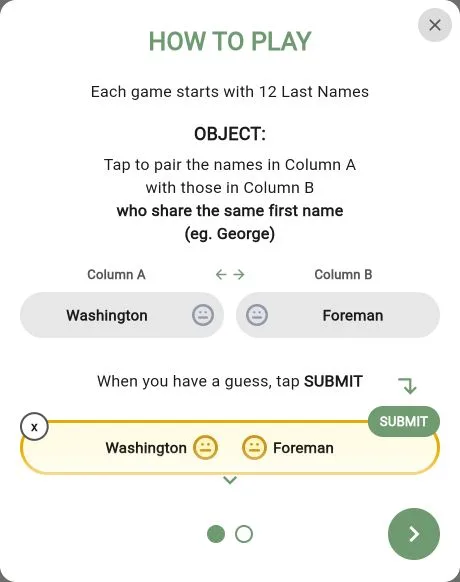

Namesake is a daily trivia puzzle that asks you to pair famous people and fictional characters who share a first name. Choose one clue from Column A and one from Column B, then press SUBMIT to work through six pairs.
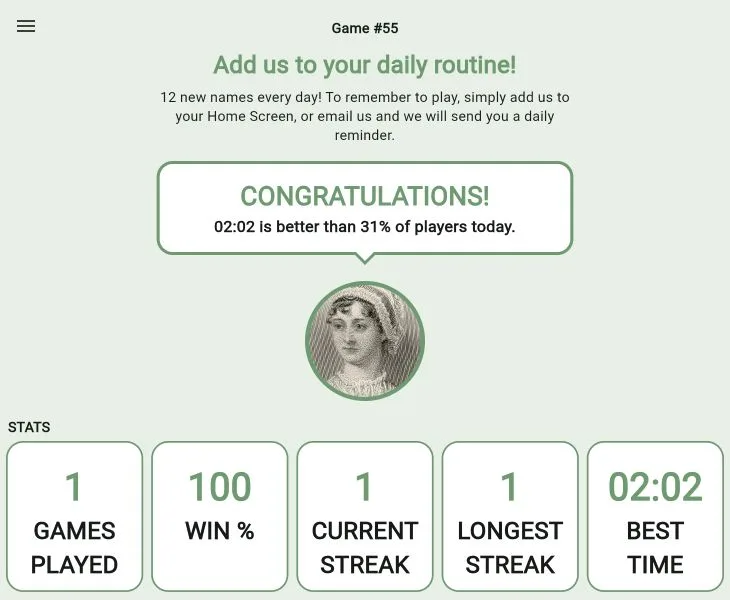
Our November 3, 2026 desktop game, No. 55, ended with all six pairs correct, no hints and no strikes. The interesting part was identifying which person each surname meant before looking for their namesake.
Identify the person before pairing the surname
The board mixed bare surnames with more specific descriptions. “Austen, 18th C Novelist” narrowed one identity, while “Lincoln (played ‘Rick Grimes’)” pointed to an actor rather than the president. That distinction matters: a familiar surname can send you toward the wrong first name.
We began with a nursery-rhyme clue. Selecting it and a clue in the opposite column pulled both into an orange outlined row with a SUBMIT button and a small cancel control. The remaining right-column clues shifted position, so check the selected row rather than relying on where a name was a moment ago.
You do not type the shared first name. After our first successful submission, an “Exactly!” popup supplied it alongside portraits and short descriptions of both identities. Later successes produced similar reveals, and completed rows turned green. Those descriptions made each match a small identification payoff rather than just a disappearing tile.
Hints and mistakes add time
The in-game instructions say holding a name reveals a hint about that person and adds 30 seconds. They also specify a 30-second penalty for each wrong guess and game over after three wrong guesses. Our zero-strike round did not exercise those penalties, so treat these as documented rules rather than measured error outcomes.
Start with identities you can place confidently, then reconsider ambiguous surnames among the remaining clues. That approach worked on No. 55; one completed board cannot establish how demanding other days will be.
The result screen showed 02:02, one game played and a streak of one. Tutorial reading and capture pauses affected the session, so that number is not a reliable estimate of normal solving time. If the clock distracts from recalling names, the instructions point to an option to turn it off in Settings; we left it running.