
Goatle is a daily trivia game with three rounds of list questions. Before each round, roll dice for time and letter hints, then type any five valid answers before the countdown ends. In our archive run, a four-letter word question proved more awkward than naming five Pixar films, even though both used the same five-slot format.
Roll first, then start the clock
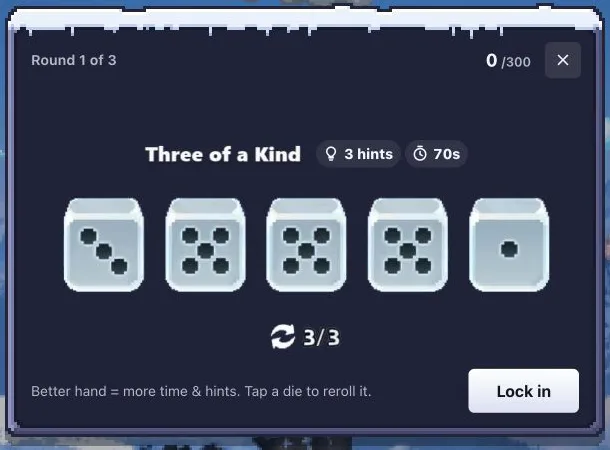
The dice stage gives you a small decision before you know the question. Tap a die to reroll it, with three rerolls available per round, then choose Lock in to reveal the prompt and begin answering. The current instructions assign resources like this:
| Dice combination | Time | Hints |
|---|---|---|
| Five of a Kind | 90 seconds | 5 |
| Four of a Kind | 80 seconds | 4 |
| Full House | 75 seconds | 3 |
| Straight or Three of a Kind | 70 seconds | 3 |
| Two Pair | 60 seconds | 2 |
| Pair | 50 seconds | 2 |
| High Card | 40 seconds | 2 |
Our first hand was Three of a Kind, worth 70 seconds and three hints. A reroll returned the same face and still used one of the three attempts: spending a reroll does not guarantee a better hand. Round two started with Four of a Kind, giving us 80 seconds and four hints without further rerolling.
Five answers means five that fit the whole question
Each prompt has 10–50 valid answers, according to the instructions. You need any five, so start with examples you can recall confidently rather than hunting for an obscure response. Unlike Wordle, the task is not to deduce one hidden word.
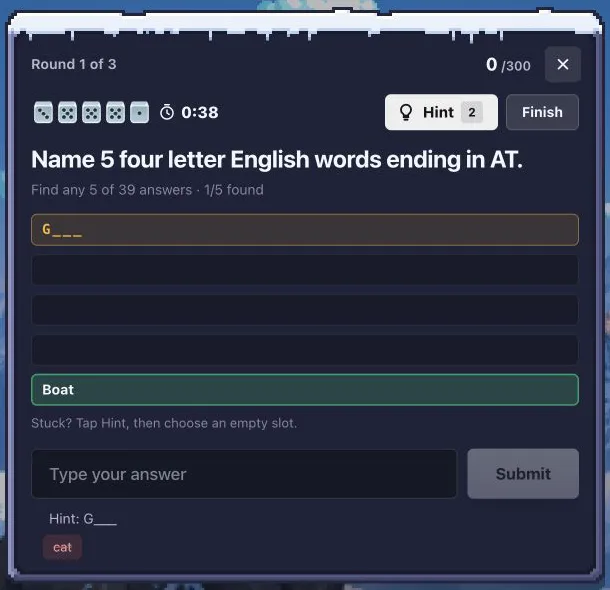
Our first prompt asked for four-letter English words ending in AT. We entered “cat,” overlooking the length requirement, and received “Not on this list.” “Boat” was accepted and appeared in a green slot. The mistake is a useful reminder to read every condition before typing: a familiar association can still fail the actual question.
The rules say wrong guesses cost nothing, but the countdown continues while you think and submit. Rejected guesses remained visible below the input. That makes switching to a different candidate more useful than repeatedly trying the same rejected response.
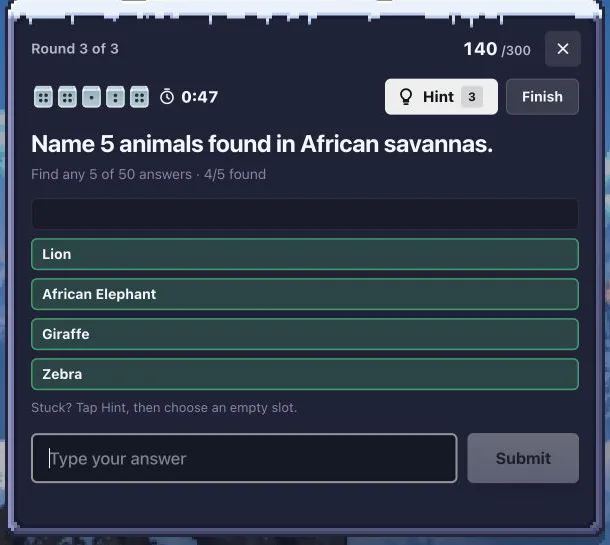
In the animal round, entering “elephant” produced the displayed answer “African Elephant.” That particular shorter name worked; we did not test enough variants to promise broad spelling or synonym tolerance.
Use a hint on a specific empty slot
Press Hint, then select an empty answer slot. In the word round, this revealed “G___” and reduced our remaining hints from three to two. We subsequently entered “goat,” which was accepted. The clue helped retrieve an answer, but it did not fill the slot automatically.
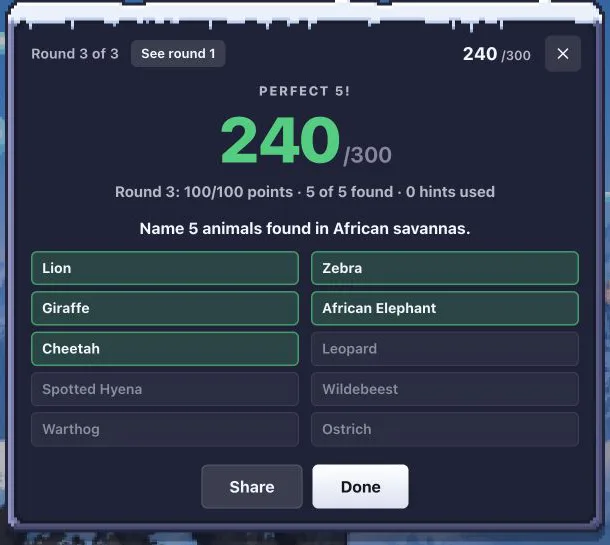
We finished that round with two answers before time expired. The result awarded 40/100 points and recorded one hint used. The instructions specify 20 points per accepted answer, with 100 available per round and 300 across the day. Five accepted Pixar film titles earned the full 100 in round two without hints; the final animal round also earned 100. Our completed total was 240/300.
Try an archived day before judging the difficulty
The archive let us select a previous date without signing in. Its notice says replays save on the current device and do not count toward that day's scores, making it a useful place to learn the controls before attempting the current daily set.
Testing took place on 24 October 2026, using all three rounds of archived puzzle #19, dated 23 October, in a desktop browser iframe. The first-round timer included pauses to inspect and document feedback, so its timeout is not a typical completion-time estimate. One set also cannot establish how difficult future topics will be. Hardmode was visible, but its rules were not verified; mobile play and account features were not tested.