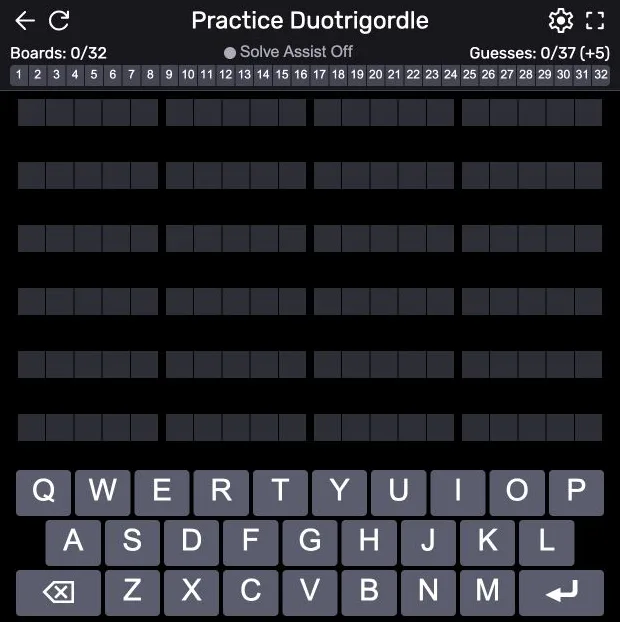

Duotrigordle is a daily word puzzle that asks you to solve 32 five-letter words with one shared set of 37 guesses. Every submitted word supplies separate Wordle-style color clues across the unfinished boards, and a Practice option lets you learn outside the daily challenge. In my standard Practice run, I solved 17 boards before spending enough unsuccessful guesses to make a complete finish impossible.
One word, many different clues
Enter a five-letter English word and submit it with Enter or the on-screen return key. Green marks a letter in its correct position, yellow places it elsewhere in that board's word, and gray marks an unsuccessful letter match. Read each board independently: the same guess can be useful in several places for different reasons.
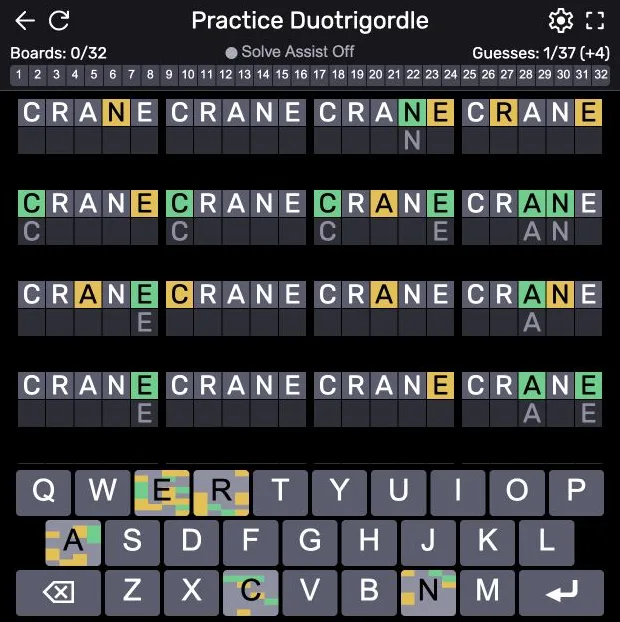
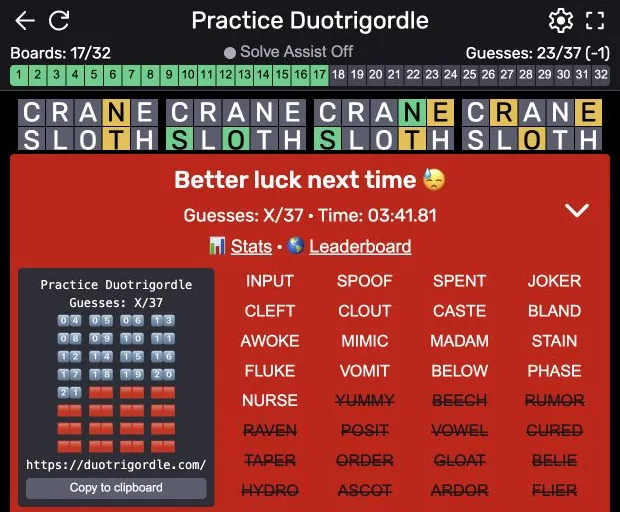
My opening CRANE demonstrated this immediately. On the first board, N was yellow; on the third, N was green and E was yellow. The guess counter advanced just once, despite the wall of feedback. With input hints enabled, faint letters also appeared in the next row at confirmed green positions.
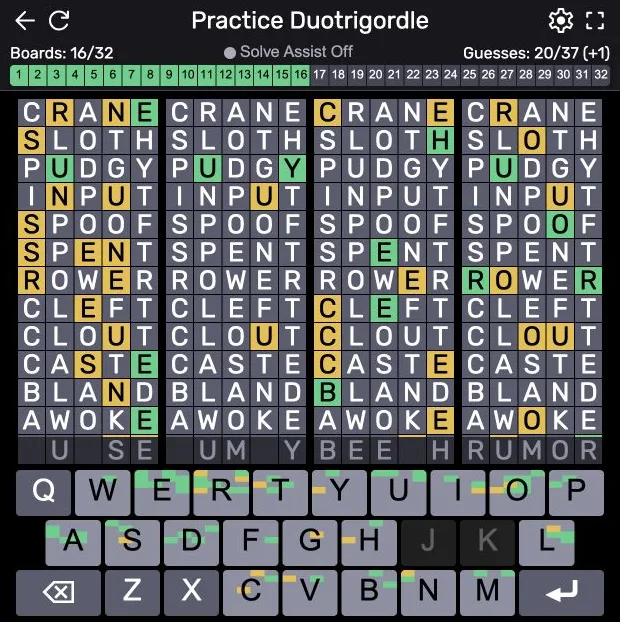
I followed with SLOTH and PUDGY to test more letters. INPUT then completed the first board on guess four. That sequence gave me a workable start, but one run does not establish an optimal opening trio. A deliberately invalid ZZZZZ submission earlier in the run did not advance the guess counter; I did not establish the game's full dictionary or spelling policy.
Watch the margin before chasing a stubborn board
The header's extra number beside the guess count deserves attention. At the start it showed +5. By the time I had solved 16 boards in 20 guesses, it had fallen to +1: there was little room left for guesses that did not complete anything.
A useful recovery came on the fourth board. ROWER helped establish O in the second position, E in the fourth and R in the fifth, without solving it. Later, AWOKE supplied a yellow K there. JOKER combined those clues and completed that board. The benefit was not just finding another word; a guess aimed elsewhere had contributed information to a previous sticking point.
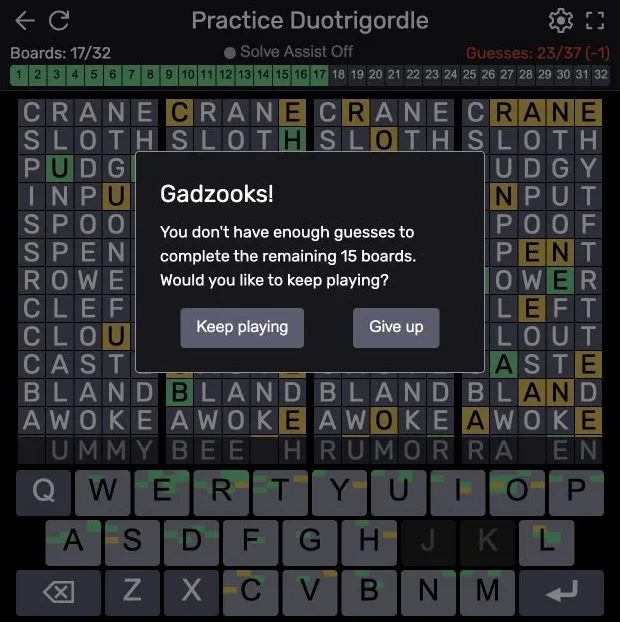
My ending shows the cost of ignoring that wider picture. After NURSE brought the total to 17 solved, I tried DUMMY and then GUMMY without completing another board. At 23/37 guesses, the margin read -1. The game warned that the remaining 14 guesses could not complete the remaining 15 boards and offered Keep playing or Give up.
I chose Give up and received an X/37 failure result. This was an explicit loss, not a session that exhausted all 37 entries. My practical adjustment for another attempt would be to scan the other unfinished boards before spending consecutive guesses on similar candidates. That is a lesson from this failure, rather than a demonstrated winning method.
Reduce the wall of tiles
On the tested desktop layout, several boards appeared together and the rest required moving through the page. The numbered strip tracked solved boards. Turning on Hide Completed Boards through Settings removed finished puzzles from the working view, making it easier to focus on what remained.
The keyboard's multicolored letter patches and the faint green-position reminders help organize a lot of information, although the dense display still demands careful reading. I kept Solve Assist off throughout. The official instructions describe that optional feature as making logical deductions without consulting a word list; I did not test its solving behavior.
What this Practice run covers
Testing took place on October 28, 2026, in a desktop browser using standard Practice. Daily, Sequence and Jumble entries were visible, but those challenges were not played. The screenshots show a Practice puzzle, including its failed result, rather than today's daily answers.
The session included investigation and pauses, so its displayed timer is not a useful completion-time estimate. Mobile controls, accounts, persistence, paid features and the daily reset time remain unverified. Practice is the mode I used to learn how much a few speculative guesses can cost before attempting the daily format.