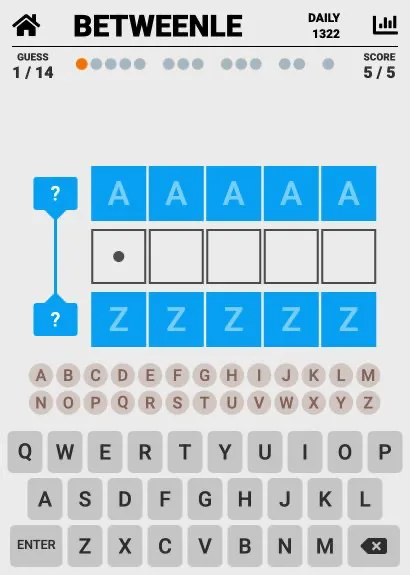

Betweenle is Nebula Bytes’ daily five-letter word puzzle built around alphabetical order. Enter a valid word, then use the upper and lower dictionary boundaries, orange dot and distance numbers to find the hidden word within 14 guesses.
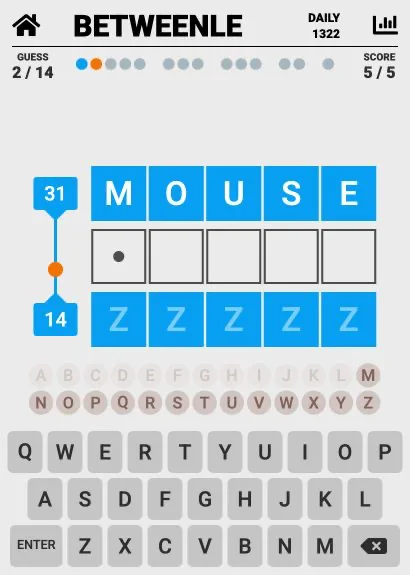
Our Daily #1322 run on October 28–29, 2026 started with MOUSE. It became the upper boundary: the answer came later in the dictionary, with a displayed distance of 31 above and 14 below. We completed that round unaided in 11 guesses for 3/5 trophies.
Read the distances as dictionary positions
The official Help defines these numbers as percentages of the whole game dictionary. Read them as dictionary distance rather than a count of remaining words. The orange dot indicates whether the answer is closer to the upper or lower boundary. Neither clue tells you which letters match.
Our second guess, TIGER, became the lower boundary. That made the next task concrete: think of a word after MOUSE but before TIGER. We chose STONE, which replaced the upper boundary and reduced its distance to 2.8. Both ends were now much closer to the target.
The useful check before another submission is spelling order. Compare a candidate with both boundaries from left to right, stopping at the first different letter. A word that merely shares a subject or several letters with a previous guess does not necessarily fit the remaining interval.
Winning and keeping five trophies are different goals
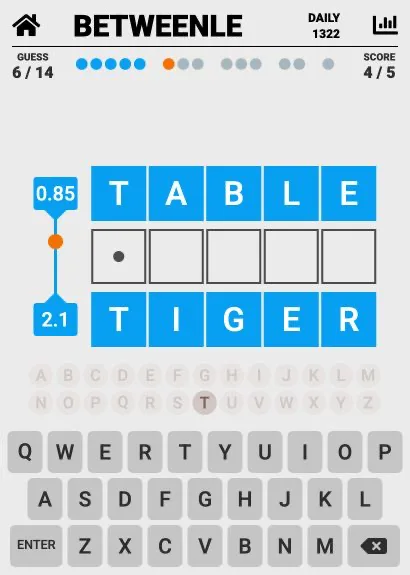
The board still showed 5/5 as we prepared our fifth submission. After TABLE failed to solve it on guess five, the next-guess display read 6/14 and the score fell to 4/5. We could keep playing; losing a trophy did not end the round.
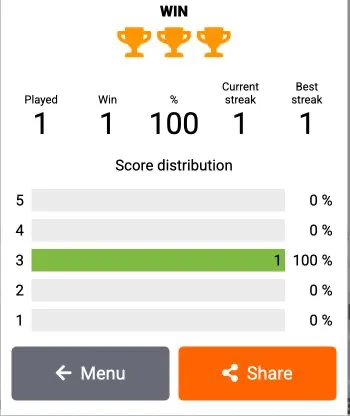
Later, the next-guess display reached 9/14 with 3/5 remaining. Our eleventh submission won at that score, and the results panel recorded one played game and one win. Treat the remaining attempts and trophy display as separate signals: one tells you how much room is left to solve, while the other reflects the score still available.
A tight interval still needs another word
TABLE and TEACH narrowed our boundaries to distances of 0.85 and 0.42. Those small percentages felt encouraging, but we still needed five further submissions after TEACH to finish. Nearness on the rail was useful feedback, not a supplied list of candidates.
Our practical takeaway from this single Daily is to use the dot to focus attention near an edge, then check any word you recall against both boundaries. That helps turn the visual clue into a legal candidate without assuming a smaller percentage guarantees an easy finish. Players who enjoy mentally sorting words have a concrete task at every step; players who prefer revealed letter positions may find the final vocabulary search more demanding.